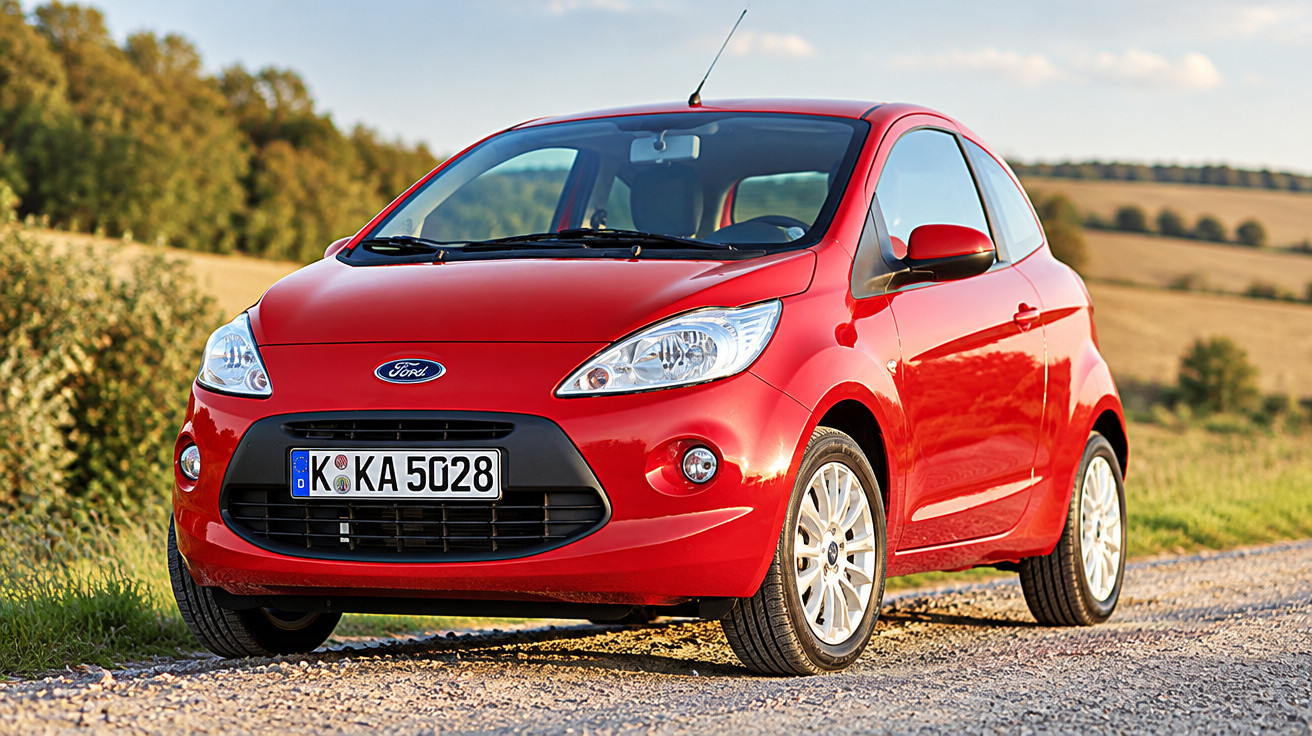
It is remarkable that, after 12 years on sale, almost nobody seems certain how to say Ford Ka. Even people at Ford alternate between spelling it out as K-A, saying Ka with a short ‘a’, or pronouncing it like the first part of ‘car’. This is despite global sales of 1.4 million, with an extraordinary 500,000 of those sold in the UK. It is rather like being unsure how to pronounce Coke.
Ford Ka and its Fiat-based replacement
Fortunately, there will be plenty of opportunity to keep getting the pronunciation right - or wrong - because an entirely new Ka has arrived. Developed alongside Fiat, it shares a considerable amount of engineering with the Panda and the new 500. Every Ka engine comes from Fiat, which is no hardship: Fiat builds excellent small petrol and diesel engines. Nor should buyers be concerned about build quality from Fiat these days, as the Italian firm has made major improvements in that area.
Choose a new Ford Ka and the engine line-up consists of a 1.2-litre petrol or a 1.3-litre diesel. There is currently no confirmation of the Fiat 1.4 petrol, although it seems likely to appear eventually. An ECOnetic Ka should follow too. Since the larger, heavier Fiesta ECOnetic achieves 76.3mpg and 98g/km, the environmentally focused Ka ought to be among the most eco-friendly cars available.
There are four trims: Studio, Style, Style Plus and Zetec. However, there is more to the Ka range than specifications alone. Like the 500, it can be personalised with Tattoo, Grand Prix and Digital Art packs, which alter both the cabin and exterior appearance. The Digital Art version, for instance, receives numerous green stripes across its bodywork - effectively an eco-Zebra.
Personalisation versus Ford Ka identity
That does not immediately inspire confidence. The brilliance of the previous Ka - and the reason it remained on sale for an astonishing 12 years while still topping its class at the end - lay in superb engineering and design. Its formula was uncomplicated, but executed exceptionally well. Whenever manufacturers start piling cute styling packages onto a car, it raises the worrying question of what they are attempting to disguise.
With the Ka, Ford does have something it needs to conceal: all that Fiat DNA. Sharing technology with another manufacturer makes sound financial sense, but the finished cars should still possess distinct personalities. Otherwise, you get a Golf/A3 scenario, in which two models begin to merge into one another.
Ford says it has given the Ka different engineering from the Panda and 500, ensuring it retains a Ford-like character. Yet it has not done enough with the first points of contact. The key comes from Fiat, the indicator stalks are Fiat items, and even the smell is Fiat. It may sound nerdy, but it is true.
That said, there is no reason to be excessively negative. The current 500 has collected awards everywhere, including in the UK. Its 1.2-litre engine is superb: smooth and, despite producing just 68bhp and 75lb ft, strong enough that the Ka never feels short of performance. It is happy to cruise gently in higher gears, while delivering useful response without requiring a downshift when more power is needed. Even accelerating from 70mph in fifth presents no problem. The drawback is the five-speed gearbox: fifth is fairly short in order to preserve responsiveness. Consequently, at 85mph the engine is turning at 4,000rpm. It is far from noisy, although its buzz is noticeable.
Space and cabin design in the Ford Ka
Platform-sharing brings another advantage, as cabin space is surprisingly good. Moving from a five-door Fiesta into the Ka, the smaller car offered considerably more headroom and legroom. That is hardly surprising when the new Ka is 10cm taller than its predecessor. Plastic quality and the interior design are also generations ahead of the old Ka.
The distinctive teardrop dashboard has gone, replaced by one from the Fiat 500. As a result, the main controls sit close at hand, including the dashboard-mounted gearlever. It is an effective design, even if it falls just short of the 500’s final touch of chic.
Ford Ka handling lacks the old magic
The Fiat connection is not wholly positive, though. As already noted, every touch point feels unmistakably Fiat, and the same applies to ride and handling. Ford insists it carried out the Ka’s chassis set-up itself, meaning the steering and suspension ought to feel typically Ford. The only explanation is that plenty of Fiat engineers were posing as Ford staff during the process, because the Ka and 500 drive almost identically.
Yes, the Ka’s steering is marginally heavier and lacks some of the electrical assistance found in the 500 and Panda. Its ride is also slightly less bouncy than the Fiats’. But the differences are tiny.
Most importantly, the go-kart sensation delivered by the old Ka - its central purpose, its USP, whatever label you prefer - has vanished. This Ka is nowhere near as eager to be thrown around as its predecessor, with the steering and chassis losing all of their former fluidity. Climbing into a Fiesta immediately afterwards was a relief; even its gearbox felt more precise.
Ford is capable of making modern cars that are enjoyable to handle, just not with this Ka. That is strange, because the Fiat 500 and Panda are both cars I like enormously. They are excellent. To an extent, the new Ka is good too: it looks acceptable, although somewhat tall from the rear, drives acceptably and accommodates four people adequately. But a 500 is bought for its cheeky styling, while the Panda appeals through practicality and value. A Ford should be bought for the way it drives.
Ford has reshaped its entire identity around that quality - even the Kuga SUV handles well. This new Ka does not. It lacks Ford branding and Ford DNA, and it will never remain relevant for 12 years, regardless of how its name is pronounced.


Comments
No comments yet. Be the first to comment!
Leave a Comment