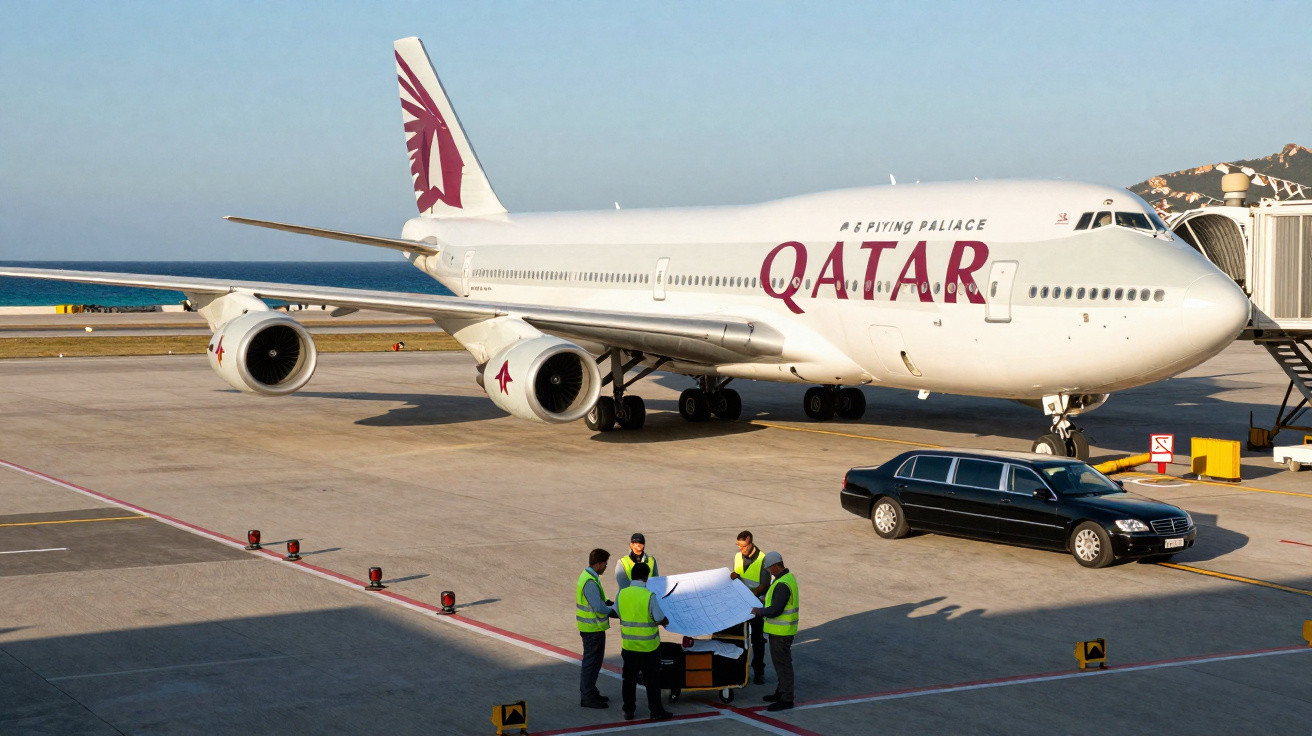
On the Costa Smeralda, glamour has long been part of everyday life. Then Qatar’s royal family arrived in an aircraft so vast that the local airport had to be physically altered simply to accommodate it.
A royal jet too large for the holiday island
The story centres on Tamim bin Hamad Al Thani, the emir of Qatar, and his preferred holiday retreat: Sardinia’s exclusive Costa Smeralda in northern Italy. For years, this stretch of coast has drawn billionaires, celebrities and discreet members of the aristocracy, arriving in polished business jets and helicopters.
The emir’s travel arrangements elevate that lifestyle several levels further. His preferred aircraft is a Boeing 747-8 BBJ, the Boeing Business Jet adaptation of one of the longest passenger aircraft ever made. In airline service, a 747-8 can carry more than 400 passengers. As a VIP aircraft, however, that vast cabin becomes something resembling a flying palace for a very small group of guests.
The difficulty was both straightforward and uncomfortable: the aircraft was simply too large for Olbia Costa Smeralda Airport, the principal entry point for northern Sardinia and the resort area where Qatar’s ruling family spends the summer.
The emir’s jet was not merely inconvenient for Olbia airport – it exceeded the technical safety limits written into its design.
Why the aircraft could not fit on the ground
Airports are not planned arbitrarily. They must comply with stringent international rules established by the International Civil Aviation Organization (ICAO), including a coded system that determines which aircraft dimensions an airport can safely accommodate. The classification is based chiefly on runway length and aircraft wingspan.
Olbia held certification for “Code E”. This category is sufficient for major long-haul aircraft including the Boeing 777 and Airbus A330. Both are substantial wide-body jets regularly used on intercontinental routes.
The emir’s Boeing 747-8 falls under “Code F”, a classification reserved for aviation giants such as the Airbus A380 and the largest 747 variants. The 747-8 has a wingspan of roughly 68.4 metres. At that width, Olbia’s standard taxiways and safety margins no longer provided the required clearances.
In practical terms, the aircraft could have struck obstacles, breached protected safety zones or put excessive strain on surfaces never intended for an aircraft of its size and weight. Ordinarily, pilots facing this issue would be directed to a large international airport with suitable Code F facilities, such as Rome or Milan.
This was not, however, an ordinary customer. Via the Qatar Investment Authority (QIA), Qatar owns a controlling stake in Costa Smeralda Holding, which oversees several regional assets. In effect, the emir was taking holidays in an area closely linked to his country’s sovereign wealth fund.
When a client changes the airport layout
Rather than selecting a smaller aircraft or landing at a more distant airport before continuing by helicopter, the choice was made to modify Olbia for the jet. The project was presented not as a frivolous luxury, but as a long-term logistical answer to regular royal visits, which often include several accompanying aircraft and support flights.
The work involved considerably more than cosmetic changes. Engineers had to reconsider the airport’s operations at a fundamental level.
- Taxiways were expanded to comply with Code F safety requirements.
- Pavements and aprons were strengthened to support take-off weights of up to approximately 440 tonnes.
- Safety distances around runways and taxiways were reassessed and redrafted on official charts.
- Ground-handling procedures and emergency plans were revised for a significantly larger aircraft.
These alterations enabled Olbia to gain certification for Code F operations, putting a comparatively small island airport in the same technical class as major international hubs in terms of aircraft dimensions.
In making room for a single jet, Sardinia gained an airport that can receive some of the biggest aircraft flying today.
A flying palace with substantial capabilities
A VIP-configured Boeing 747-8 is about more than prestige. Such interiors are generally equipped with several bedrooms, private lounges, meeting rooms and dining spaces. Layouts may also incorporate a small medical facility, giving the royal entourage a degree of independence and security on long journeys.
This type of aircraft illustrates a broader tendency in what the luxury sector calls “high yachting” or “haute plaisance”: technology is adapted to the owner, rather than the reverse. Superyachts receive purpose-built marinas; here, an aircraft was given a bespoke airport.
For Olbia, meeting the emir’s requirements has altered the region’s aviation landscape. Visitors arriving on conventional airliners or private jets now use infrastructure that was reinforced and enlarged for an aircraft they may never encounter.
Strategic advantages for Sardinia
Beyond the attention-grabbing detail of a royal aircraft, the airport improvements provide Sardinia with several clear benefits. Code F capability means the island could, in theory, receive direct long-haul services using large aircraft during peak periods, creating scope for more adaptable tourism strategies.
It can also act as an alternative landing airport for larger aircraft facing emergencies or diversions in the Mediterranean. This gives airlines and aviation authorities another option when weather conditions or technical problems require flight plans to change.
There is a reputational benefit too. An airport capable of accommodating wide-body private aircraft and heavy VIP traffic strengthens the Costa Smeralda’s standing at the luxury end of the travel market, alongside established destinations such as the French Riviera and the Balearic Islands.
Who pays and who benefits?
Infrastructure shaped around private wealth often prompts questions about its public value. The details of individual investment arrangements are seldom transparent, but several recurring patterns are visible in projects of this kind.
| Aspect | Potential benefit | Potential concern |
|---|---|---|
| Airport capacity | Greater flexibility for airlines and charter operators | Improvements designed for a very small elite |
| Local economy | Employment in construction and tourism | Reliance on ultra-high-net-worth visitors |
| Public image | Prestige for the destination | The impression that infrastructure serves one man’s comfort |
Local residents can see both perspectives: better facilities and increased expenditure on one side, alongside concerns over priorities and accessibility on the other. Airport expansion can affect noise, road traffic and housing markets in nearby towns, particularly in areas where luxury tourism is already driving prices higher.
How airport categories work in practice
For those unfamiliar with aviation terminology, the distinction between Code E and Code F may appear abstract. The ICAO system applies a two-part designation: a number relating to runway length and a letter covering aircraft wingspan and wheelbase.
Put simply:
- Code E includes major long-haul aircraft such as the Boeing 777 and Airbus A330.
- Code F covers the largest types, including the Airbus A380 and Boeing 747-8.
Advancing from E to F is not merely an administrative step. It requires checks that taxiways, parking stands, lighting, signage and rescue services all satisfy more demanding standards. Every object close to a runway, from fencing to lights, must observe wider safety clearances because aircraft wings reach further out.
That scale of work explains why airports do not often upgrade solely for occasional traffic. Normally, it requires dependable demand or a compelling commercial case - or, as in this instance, a combination of strategic investment and a particularly determined VIP visitor.
Private jets, climate pressure and possible futures
Stories like this also emerge at a time when private aviation faces increasing political and social scrutiny. Campaigners point to high emissions per passenger, while several European countries are considering restrictions or increased taxation for such flights.
If regulations become stricter, airports heavily dependent on luxury private aviation may need to reconsider parts of their operating model. Olbia, however, retains an advantage: its capacity to handle large commercial aircraft if demand moves towards more consolidated, high-capacity services.
It is easy to envisage seasonal long-haul flights from North America or the Gulf using wide-body aircraft and landing on infrastructure initially designed around one royal jet. Such a development would turn a highly specific investment into a means of broader connectivity, potentially extending its gains beyond the summer elite.
For the moment, though, Olbia’s unusually large visitor remains a vivid example of how global wealth can quite literally reshape runways, taxiways and maps. When your holiday aircraft weighs hundreds of tonnes and spans almost seventy metres, even an island accustomed to billionaires must find space for it.















Comments
No comments yet. Be the first to comment!
Leave a Comment