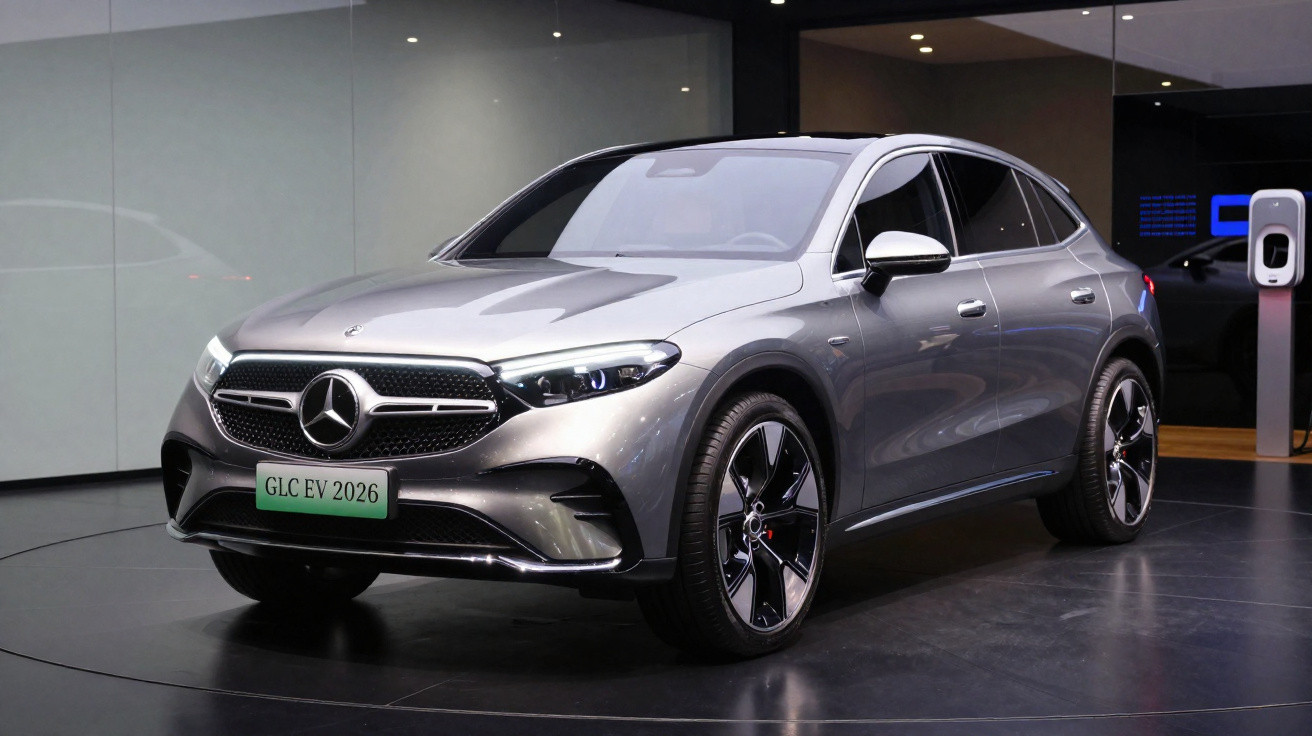
The new electric Mercedes-Benz GLC will go on sale in 2026, bringing an 800 V electric architecture - years after rivals such as Porsche and… Hyundai adopted this solution - alongside a new generation of electric motors and batteries, recently introduced in the new CLA.
It fills a significant gap in the electric SUV market, where Mercedes had previously been represented by the EQC, launched in 2019. That model was based on an internal-combustion vehicle platform, with the resulting compromises in space and practicality.
It is particularly significant that the GLC is receiving these more advanced features, given that it has been Mercedes’ best-selling model worldwide for many years. The combustion-engined GLC will remain on sale for several more years. Indeed, both models are built at the same factory in Bremen, Germany, while the electric motors are supplied from Romania.
“An illuminated work of art”
The electric Mercedes-Benz GLC also introduces a new front-end design. Its former functional grille now serves a purely aesthetic purpose, described by the German designers as an “illuminated work of art with cutting-edge technology”.
It stands out through its chrome surround, smoked-glass structure and illuminated trim. Depending on the market and specification, it can feature a design with 942 backlit dots and even an illuminated central star.
Externally, it is 13 cm longer at 4.85 m, 2.3 cm wider at 1.91 m and 0.5 cm taller at 1.64 m. Its wheelbase has also grown by 8.4 cm, to 2.97 m. This increase helps explain the substantial improvements in second-row accommodation, including an extra 4.7 cm of legroom.
Passengers also benefit from considerably greater freedom of movement because the floor no longer has a very bulky central tunnel. There is no driveshaft or exhaust system running the length of this GLC.
The boot has a capacity of 570 litres: 100 litres more than current plug-in hybrid versions, although 30 litres less than petrol-only models.
Innovation inside the electric Mercedes-Benz GLC
Innovation extends to the cabin, where the largest display ever fitted to a Mercedes-Benz can be specified as an option. This new 39.1-inch (99.3 cm) Hyperscreen combines what were previously three separate displays into one. The entry-level version, which has three screens for the instruments, infotainment and front passenger, has yet to be seen.
There is considerable anticipation around testing this dashboard system, which Mercedes-Benz says is the first in the world to integrate Microsoft and Google Artificial Intelligence features simultaneously. Allegedly, it gives the system the ability to hold a conversation as naturally as one with a travelling friend or family member, albeit with unlimited general knowledge.
The brand also highlighted the high-resolution graphics and advanced processing capabilities when revealing the new electric GLC. Its interior further includes a range of personalised ambient-lighting programmes and functions, as well as backlit surfaces.
Also noteworthy is the panoramic roof, whose opacity can be electrically adjusted across nine separate sections. It can display 162 light points to recreate a starry-sky effect, as already seen in the CLA. Physical steering-wheel controls also return, as in the CLA Shooting Brake, following requests from many customers who disliked their removal from the current GLC.
489 hp and up to 713 km of range
Not every technical detail of the new electric Mercedes-Benz GLC powertrain has yet been revealed. This is understandable given that its market launch is still many months away, and manufacturers rarely wish to reveal everything to their competitors.
The new 800 V MB.EA platform has made it possible to raise maximum DC battery-charging power substantially, up to 330 kW. AC charging is available at 11 kW or, optionally, 22 kW.
According to the German manufacturer, up to 303 km of range can be added in just 10 minutes when charging at the maximum rate. In the most favourable conditions, a 10% to 80% DC charge may take only 22 minutes.
The GLC 400 4MATIC, the first version to be announced, uses two electric motors - one on each axle - delivering a combined maximum output of 360 kW (489 hp). The output of each motor and maximum torque have not yet been disclosed.
However, its top speed is known to be 210 km/h, while 0–100 km/h takes 4.3 seconds. Its 94 kWh usable battery promises between 571 km and 713 km of combined WLTP range. Still provisional, energy consumption figures range from 18.8 kWh/100 km to 14.9 kWh/100 km.
As in the new CLA, the rear electric motor is paired with a two-speed gearbox, designed to sharpen acceleration response and reduce energy consumption.
Air suspension and rear-wheel steering
The chassis uses independent suspension at all four wheels, including a multi-link rear axle. Higher-specification versions can be fitted with intelligent air suspension, developed to better absorb jolts and vibrations created by less even road surfaces.
Its new Car-to-X function can electronically adjust the dampers before encountering imperfections in the road, while ride-height control uses Google Maps data to keep the vehicle as low as possible for as long as possible.
This reduces aerodynamic drag - with a Cd figure of just 0.26 - and therefore energy use. For the first time, the driver can also alter the Airmatic suspension ride height through voice commands.
One area where the first electric Mercedes-Benz models fell short was brake response: the pedal felt too spongy and lacked initial stopping power, indicating unsatisfactory integration between regenerative and friction braking.
To address this, the new electric GLC receives a new One-Box braking system. It can calculate the maximum possible energy recovery and the minimum required use of the friction brakes.
According to the German engineers, the new electric Mercedes-Benz GLC generates electricity while braking in more than 99% of everyday driving situations. Regeneration can reach 300 kW and helps extend driving range, with four recuperation levels available.
The electric GLC can also be ordered with rear-wheel steering. At speeds of up to 60 km/h, the rear wheels turn by up to 4.5° in the opposite direction to the fronts, cutting the turning circle from 12.1 m to 11.2 m. Above 60 km/h, they turn by 2.5° in the same direction as the front wheels, creating the effect of a longer wheelbase and providing greater stability and safety at high speed.
When will it arrive?
The new electric Mercedes-Benz GLC is scheduled to arrive in the first half of 2026, almost at the same time as what will be its principal rival, the BMW iX3, which is also making its debut at the Munich Motor Show. It promises to be one of the year’s key duels.
Both, however, must contend with the Audi Q6 e-tron - a model we have already tested and one that has enjoyed notably encouraging commercial success.
Prices are not yet known and, like its rival, the range is expected to expand both above and below this 400 4MATIC version.


Comments
No comments yet. Be the first to comment!
Leave a Comment