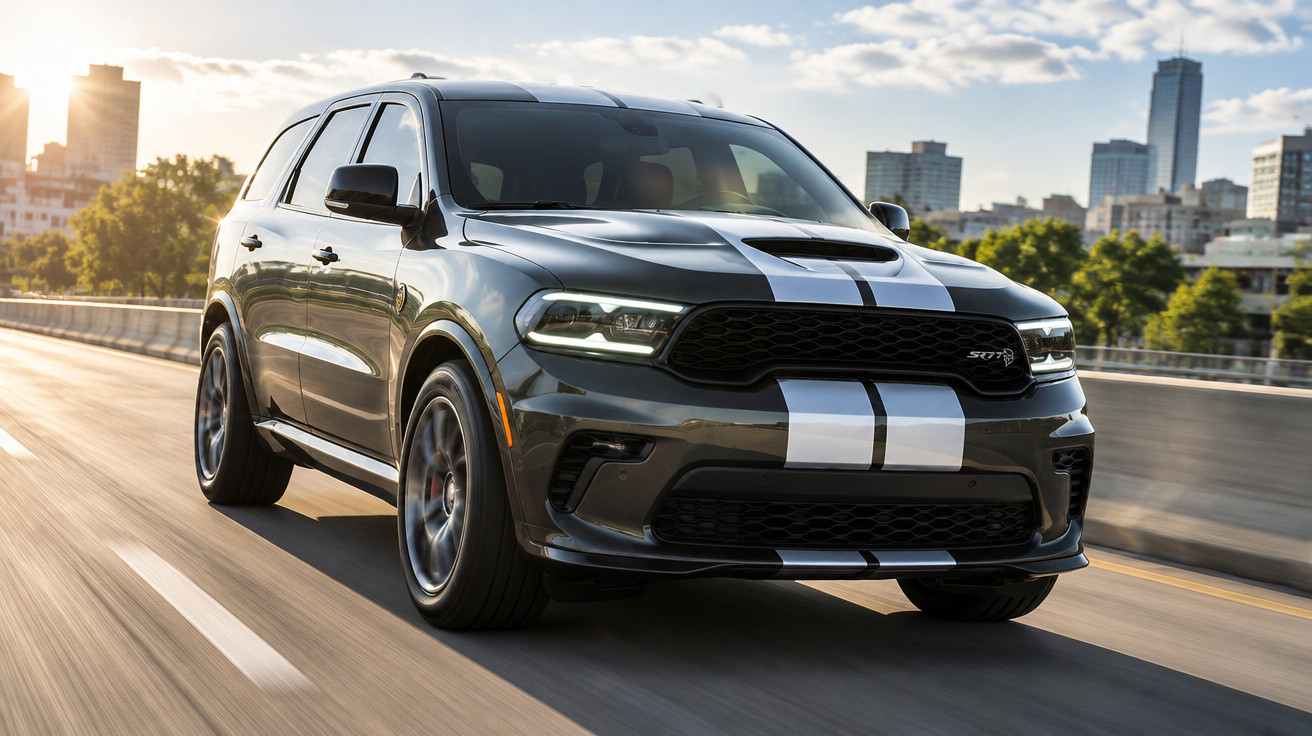
Durango Hellcat? It sounds like illicit moonshine.
It is actually a car, although, much like bootleg liquor, it is liable to singe your eyebrows. Meet the Durango SRT Hellcat: an ageing three-row SUV with an enormous V8 producing 710 horsepower purely because it can. To be clear, it delivers on that promise completely.
That seems rather extreme for a family SUV.
It certainly is. Dodge is firmly in its ‘ it’ phase, so anyone who wants a V8 can have one. That is excellent news for power-hungry drivers with fuel money to spare. After Dodge had said it would not be offered in the 17 areas governed by CARB (California Air Resources Board) emissions rules, drivers across all 50 US states can now enjoy the Hellcat soundtrack.
At its most restrained, the Durango Hellcat achieves an enormous 13 mpg combined, and there will seldom be a reason to drive it that gently.
Was it not discontinued?
Dodge has reversed so many decisions in the last few years that keeping up is difficult. In short, the Durango Hellcat was supposed to be a limited-production model, much as the Rolling Stones were supposed to have held a farewell tour. As it turns out, when enough buyers continue arriving with piles of cash, there is little incentive to stop.
What exactly does it have?
Under the bonnet sits the 6.2-litre supercharged Hemi V8 used throughout Dodge’s ‘Hellcat’ range, including the Charger and Challenger. Those models represented the top tier, beaten only by the Challenger Demon for factory-supplied output. While Dodge’s muscle cars have followed their own paths, the Durango has remained in the background. Not quietly, exactly, but you understand the point.
This engine produces 710hp and 645lb ft of torque, channelled to all four wheels through an eight-speed automatic gearbox. A transfer case varies the torque distribution between the axles according to the selected drive mode. Even in Auto, the Durango Hellcat favours the rear with a 40/60 split; only Snow and Tow modes distribute power equally. Sport and Track respectively send 65 and 70 per cent of the power rearwards.
How does the Durango Hellcat drive?
“Ornery” is the first word that springs to mind. Riding high on a performance-focused suspension with Bilstein dampers, the Durango Hellcat appears ready to be thrashed across rough ground at speed, much like the Baja-oriented Ford F-150 Raptor R - which seems almost sensible beside it.
Even in its gentlest mode, the Hemi’s supercharger eagerly whines at the smallest press of the accelerator. Select Sport or Track and the Dodge SUV charges along like a drooling dog after a thrown stick, with comparable poise. This is no refined machine; it is ‘hold my (proverbial) beer’ made into a car.
Driven hard along a country road, the Durango Hellcat jolts about like a rodeo horse and repeatedly feels as though it could stray from the route, largely because it makes pressing on so tempting. Its throttle is responsive and, although it demands attention, it rarely feels uncontrollable - provided you do not launch it sideways over a bank.
What is the interior like?
It is reasonably roomy, as you might expect. The third row is optional on the Hellcat, yet it still provides 487 litres of luggage space. Without the third row, capacity increases to 1,226 litres, while using all the space behind the front seats opens this up to a considerable 2,410 litres.
Otherwise, the cabin is every bit as dated as the outside. There have been a few updates intended to bring it up to date, but its age is obvious, especially alongside the latest Charger Sixpacks and their polished new interiors. The driver faces a partly analogue, partly digital instrument cluster, while a 10-inch touchscreen handles the familiar infotainment menus, navigation and entertainment features. It is somewhat cluttered, yet there is plenty of information and many settings to explore, especially for adjusting the SUV’s various driving characteristics.
Should neither the Durango’s cabin nor exterior appeal, the Jailbreak trim opens up an enormous range of customisation choices at extra cost. Buyers can pick from a broad selection of exterior paints, matching racing stripes, interior seat colours and badge colours, alongside a lengthy list of other options to make a Durango Hellcat their own.
What is the final verdict?
The Dodge Durango is a capable SUV with enough built-in attitude that an SRT Hellcat model feels inevitable, let alone its arrival in production. It remains a large, muscular three-row people carrier with sufficient practicality to serve an entire household, and fitting a wildly overpowered engine beneath the bonnet does not alter that. What it does alter is its character: it becomes a rowdy machine designed to delight on rural back-road antics. Large, unattractive and hilariously impractical, the Durango SRT Hellcat can only be called “a hoot”.
At the time of writing, the Durango Hellcat remains on sale, although, like the McRib, it could disappear only to return when it is needed most. Either way, prices start at $80,590, rising to $81,585 for the Jailbreak trim.




Comments
No comments yet. Be the first to comment!
Leave a Comment