What am I looking at?
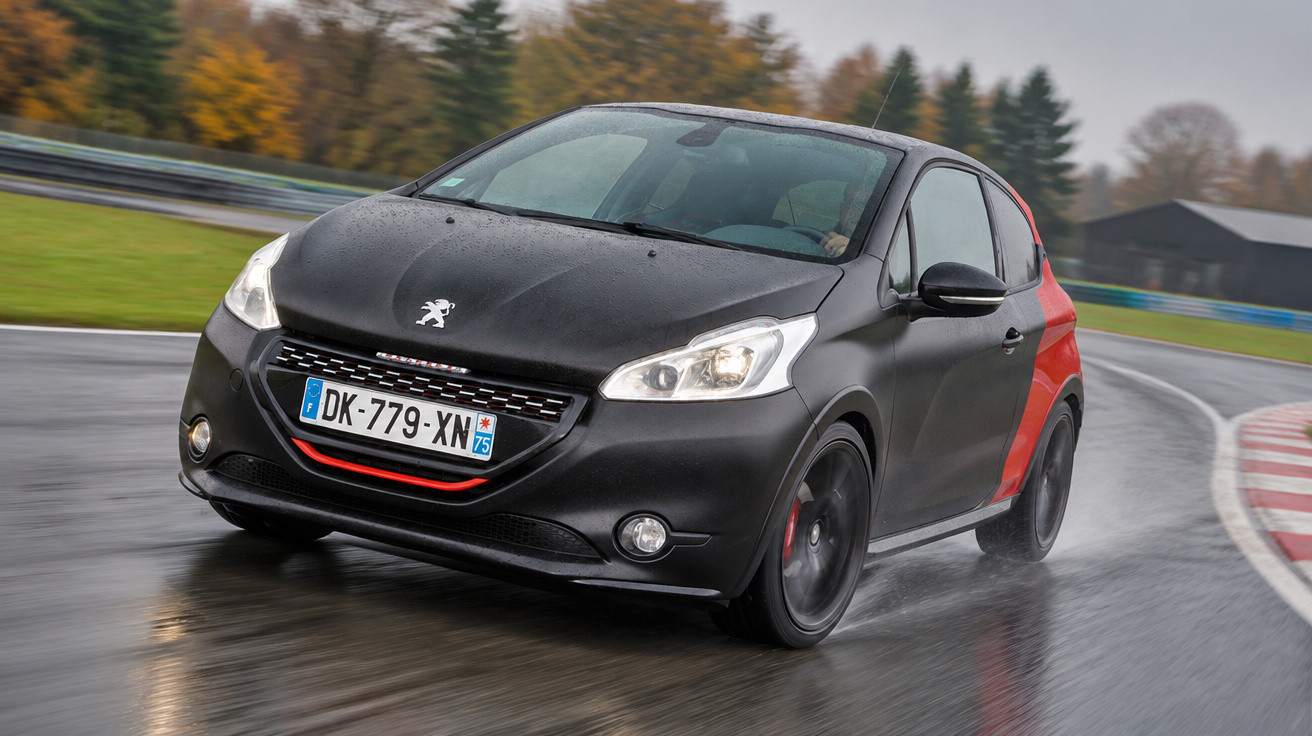
You are looking at a seriously capable car. Created to mark 30 years since the celebrated 205 GTI first arrived, the Peugeot 208 GTI 30th has been reworked by Peugeot Sport, the same outfit behind the RCZ R.
The outcome is a car that improves on the standard 208 GTI in almost every measurable respect.
There is one caveat, though: we drove the GTI 30th only on a circuit drenched by heavy French rain. Weather specialists would probably have described the conditions as ‘wet’. Expectations were therefore kept in check.
Peugeot 208 GTI 30th mechanical upgrades
This is not a commemorative model assembled in a hurry. The 208 GTI 30th receives a substantial package of mechanical changes. The most significant is the Torsen differential fitted between its front wheels, taken directly from the RCZ R by Peugeot Sport.
The differential is joined by a modest rise in power, from 197bhp to 206bhp, while torque climbs from 275Nm to 301Nm from the 1.6-litre turbocharged four-cylinder engine. It also gains new brakes: 323mm discs gripped by Brembo four-piston callipers. Ride height is lowered by 10mm, with the front track widened by 22mm and the rear by 16mm.
Further changes include revised damper settings and spring rates, a dedicated exhaust system-which, truthfully, still does not sound especially special-and wider, grippier tyres. It is an impressive list of additions.
The revisions extend beyond the mechanical components, too. Inside are two new bucket seats, while black trim features extensively elsewhere. It has a smart, purposeful appearance. Yet, once seated correctly, the small, chunky steering wheel still blocks part of the instrument display. Sorry officer, I couldn't see the speedo, etc...
How does the Peugeot 208 GTI 30th drive?
In a straight line, the 30th does not feel markedly faster than the regular GTI. Its 0-100km/h time is marginally improved at 6.5 seconds, although top speed remains unchanged at 230km/h. The engine is still not the most stirring turbocharged four-cylinder unit, but it is respectably quick and seems entirely content to provide that pace.
The real transformation comes through bends. The traction control has been recalibrated to allow the differential to do more of its work, but switching it off altogether best reveals the mechanical hardware operating underneath. Combined with the larger tyres and altered damping, it produces a considerable gain in mechanical grip. Apply the throttle when leaving a tight corner and the 30th simply gets on with it: no fuss, just strong, continuous acceleration without compromise.
The brakes are reassuringly powerful, offering a firm, positive pedal that represents a major step up from the merely adequate stoppers of the standard car. Meanwhile, the reworked steering is light-if slightly weightier than that of the regular GTI-and sharp, while providing enough feedback to indicate what the front tyres are doing.
Overall, the 30th is more taut, more controlled and grippier than the ordinary car. Numerous small improvements have been executed properly and, together, they create something that is not merely marginally better than its base car but dynamically a substantial advance. Consider us impressed, Frenchists.
Should I buy one?
A more relevant question may be, ‘Can I buy one?’. Peugeot will build 800 examples, of which only 100 will reach the UK. All 30 cars finished in the two-tone, part-matt and part-metallic Coupe Franche paintwork-an £800 option, we should note-have already been allocated. Anyone who wants one should move quickly.
At £21,995, however, it is not inexpensive. A Fiesta ST begins at £4,000 less. Just saying...



Comments
No comments yet. Be the first to comment!
Leave a Comment