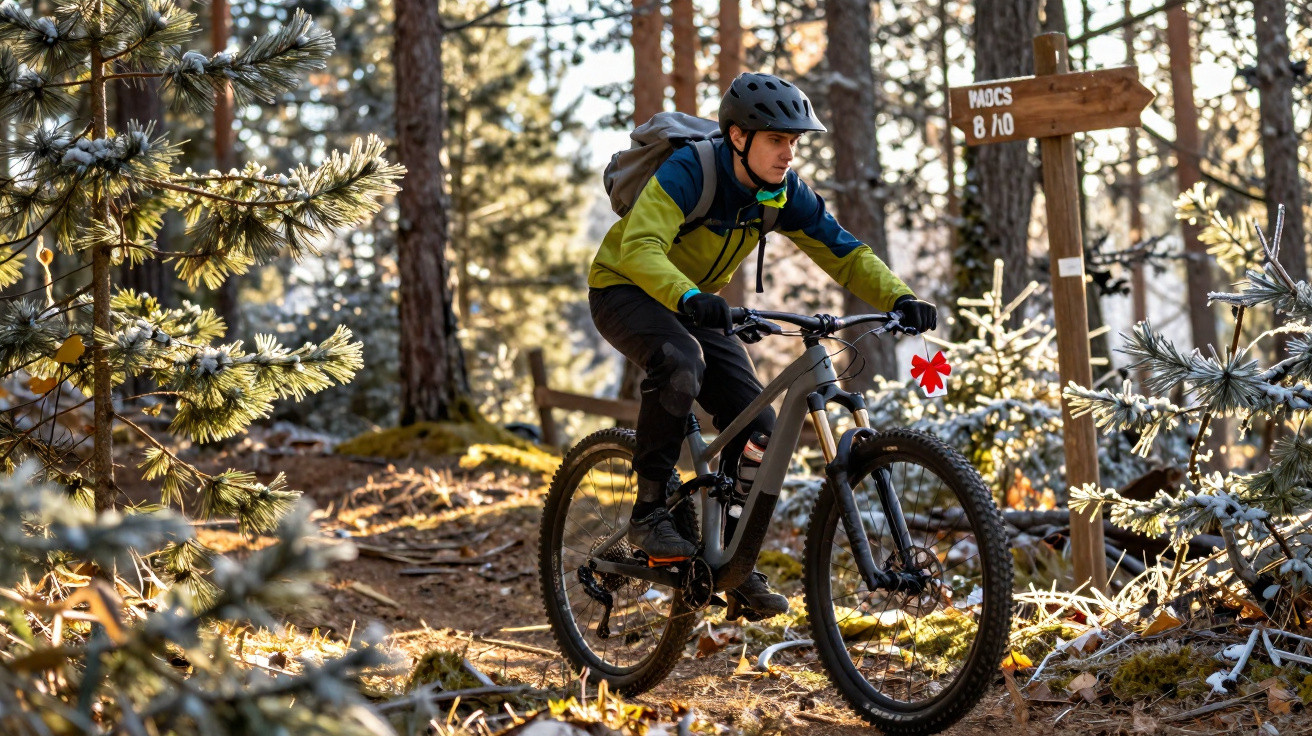
Amid the familiar seasonal mayhem - lists, deliveries and late-night scrolling - one question keeps surfacing: is this the year you stop buying “stuff” and choose something that genuinely transforms your weekends? Somewhere between a smartwatch that stays in its box and a console that ends up collecting dust, a full-suspension Decathlon electric mountain bike has reached a price that feels unexpectedly achievable.
Last week, in a Decathlon shop, I saw a dad standing with his phone in his hand, lingering beside an e-MTB he plainly wanted for himself while claiming he was “checking for his son”. He left, then returned twice. Once the salesperson mentioned the Christmas promotion and instalment payments, his shoulders visibly relaxed. The choice seemed to make itself.
That small scene pointed to something much larger.
The point where an electric mountain bike becomes attainable
Full-suspension electric mountain bikes once occupied a world far removed from ordinary budgets. At €4,000, €5,000 or €6,000, they were the sort of bikes you looked at as you might look at sports cars: appealing but distant, indulgent and slightly absurd. Decathlon has quietly lowered that barrier with bikes such as the Rockrider E-ST and its full-suspension counterparts, bringing them below the mental threshold at which your brain starts shouting “far too much”.
That is particularly relevant this Christmas. Technology pricing is unpredictable, while plenty of brands put “Black Friday” labels on ageing stock and call insignificant reductions a deal. Decathlon occupies an unusual middle ground: you are not buying anonymous components, but neither are you draining your savings. Instead of one supposedly major Christmas present, you are choosing something that can provide hundreds of smaller moments.
Those moments generally begin on a muddy trail rather than beneath the tree.
On the specification sheet, the proposition is straightforward: a full-suspension e-MTB offering roughly 120–140 mm of travel, a mid-drive motor of around 250 W, a 500–630 Wh battery, and a price usually sitting in the €2,000–€2,800 bracket. That is the range in which Decathlon has positioned its more capable Rockrider e-bikes, while rival models often start €1,000 higher. In everyday terms, that gap separates “perhaps in three years” from “we could actually buy this now”.
Speak to riders who have made the switch and a familiar pattern emerges. A rider I met on a woodland loop north of Lyon said that, after buying his Decathlon e-MTB in a Christmas promotion, he moved from cycling twice a month to riding three times a week. He had not suddenly become “sporty”; he simply no longer dreaded punishing climbs and exhausted legs. The bike handled the hard work during the week, leaving him to enjoy it.
Spread that cost across a full year, and the price per ride becomes far less intimidating. It begins to resemble paying rent for freedom.
The reasoning is simple. Full suspension was once a luxury, and electric assistance was another. Combine them and you had a plaything reserved for affluent enthusiasts. Decathlon has removed as much of that luxury as possible without losing what makes the experience worthwhile. Its suspension will not win a World Cup, and the motor name may not be the most exotic one on YouTube thumbnails. Yet the frame geometry has been properly considered, the parts are respectable, and the after-sales support network is… in your town.
That final point makes a substantial difference. There is no need to track down a specialist workshop to adjust a derailleur or fit new brake pads. You can visit the same shop where you pick up socks and inner tubes. For everyday cyclists and interested newcomers, that dependability is often more valuable than saving an extra half-kilo or having a marginally more glamorous motor badge.
There is a reason these entry-point e-MTBs are filling trailhead car parks more quickly than high-end exotica.
Choosing the right Decathlon e-MTB before the Christmas rush
The most sensible starting point is to consider how you really ride, rather than how you imagine riding in an ideal version of your life. Will you mainly use forest tracks and undulating fire roads, or are you planning serious Alpine descents? For most people considering a Decathlon full-suspension e-MTB, the ideal category is trail rather than enduro. That calls for moderate suspension travel, a relaxed riding position and tyres that roll reasonably efficiently across mixed surfaces.
Start with three priorities: battery capacity, suspension travel and braking. A 500–630 Wh battery can cover 35–70 km, depending on your weight, the gradients and how much assistance you use. About 120–140 mm of travel works well on technical singletrack without making the bike feel like a sofa. Hydraulic disc brakes are essential, especially when the added bike weight meets winter mud. Once those essentials are covered, the remaining decision is largely about how the bike feels.
That is why a brief test at the shop - even ten minutes in the car park - is enormously valuable.
The pressure of Christmas shopping can make people choose the wrong frame size simply because they panic. This is not a jumper: an ill-fitting e-MTB makes every ride feel like a minor struggle. If you sit between M and L, take time to try both sizes. Should your nearby Decathlon have no stock, ask to test a comparable non-electric model to assess its geometry. Your back, knees and shoulders will quietly appreciate that decision in March.
You should also consider the amount of motor power you genuinely require. At first, many cyclists select turbo assistance for every ride, before gradually favouring eco or trail modes after the novelty wears off. It is normal to overdo it at the beginning. If you are deciding between two models whose main difference is motor torque, bear in mind that most beginner and intermediate riders will not regularly ride at the edge of that power anyway.
Let us be honest: nobody truly takes those long, heroic rides every day, however confidently we promise ourselves otherwise when clicking “order now”. Over time, everyday practicality matters more.
Psychologically, the words “Christmas deal” influence us more than we might care to admit. You are not merely purchasing a bike; you are also partly buying into a story. New year, new habits, new you, and so on. The best way to see past that noise is to shop before the final weekend of panic, when the remaining sizes disappear and urgency pushes you into accepting compromises.
A Decathlon salesperson I spoke to in early December put it like this:
“People think they’re coming for a gift. Most of them actually come to change how their Sunday feels. The bike is just the excuse.”
If that sounds familiar, it may help to note down what you genuinely expect from the bike before entering the shop:
- Do you want to cycle more frequently, or simply travel further on occasional outings?
- Will you ride by yourself, with children or alongside much fitter friends?
- Would you accept a slightly heavier bike in exchange for a larger battery?
These modest questions help keep your decision grounded when an eye-catching display or a busy, persuasive crowd tries to lead you in another direction.
A Christmas gift that keeps encouraging you outdoors
The curious thing about e-MTBs is that, after a few weeks, the “electric” element gradually becomes less prominent in your mind. Initially, it is all you notice: the motor hum, the assistance modes and the falling range percentage. Then winter Sundays arrive, the sofa becomes highly appealing, and that same motor acts as a private defence against inertia. Knowing that the toughest climbs are made easier gently shifts the balance towards getting dressed, charging the battery and heading outside.
On a cold January morning, that slight push can mean the difference between another day spent scrolling and a ride that leaves your cheeks stinging and your legs aware of their purpose. One ride will not alter a life. Fifty rides can. This is where a fairly priced Decathlon full-suspension bike earns its value: not as a trophy, but as a machine that makes a useful habit easier to maintain.
On a human level, that may be the true “perfect price”: low enough to make saying yes possible, but high enough that you make sure to use it.
| Key point | Detail | Why it matters to the reader |
|---|---|---|
| “Accessible” price | Decathlon full-suspension e-MTB at around €2,000–€2,800 | Makes it possible to choose a serious bike without a professional-level budget |
| Well-matched equipment | ~500–630 Wh battery, hydraulic braking, trail geometry | Comfort and safety on real tracks, rather than only on paper |
| Shop network | Servicing and repairs available close to home | Less stress, more riding time and a longer useful life for the bike |

Comments
No comments yet. Be the first to comment!
Leave a Comment