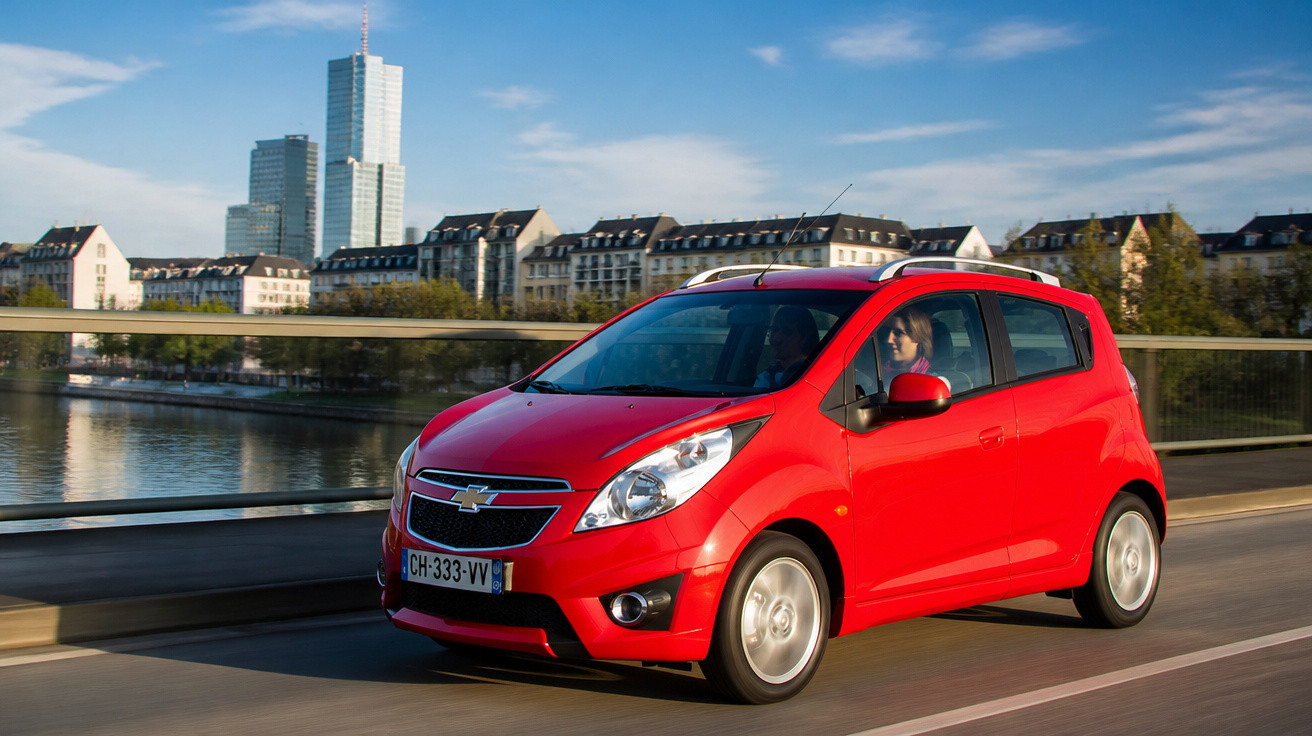
For plenty of buyers, a second-hand car is perfectly acceptable. Others, however, insist on buying new: they would be no more inclined to drive a car previously owned by somebody else than they would to wear another person’s old trousers. Chevrolet built the Spark for precisely those people.
Chevrolet Spark pricing and trim levels
This is a genuine five-door hatchback, with prices starting at less than £7,000. I have not looked through the Spark brochure, but I suspect the entry-level version will not be the one used for the publicity shots. Admirably, it includes six airbags, yet it also comes with manual windows, wheels resembling sofa castors, a vacant space in the dashboard where the radio should be, and locking that is only central if you sit in the middle of the car - presumably atop the handbrake - and stretch to all four lock buttons.
Spend a little over £8k and those omissions are addressed, with air conditioning included too. Continue up the range and Chevrolet gives the flagship LT equipment that makes it look fairly tempting by minicar standards. That is why these were the only versions Chevy put in front of the camera. It receives larger wheels, chrome highlights, and silver and body-coloured dashboard trim. Those visual additions must cost pennies to fit, but because the LT also brings further equipment, you have to pay thousands more to have them. It comes in at nearly £10k.
For that sum, though, you could buy a better car if you were prepared to metaphorically put on pre-owned underwear: a proper supermini with low mileage and lots of warranty still remaining. That is what I would choose. Even if you cannot resist the scent of a new car, the £9-£10,000 bracket becomes rather competitive, with Fiat 500s, Kas and Twingos available. They are all three-door cars, however. So the choice is simple: if you absolutely require a cheap new car with five doors and five seat belts, consider the Spark.
Viewed in those terms, it is a good car. For one thing, it looks distinctive, with a surprisingly combative attitude for such a tiny car. Its lights are sharply angled and glittery, the details are deliberately exaggerated, and the bodywork is cut with a sequence of switchblade-like creases. The rear door handles are concealed in the pillars, while the cabin is narrower than the track. Even so, it cannot entirely hide its unavoidably tall, stubby shape. Seen from just behind a true side-on angle, it appears as though somebody has kicked it in the face. Nevertheless, it is a welcome break from convention, which seems to demand that every little car wears a consciously adorable expression - like a row of Hallmark birthday-card rabbits with pink bows at their necks.
Chevrolet Spark cabin space and comfort
Imagine the instrument cluster from a scooter’s handlebars transplanted onto a steering column, and you have the Spark cabin’s most memorable feature. The speedometer is a proper analogue dial, while every other detail is displayed on an LCD screen. Absurdly, although the LCD itself is the same size, basic models do not even get a clock. Producing two different versions must surely cost Chevrolet more money, so this feels like another ploy to push buyers towards a higher-specification model.
Five occupants can fit, provided the broader ones sit in the front. Rear legroom and headroom are acceptable, but the rear bench is as narrow as you would expect after seeing the car from outside. It is no Tardis, although The Doctor would not find more interior space anywhere else in this class either.
It is a comfortable little car as well, particularly when pottering around town. The body feels robust and does not tremble over bumps, while the springs absorb those bumps remarkably well anyway. Its dampers also do a good job. Overall, it feels engineered with a degree of expense. Turn the radio down, however, and you immediately hear where the savings have been made. Road noise is dreadful. I did not realise Lidl sold own-brand suspension bushes.
The engine is not especially quiet, either. The first 1.2 I drove sounded like a cement mixer and had a sticky gearchange. The second was much improved in both respects. These were pre-production cars, so I expect the version you buy will resemble the latter rather than the former.
The most appealing engine of all, though, was the humble 1.0-litre base unit. Rev it hard and it is willing enough, while 68bhp is a respectable output for the money.
You will need the larger 1.2 Spark, however, if you want to reach 62mph in less than 15.5 seconds. You will also want it if you ever need the outside lane, or if you climb hills carrying more than just yourself. The 1.2 produces 81bhp, and at this end of the market those extra 13 horses make a significant difference. Its fuel economy figure is identical too.
Chevrolet Spark handling and performance
The best small cars are those you can fling through corners to within an inch of their lives while they still feel as though they are working with you. The Spark is one of them. It feels nimble. The front end follows steering inputs precisely, while information from the tyres travels back through the wheel to your fingertips. With the throttle, you can encourage the rear tyres to squirm a little. It is not wild, but it raises an impish grin. Because it all happens at such modest speeds, even in the suburbs, you can feel like a hooligan without actually behaving like one.
The Chevrolet name still suggests cumbersome American land yachts. Yet it is a less damaged badge than Daewoo, the name once used for this GM division. The Spark is no Corvette, but it indicates that Chevy is travelling in the right direction - and at a fairly brisk pace.


Comments
No comments yet. Be the first to comment!
Leave a Comment