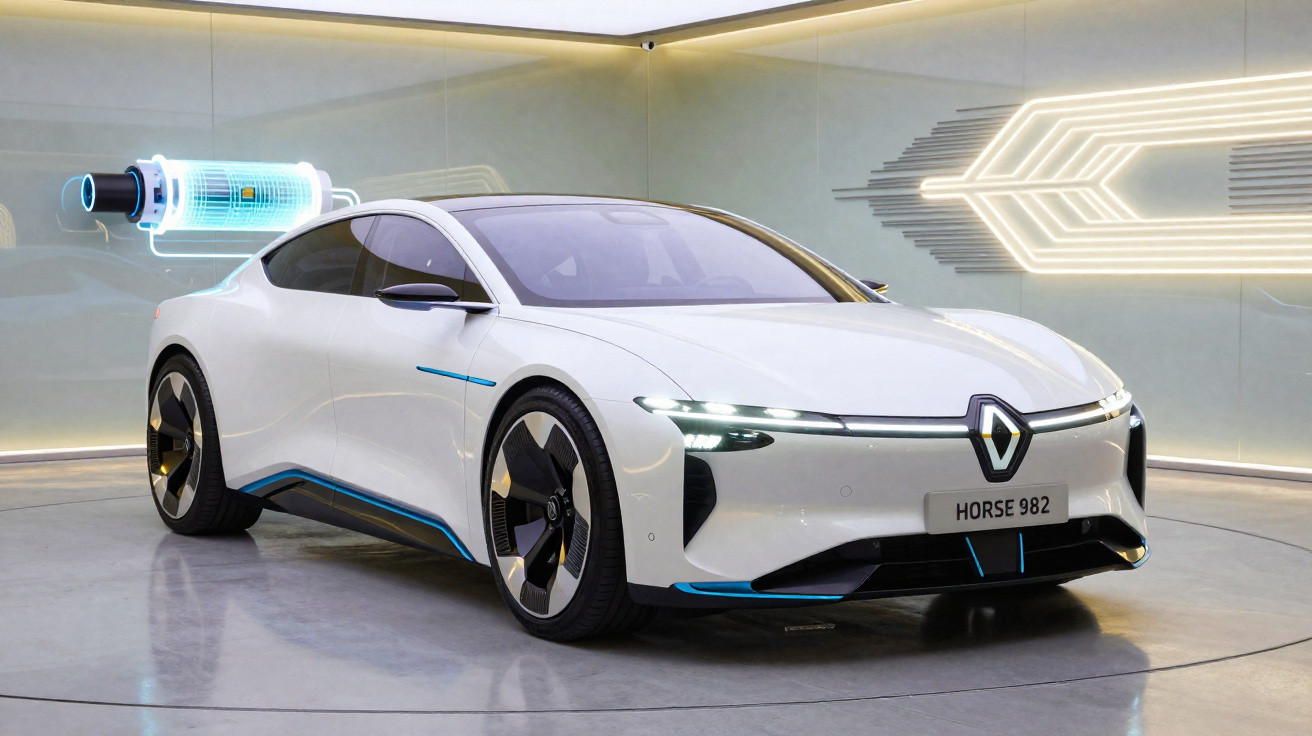
Renault and Chinese group Geely have unveiled an electric motor through their Horse joint venture that is said to achieve efficiency of up to 98.2 per cent. While that sounds like a laboratory record, it is intended to appear in everyday hybrid and plug-in hybrid vehicles before long, gradually reducing their energy demand.
What is behind the new Renault-Geely motor
Horse is a Renault and Geely joint company focused exclusively on powertrain technology. It has developed a unit known internally as “Amorfo”. Its key innovation is neither a more powerful magnet nor an exotic cooling solution, but an unobtrusive yet highly demanding technical component: the stator.
The stator is the stationary part of an electric motor around which the rotor turns. Usually, stators are made from laminated crystalline electrical steel. Horse has instead chosen amorphous steel, a metal with a disordered atomic structure.
According to the manufacturer, the new motor achieves 98.2 per cent efficiency – a figure that stands out even when compared with modern electric powertrains.
This irregular structure is intended to limit the formation of energy-wasting eddy currents in the material when it is exposed to rapidly changing magnetic fields. Essentially, the aim is to save every tenth of a watt that would otherwise be lost as heat.
Steel sheets thinner than a human hair
The material itself is not the only crucial factor; the thickness of the sheets used to build the stator is especially important. Horse cites a thickness of just 0.025 mm. By comparison, a human hair is generally between 0.05 and 0.08 mm thick. The sheets used in conventional motors are around ten times thicker.
This extreme reduction in thickness dramatically cuts eddy-current losses within the metal. Lower losses mean less heat generation and, in turn, more usable drive power from the same electrical energy.
- Stator sheet thickness: 0.025 mm
- Reduction in internal motor losses: up to 50 %
- Announced efficiency: 98.2 %
- Power: 190 PS
- Torque: 360 Nm
Performance figures of this kind are well suited to compact and mid-sized vehicles with hybrid or range-extender powertrains. That is precisely where Horse positions the motor: not as a dedicated performance unit, but as an efficiency component for high-volume production.
What 98.2 per cent efficiency means in practice
Current electric powertrains are already considered highly efficient. Depending on their design and operating point, many motors achieve around 93 to 97 per cent efficiency. At first glance, moving up to 98.2 per cent may appear to be only a small gain. Engineers know, however, that every additional step becomes substantially more difficult and expensive as the final percentage points are approached.
Horse says the new technology halves the motor’s internal losses. This does not mean that a car will suddenly use half as much energy, as the motor is only one element of the overall system. Nevertheless, its contribution is measurable.
At system level, Horse expects energy consumption to fall by around one per cent – little for an individual car, but substantial across millions of vehicles.
One per cent may sound almost trivial in daily use. Yet when calculated across a 15-year service life, high annual mileages and large fleets, it amounts to enormous quantities of energy. Every tenth of a litre and every kilowatt-hour matters to manufacturers seeking to meet fleet targets and CO₂ requirements.
Laboratory versus reality: how reliable are the figures?
The stated 98.2 per cent figure comes from the manufacturer’s measurements. Such tests are generally carried out in idealised laboratory conditions, with precisely controlled temperatures, an optimum operating point, no ageing and perfectly matched peripheral components.
Conditions on the road change constantly. A motor rarely operates within its ideal efficiency window, while materials heat up and cool down again, and magnets and insulation age. Many engineers are all too familiar with the gap between attractive test-bench results and the data later collected in everyday operation.
Renault and Geely have not yet disclosed which model will receive the motor in series production, or when this will happen. What is clear is that the motor is already listed in Horse’s product portfolio, meaning it is theoretically available to all brands in the two groups. These could include Renault, Dacia, potential Renault partners and Geely-group marques such as Volvo or Lotus.
Why Chinese groups are stepping up powertrain development
Japanese and European manufacturers dominated the market for efficient powertrains in recent years. Toyota and Honda set benchmarks with their hybrid motors, while German premium manufacturers impressed with sophisticated electric machines. Chinese brands now appear unwilling to leave this field to others.
Manufacturers including Dongfeng and Changan have recently announced combustion engines with efficiencies close to 50 per cent, an exceptionally high figure for petrol engines. BYD has presented an electric motor regarded as especially innovative and designed for extremely low energy consumption.
The Amorfo motor joins a wave of new powertrain concepts through which, above all, Asian manufacturers are pursuing efficiency records.
For Renault, its partnership with Geely and the transfer of powertrain technology into Horse represent a strategic move: sharing development costs, pooling expertise and responding more quickly to new requirements. The amorphous steel stator is one result of this alliance.
What amorphous steel actually is
The term “amorphous” may initially sound abstract. In materials science, it means that the atoms in a material are not arranged in regular crystal lattices, but are distributed more chaotically. Glass is a classic example of an amorphous material.
In electric motors, this brings two advantages:
- Magnetic properties can be adjusted more precisely.
- Losses caused by changing magnetic fields are lower because there are fewer ordered “channels” through which eddy currents can form.
The drawback is that manufacturing these sheets is expensive and technically demanding. The thin layers must be produced, stamped and stacked with great precision. That creates a genuine challenge for mass production.
What the new motor could mean for hybrid drivers
Drivers of hybrid or plug-in hybrid vehicles often first notice efficiency improvements in two areas: quieter operation and lower heat generation. If the motor has fewer internal losses, the cooling system can be designed to be smaller, fans need to run at maximum speed less often, and the system operates with less strain.
There is also the gradual effect on consumption. When slightly less energy is needed for every 100 kilometres, electric range in hybrid operation increases. In the best case, the car remains in EV mode for longer, brings in the combustion engine less frequently and puts less wear on its components.
It will be particularly interesting to see how manufacturers integrate the motor into the overall system:
- as the main drive unit in full hybrids
- as the electric motor in plug-in hybrids with a larger battery
- as part of a range-extender concept, in which a small combustion engine serves only as a generator
How efficiency could become noticeable in daily use
For drivers, the fuel or electricity bill ultimately matters more than the decimal figure on a data sheet. In real-world use, one per cent lower energy consumption could mean travelling a few dozen kilometres farther on a full tank or battery charge.
This seemingly small benefit can quickly pay off for company fleets with thousands of vehicles. Lower energy use means not only reduced operating costs, but also lower emissions across the vehicles’ overall life cycle. It also gives manufacturers scope to offer more powerful versions without putting their fleet targets at risk.
Technology enthusiasts will watch closely to see how the motor performs in independent testing. If real-world results come even close to the announced efficiency, the Amorfo motor could become a blueprint of sorts for future generations of electric powertrains.






Comments
No comments yet. Be the first to comment!
Leave a Comment