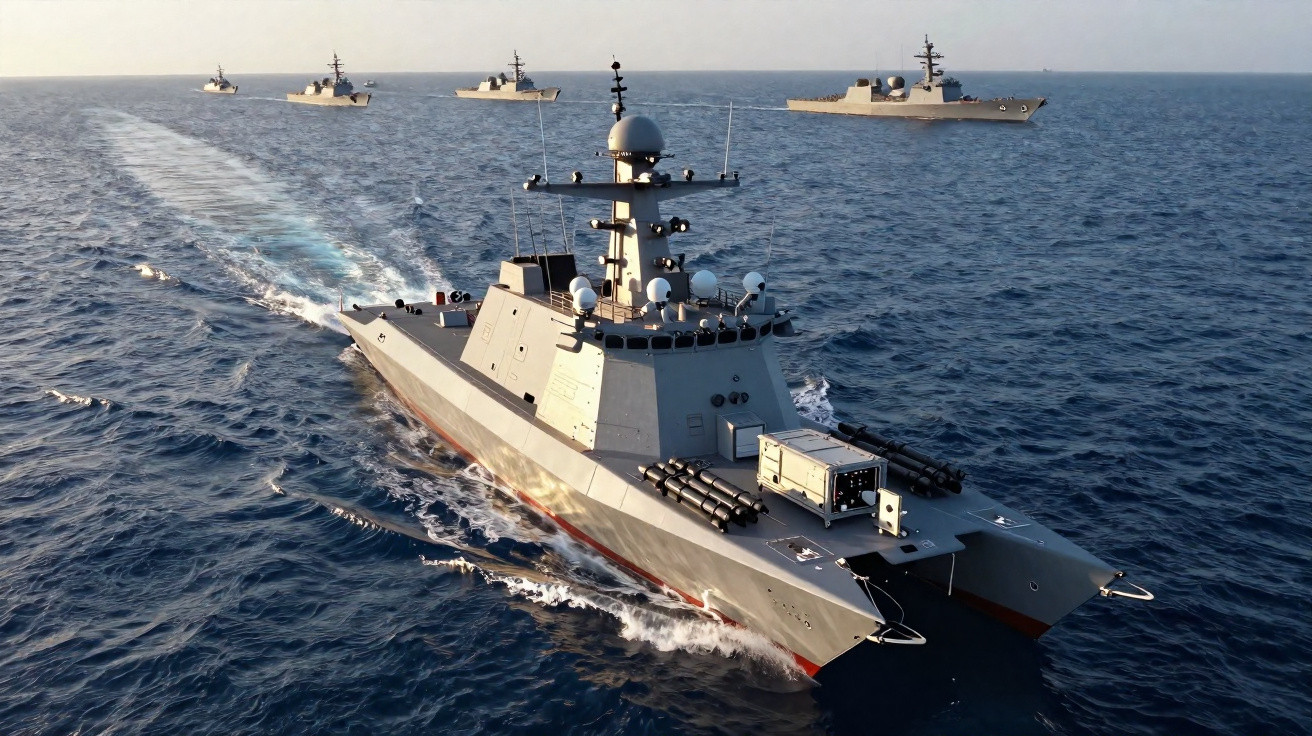
While arguments continue over vast surface fleets and billion-dollar aircraft carriers, the US Navy is directing serious funding and focus towards slimmer, less costly and entirely autonomous vessels. Its newest wager, the Modular Attack Surface Craft (MASC), pushes that approach to the limit, combining the historic logic of fast attack galleys with 21st-century algorithms and long-distance autonomous operation.
A 20-metre uncrewed attack catamaran with formidable firepower
Developed by US company BlackSea Technologies, the MASC is a 20-metre aluminium catamaran conceived from the outset as a combat craft rather than an adapted commercial vessel. This is significant because its hull, propulsion and internal arrangement have all been tailored for sensors, weapons and extended missions with no sailors aboard.
Its twin-hull configuration provides both strong stability and a shallow draft. Together, these qualities allow the vessel to follow coastlines, navigate restricted waters or work in the open sea without compromising seaworthiness. It has been designed for the operations naval planners describe as “littoral”: the complex, congested waters close to land where many future confrontations are anticipated.
Volvo Penta D8-IPS600 integrated drives provide propulsion. Rather than using conventional propeller shafts extending through the hull, the IPS arrangement combines the engine, transmission and steerable drive units in compact pods. This configuration eases maintenance, creates more internal space for payloads and lowers drag.
The MASC can carry roughly 28,000 kg of payload - around twice that of typical autonomous surface vessels of similar size.
That payload capacity sits at the centre of the concept. The hull functions as a modular platform capable of accepting mission containers, with launchers, sonar arrays, electronic warfare equipment or long-range sensors interchangeable according to the assignment. Rather than a single-role “drone boat”, the vessel is effectively a chassis for a range of naval tasks.
Seven missions from one MASC hull
Where early unmanned surface vessels commonly concentrated on a single specialist role, the MASC has been planned as a multi-role system from the beginning. The US Navy is seeking a platform that can be adapted for different emergencies without requiring a return to the shipyard.
A plug-and-play warship
Reports indicate that the craft can undertake at least seven separate mission categories without carrying a crew:
- Anti-submarine warfare (ASW), towing or deploying sonar and operating alongside other platforms
- Anti-surface warfare (ASuW), using missiles or loitering munitions against vessels
- Electronic intelligence and electronic warfare, detecting and jamming hostile emissions
- Long-range logistics, transporting supplies through contested waters without exposing crews to danger
- Precision naval strike against maritime or coastal targets
- Mine countermeasures, employing towed or robotic equipment to find and neutralise mines
- Infrastructure surveillance, covering targets ranging from offshore installations to undersea cables
This versatility depends on a software foundation known as UMAA, short for Unmanned Maritime Autonomy Architecture. It is the US Navy’s open-architecture standard for autonomous ships.
With UMAA, modules from different suppliers are meant to slot in like smartphone apps, avoiding lock-in to a single defence contractor.
In practice, this could mean that a MASC conducting minehunting in the Gulf might theoretically be converted into a missile carrier in the Pacific a few days later, assuming the necessary containers and software packages were available. The Navy expects the approach to shorten upgrade cycles and accelerate innovation compared with conventional warship programmes.
Global endurance from a compact vessel
Norfolk to Japan with no sailor aboard
The stated figures are ambitious. In standard mode, travelling at a restrained cruising speed of 10 knots, the MASC has a range of approximately 3,000 nautical miles, or about 5,500 km. That places it alongside some crewed patrol vessels.
Its long-range deployment mode is where the craft differs. BlackSea states that, through optimised routing, fuel control and restricted use of high-power systems, it can travel as far as about 18,500 km without refuelling. Strategically, that would make a continuous uncrewed passage from Norfolk, Virginia, to waters near Japan possible.
This reach allows planners to consider another form of naval presence. Rather than sending a destroyer across half the world, a task force could dispatch a wave of MASC units days or weeks in advance and position them near important straits or choke points.
MASC production designed to run like a missile line
Reusing an earlier drone boat’s industrial base
BlackSea Technologies says that, at scale, it could produce one MASC hull each day by using an established production line for its Global Autonomous Reconnaissance Craft (GARC). The two craft families share many elements, including navigation equipment, computing modules and perception sensors.
| Feature | GARC | MASC |
|---|---|---|
| Main role | Reconnaissance and surveillance | Attack and multi-role combat missions |
| Hull type | Smaller USV | 20-metre catamaran |
| Payload emphasis | Sensors | Sensors plus up to ~28 tonnes of weapons and equipment |
| Production line | Existing | Adapted from GARC line |
Using existing industrial tooling and supply networks reduces development time. According to BlackSea, a working prototype can be produced in around six months, a rapid timetable by naval standards, where new vessels frequently require years before reaching sea trials.
Cost details are still classified, but the underlying rationale is straightforward: large quantities of standardised, comparatively inexpensive, unmanned hulls intended to saturate contested waters.
A “distributed fleet” that operates more like a swarm
Quantity has a logic of its own
The MASC forms part of the US Navy’s vision of a “lethal distributed fleet”. Instead of concentrating armaments in a small number of costly warships, this model spreads weapons among numerous smaller platforms. Doing so complicates adversary targeting and lessens the political impact of losing any individual vessel.
In a crisis, dozens of small, armed USVs fanning out across a region can force an opponent to spread its defences thin, creating dilemmas at sea.
MASCs are not intended as replacements for destroyers or frigates. Their purpose is to multiply the force by broadening sensor coverage, carrying additional missiles and approaching the most dangerous areas - minefields, confined straits and possible ambush locations - where the Navy would prefer not to deploy crewed ships.
The parallel with Second World War Liberty Ships is difficult to ignore. The United States then produced hundreds of uncomplicated cargo vessels to sustain Allied logistics. Today, planners envisage a comparable combat model: many broadly standardised, sufficiently capable attack craft that could be lost and replaced without seriously crippling the fleet.
From medieval attack galleys to AI-led catamarans
An ancient concept equipped with sensors and missiles
“Attack galley” may seem an overly romantic description, yet the analogy has substance. Medieval and early modern galleys were long vessels with shallow drafts that raced along coastlines, attacking flanks through speed and surprise. Their advantage depended less on armour than on manoeuvrability and concentrated striking power.
The MASC follows a similar pattern. Algorithms, rather than rowers labouring below deck, manage navigation, threat detection and route planning. In place of archers, its payload might consist of anti-ship missiles, lightweight torpedoes or loitering munitions fired at speed from their launch tubes.
As with galleys, MASCs are better understood as opportunistic predators. They are not intended to endure a gun battle against a cruiser. Instead, they are designed to emerge in locations where opponents consider themselves relatively secure: close to harbours, around logistics routes or along the margins of contested islands.
Risks, grey areas and operational scenarios
This level of autonomy brings legal and political issues. How much mission decision-making can be handed to software over a lengthy operation? Following a strike, how can a navy demonstrate that a human remained in the decision loop?
One probable initial application would be high-risk surveillance in volatile areas such as the Strait of Hormuz or the South China Sea. A MASC might patrol commercial shipping routes, search for mines or track suspicious vessels. If it were attacked, only equipment would be lost rather than lives, although the potential for escalation is clear.
Saturation operations represent another possible scenario. In a hypothetical clash near Taiwan, a US carrier strike group could send a wave of MASCs ahead of its crewed vessels. Certain units might carry decoys and jammers, while others carried actual missiles. Until it was too late, hostile radars and commanders would have difficulty telling high-value targets apart from cheaper drones.
Key MASC terms and concepts explained
What “autonomy” means at sea
In naval language, “autonomous” seldom refers to completely independent thought. More often, it means systems able to follow planned routes, prevent collisions, manage fuel and respond to basic changes, including bad weather or nearby traffic, without continuous human steering.
More consequential choices, particularly those involving lethal force, are generally kept for remote operators. Those personnel could oversee several vessels simultaneously and intervene only when rules of engagement demand human judgement.
Why mines and submarines are troubled by small USVs
For minefields and submarines, small uncrewed vessels represent an increasing problem. A quiet and relatively inexpensive craft such as the MASC can tow sonar arrays or release compact underwater drones to survey an area. Repeating this work day after day improves the likelihood of finding concealed mines or a submarine lying in wait.
Using unmanned vessels for mine clearance or close-in ASW also reduces the danger to sailors. This reduction in risk is among the most persuasive arguments navies make when defending such programmes to politicians and the public.
Together with aerial drones and satellite information, MASCs make up part of a layered network for surveillance and strike. Individually, each layer may appear manageable. Collectively, they strain an adversary’s attention, air defences and electronic warfare units, producing precisely the strategic pressure US planners seek.

















Comments
No comments yet. Be the first to comment!
Leave a Comment