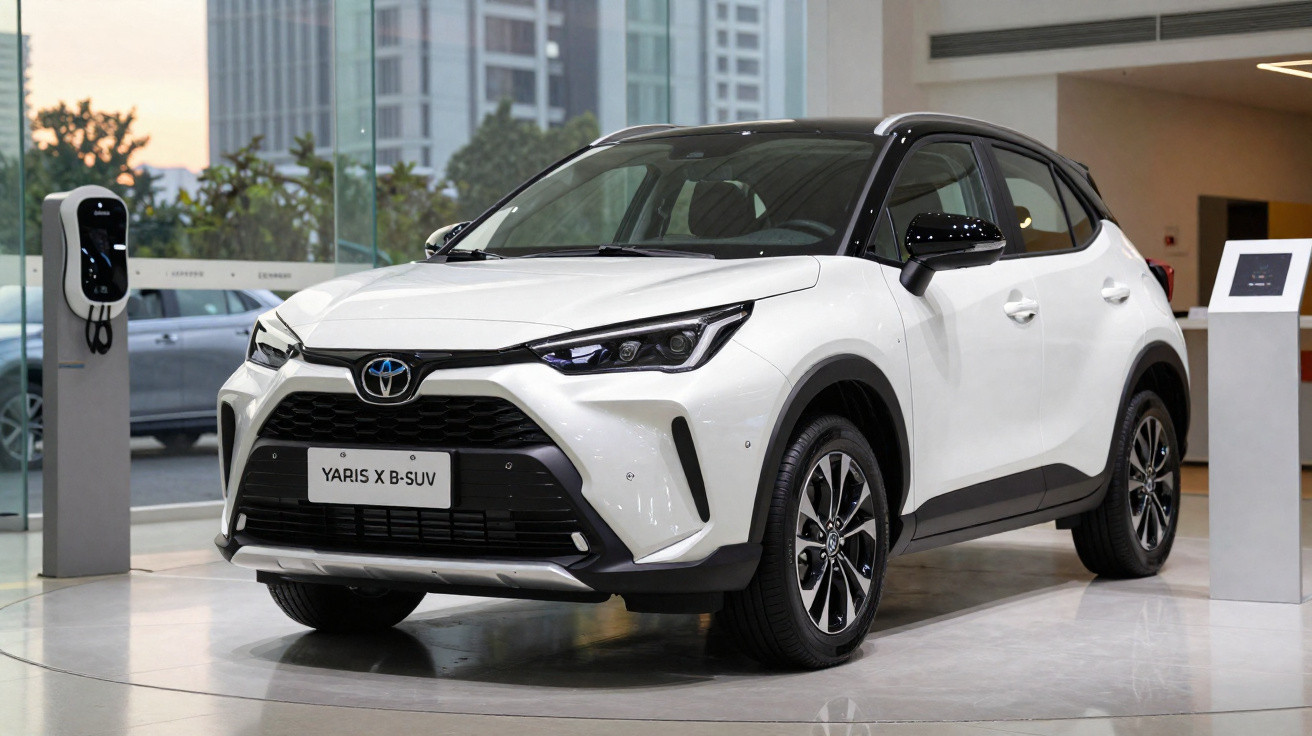
Positioned below the C-HR, the Toyota Yaris Cross is the Japanese brand’s contender in one of Europe’s fastest-growing segments in recent years: B-SUVs.
It is a somewhat late arrival, which is curious given that Toyota was among the pioneers of this type of vehicle. In the 1990s, it introduced the first RAV4 - yes, it began life as a small SUV - and in 2009 it launched the now “forgotten” Urban Cruiser, a year before the Nissan Juke, the B-SUV that ultimately defined the segment.
Given the “extra time” Toyota had to develop the Yaris Cross, does its new offering have what it takes to challenge the segment’s benchmarks? We put it to the test to find out.
More than a “Yaris in high heels”
Although it shares its name with the successful supermini, the Yaris Cross has a distinct character of its own. The test car’s two-tone gold and black paintwork is particularly appealing, in my view, of course. Its 160 mm ground clearance also deserves a mention, lending it a notably adventurous appearance.
Inside, the dashboard is identical to that of the Yaris, with its sturdy construction and abundance of storage areas standing out. It is also good to see the physical climate-control switches retained, alongside shortcut buttons for Toyota’s new infotainment system. Although it works better than systems fitted to some of the brand’s other models, it could still respond more quickly.
Up to this point, the Yaris Cross matches its rivals, both in terms of equipment levels and in the quality of its robust, mostly hard-wearing materials. The same cannot be said for passenger space.
While its larger dimensions compared with the Yaris result in greater room inside, the Yaris Cross is more cramped in the rear than its rivals. The limited door-opening angle does not help either, making it more difficult to fit child seats in the back.
Speaking of the rear seats, they are comfortable, but their head restraints are fixed and tall, which ultimately compromises rearward visibility.
The Yaris Cross makes amends with its boot, which offers 397 litres of capacity - a very positive figure. Its versatility is also noteworthy, thanks to a two-piece double floor that allows only one side of the boot floor to be lowered.
The Toyota Yaris Cross and Toyota’s “new normal”
Increasingly focused on producing cars that are “not boring” - as Toyota president Akio Toyoda has regularly said - Toyota has made the Yaris Cross one of the most engaging B-SUVs to drive.
A firmer suspension set-up, without becoming uncomfortable, combined with 18-inch wheels and lower-profile tyres gives the Yaris Cross assured and even… enjoyable handling.
OK, the steering is light and not as polished as the Puma’s, but it is accurate and direct. In truth, this Japanese model is not far behind Ford’s offering dynamically.
However, there is no “beauty without a flaw”: sound insulation could be better. The lower-profile tyres are audible, as are wind noise and the combustion engine, particularly on the motorway.
The value of experience
As for the engine, the 1.5-litre three-cylinder unit is paired with an electric motor and an e-CVT transmission, forming the hybrid system. It is far from a performance benchmark - nor would that be expected with its combined 116 hp - but it impresses above all with its efficiency and smooth operation in urban driving.
Demonstrating Toyota’s experience in the hybrid “world”, this 1.5 Hybrid, already familiar from the Yaris, returned an average of 4.7 l/100 km. Curiously, this was on journeys undertaken mainly on motorways and A-roads. In town, consumption ranged from 5.5 l/100 km to 5.7 l/100 km.
This is largely due to the fact that, according to Toyota, the engine can drive in fully electric mode for up to +70% of urban journeys. Naturally, I was unable to calculate the precise percentage of miles covered electrically, but I must admit that I rarely heard the combustion engine in town.
Compared with the competition, which overwhelmingly relies solely on combustion engines - sometimes paired with a mild-hybrid system - or even plug-in hybrids, the Yaris Cross presents itself as a “compromise solution”, and not in a negative sense.
This hybrid arrangement delivers genuine savings without “demanding” regular battery charging, as is the case with plug-in hybrids.
Is it the right car for you?
Toyota took some time to commit fully to the B-SUV segment, but when it did, it applied all its SUV-building experience to its “youngest” model.
Although it is not the roomiest vehicle in the segment, the Toyota Yaris Cross makes up for this with a powertrain that makes it one of the most appealing choices for drivers who travel mainly in urban areas.
Beyond that role, this Japanese SUV does not disappoint either, only being let down by its sound insulation, especially from the engine at higher revs. However, once you look at the trip computer and see the recorded fuel consumption, that detail is soon forgotten.







Comments
No comments yet. Be the first to comment!
Leave a Comment