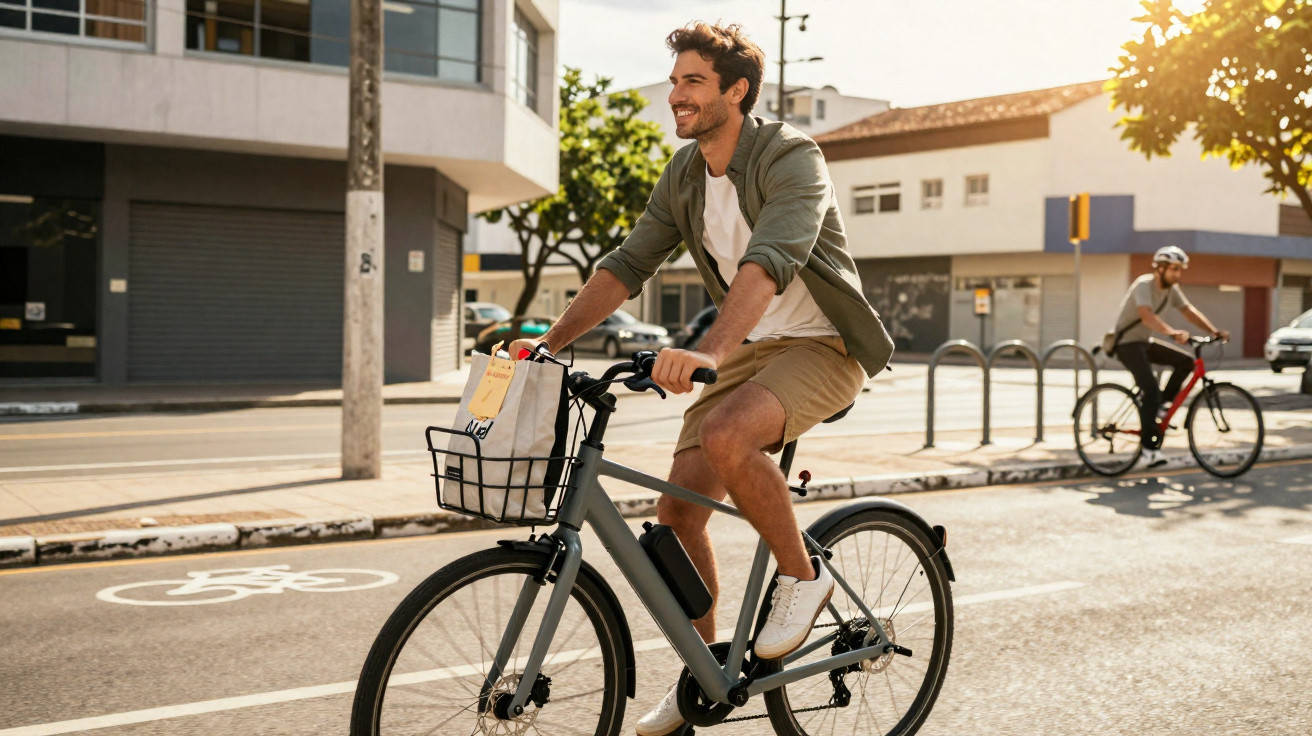
The first detail that stands out is the quiet.
There is no engine roar or snarl of traffic - only the soft electric hum of a bike moving past cars stranded in Monday congestion. The rider looks towards the line of vehicles, seemingly part apologetic and part pleased, before disappearing at the next set of lights as motorists prod at their phones.
A few minutes afterwards, the scene plays out once more. It is a different bike, but the same smile. It belongs to someone who has found a way to beat their commute - and knows it.
Now picture that bike costing almost half the amount you might anticipate. Decathlon has discreetly introduced an offer on a high-end electric bike with a 54% discount. It is the sort of reduction that stops your scrolling and sends you for a calculator.
Figures this low normally come with a catch. Or with something more.
Why this Decathlon deal is making cyclists look twice
At first glance, “54% off high-end electric bike” sounds like the kind of promotional banner most people scroll past. But the original and reduced prices make you pause. A premium e-bike normally priced in the €2,500–€3,000 bracket has suddenly entered the price territory of the mid-range models displayed in their dozens.
For many buyers, that is the psychological turning point. “One day I’ll get an e-bike” becomes, almost without warning, “wait, I could actually buy this now”. It is the uncomfortable but exciting gap between wanting something and choosing it, when a discount stops being an abstract figure and begins to resemble a key.
You can already see the practical implications. A student weighs up a worn second-hand scooter against a smart electric frame that can be charged in a hallway. A parent calculates the cost of a second family car against a bike that avoids parking headaches. Someone tired of reaching work sweaty suddenly sees an alternative that does not devastate their budget.
In an ordinary week, buying a high-end e-bike tends to be a carefully considered process. You test three models, read 15 reviews and ask the sporty friend who knows all the obscure brands. At 54% off, that process speeds up. Someone who has hesitated for months can move from browsing to wheeling a bike out of a Decathlon shop within two days, their hands slightly unsteady on the handlebars.
This is where the offer becomes more than a percentage. It disrupts the usual distinctions between “luxury” and “reasonable”, or “dream” and “practical”. When a top-level frame, dependable motor and long-range battery cost roughly what many people spend on a smartphone, priorities shift.
Across a city, those changes can accumulate. Every discounted e-bike means one fewer person compelled to rely on a car for each short journey. The result is a subtle chain reaction: fewer occupied parking spaces, slightly less rush-hour pressure and more people discovering that 10 km with electric assistance does not feel like 10 km powered entirely by their legs.
Let’s be realistic: a single discount will not transform urban mobility overnight. Yet when a mass-market retailer such as Decathlon applies a 54% reduction to a serious electric bike, it alters what seems “normal” to thousands of people who have never entered a specialist bike boutique.
What 54% less buys you - and how to avoid regretting it
Behind the prominent “-54%” sign sits a real machine. This is not solely about money saved; it is about what you will be riding every day. High-end electric bikes generally bring several concrete benefits: a responsive motor that does not lurch, a battery capable of genuinely covering a return commute, hydraulic disc brakes that work on wet cobbles and a firm frame that remains stable when you have to swerve around a delivery van.
The Decathlon offer belongs in that category, with an integrated battery, tidy styling, proper lights and, often, a rear rack ready for panniers. It is designed for everyday use rather than only warm Sunday outings. This is the kind of bike you can lock outside the supermarket without feeling as though you have parked a spacecraft.
If the offer appeals, begin with one uncompromising question: what will you truly use it for? Commuting in town, countryside rides at the weekend, pulling a child trailer or tackling punishing climbs each day? Your answer should direct every other choice. A rear-hub motor offers a straightforward, smooth experience for flatter commutes. A mid-drive motor brings greater balance and torque when your route resembles a roller coaster. You need not become a technology expert; you only need to choose a machine that suits your actual life.
Range is the second essential consideration. Think about your longest probable day: home–work–detour–friends–home. Then add 30%. If the advertised range in “real conditions” - rather than only Eco mode on level ground - broadly covers that distance with a margin left over, it should work. If it does not, even at -54%, you may end up disappointed and pedalling a heavy bike after its battery has run flat.
Let’s be honest: nobody truly reads every technical table line by line.
One practice can make all the difference: try the bike in circumstances that resemble your own routine. If the shop is on a hill, ride up it. If you expect to carry groceries, ask whether weight can be secured to the rack. Within five minutes, you will know whether the geometry feels right or whether you are stretching, hunching or battling the bike.
Most disappointments stem from overlooking the fit in a rush. People spot a major reduction and tell themselves, “I’ll get used to it,” only to find six months later that the e-bike is collecting dust in the hallway because the saddle angle is wrong or the handlebars sit too low. Minor ergonomic details become significant when you experience them every day.
There is also an unseen expense: upkeep. Even high-end electric bikes normally require an annual service, replacement brake pads and perhaps a new chain after several thousand kilometres. With a brand such as Decathlon, you at least have access to an in-house servicing network and standardised parts, which can feel less daunting than specialist workshops with waiting lists.
One Decathlon mechanic put it in a memorable sentence:
“People remember the discount the day they buy the bike, but they remember how it rides every morning at 8:15.”
A short checklist can help turn 54% off from an impulse purchase into a long-term success:
- Check the warranty for the motor and battery - in years, rather than months.
- Ask whether spare parts will be available in three to five years.
- Consider the total weight if you will regularly carry it upstairs.
- Take a proper test ride instead of simply circling the car park.
- Set aside a modest annual maintenance budget from the outset.
Approach the process with a little patience towards yourself. Not knowing the difference between torque and watts is not a failure. You are picking up a new language while considering a relatively costly item. A helpful salesperson can turn “I just want it to climb that hill without dying” into the appropriate specification sheet.
The wider story behind a discounted Decathlon electric bike
Once the initial excitement of buying has passed, something subtler remains: your way of getting about changes. On the first morning, you leave home ten minutes later than normal, half expecting everything to go wrong. Then you arrive at work earlier, lightly windblown but neither exhausted nor irritated by a traffic queue. Your emails feel less aggressive. Your coffee tastes better. It may seem like coincidence. It is not.
We have all experienced a purchase that quietly changes the feel of our days: a good mattress, noise-cancelling headphones or a tool that genuinely does its job. A high-end e-bike at 54% off belongs in the same category. It will not miraculously solve your life, but it removes one repeated source of friction: the daily journey from A to B.
Product specifications rarely mention the emotional side. There is the small surge of pride when you pass a queue of cars. There is the casual “I’ll swing by, it’s only 5 km,” which you would never previously have said. There is the rainy Tuesday when you realise you do not dread the journey and simply check the lights before zipping up your jacket. Those are the genuine returns delivered by that discounted frame and motor.
There is a social dimension, too. Friends begin asking, “So, is it really worth it?” Neighbours spot the charging cable in your hallway. A colleague borrows the bike during a lunch break and returns wide-eyed. One person’s deal gradually becomes a small reference point in a shared discussion about how everyone gets around.
The Decathlon offer fits into that wider setting. It is a brand people know, a price cut substantial enough to cut through daily distractions and a product that does not resemble a science-fiction prototype. It is accessible enough for someone who has never thought of themselves as “a cyclist” to try that identity without feeling they have joined an exclusive club.
Perhaps that is the understated strength of the 54% figure. It does not merely make a luxury item less expensive; it moves a particular idea of urban freedom into the realm of “why not me?”. It is the sort of question that stays at the back of your mind the next time you are trapped behind red brake lights for the third evening running.
| Key point | Detail | Benefit for the reader |
|---|---|---|
| 54% discount | A high-end electric bike model drops to the price of a mid-range model | Makes a product category that is usually beyond budget accessible |
| Bike quality | Robust frame, powerful motor, good range and Decathlon maintenance service | Reduces unwelcome surprises and increases the likelihood of daily use |
| Effect on everyday life | Faster, less stressful journeys and a new way to travel around the city | Encourages a rethink of the car while saving time, money and energy |



Comments
No comments yet. Be the first to comment!
Leave a Comment