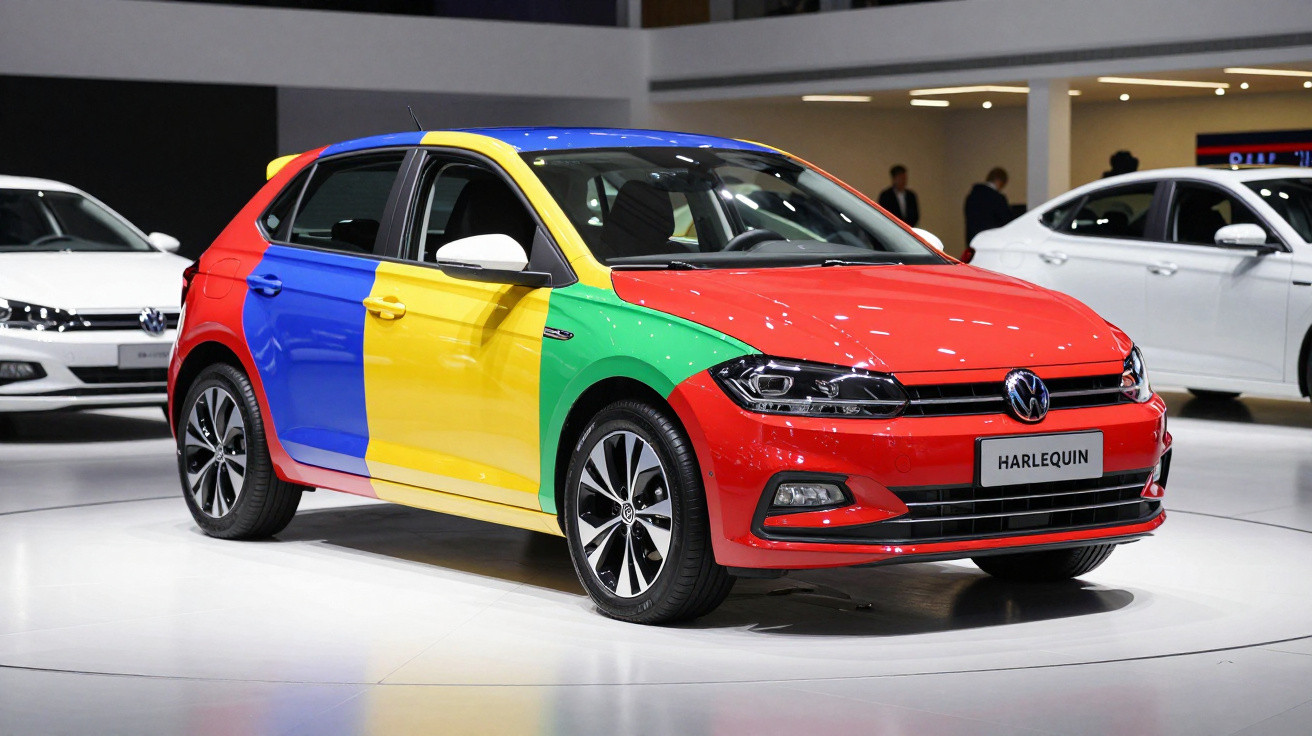
Traditionally understated, the Polo’s most eye-catching and least conservative version in its entire history is the Volkswagen Polo Harlequin.
Something of a 1990s icon - much like its “cousin”, the Skoda Felicia Fun - the Polo Harlequin is one of those cars that was never really expected to reach production.
Yet this colourful Polo was not only built but also sold, recording around 3,800 units and gaining a kind of “legion of fans” that remains strong today.
How did it come about?
Introduced in 1994, the third-generation Volkswagen Polo marked a turning point for the model, making a complete break from its 1970s roots and the Audi 50.
Built on a new platform, it was made up of modular units - mechanical components, equipment, paint colour and options - all intended to make it easier for buyers to specify their Polo.
To simplify the process even further, Volkswagen created a colour code for each of these “modular units”. Blue denoted the engine and chassis (mechanical components); red represented optional extras; green referred to paint choices; and yellow indicated equipment.
To demonstrate the system, Volkswagen produced 20 Polos painted in a blend of these colours for use at dealership events.
What the German manufacturer had not anticipated was that customers would actually want to buy a Polo… in multiple colours. Once it recognised this interest, the decision was swiftly made: 1,000 Volkswagen Polos wearing that colour scheme would be produced in 1995.
The Volkswagen Polo Harlequin was assembled like a puzzle
Named the Polo Harlequin - a reference to the characters of Commedia dell’arte, where the harlequin’s role was to entertain audiences during intervals - it was not a particularly straightforward car to build.
To produce the Polo Harlequin, Volkswagen first had to manufacture four Polo examples painted red, blue, yellow and mint green. Various body panels were then exchanged between them, creating the colourful Volkswagen Polos.
Inside, the Volkswagen Polo Harlequin featured seats with a unique pattern, a steering wheel and gear lever trimmed in blue leather and, as was typical of the era, a Blaupunkt radio.
As buyers could not choose the dominant colour of their Polo Harlequin, they had to wait until delivery to find out which version they had “ended up with”. In addition, the first 1,000 examples came with a certificate and a numbered key ring.
In 1996, Harlequin “fever” also reached the Golf. Intended for the North American market, a total of 246 Golf Harlequin units were built, painted in “Pistachio Green”, “Ginster Yellow”, “Tornado Red” and “Chagall Blue”.
Is a return in sight?
Created by Volkswagen’s importer in the Netherlands, the new Volkswagen Polo Harlequin is, for now, a one-off. Its purpose is to pay tribute to the model which, somewhat surprisingly, was never officially sold there.
Although its colour scheme closely matches that of the original model, it is not known whether a similar production method was used. Ultimately, there is only one question left: would you like to see the Polo Harlequin return?





Comments
No comments yet. Be the first to comment!
Leave a Comment