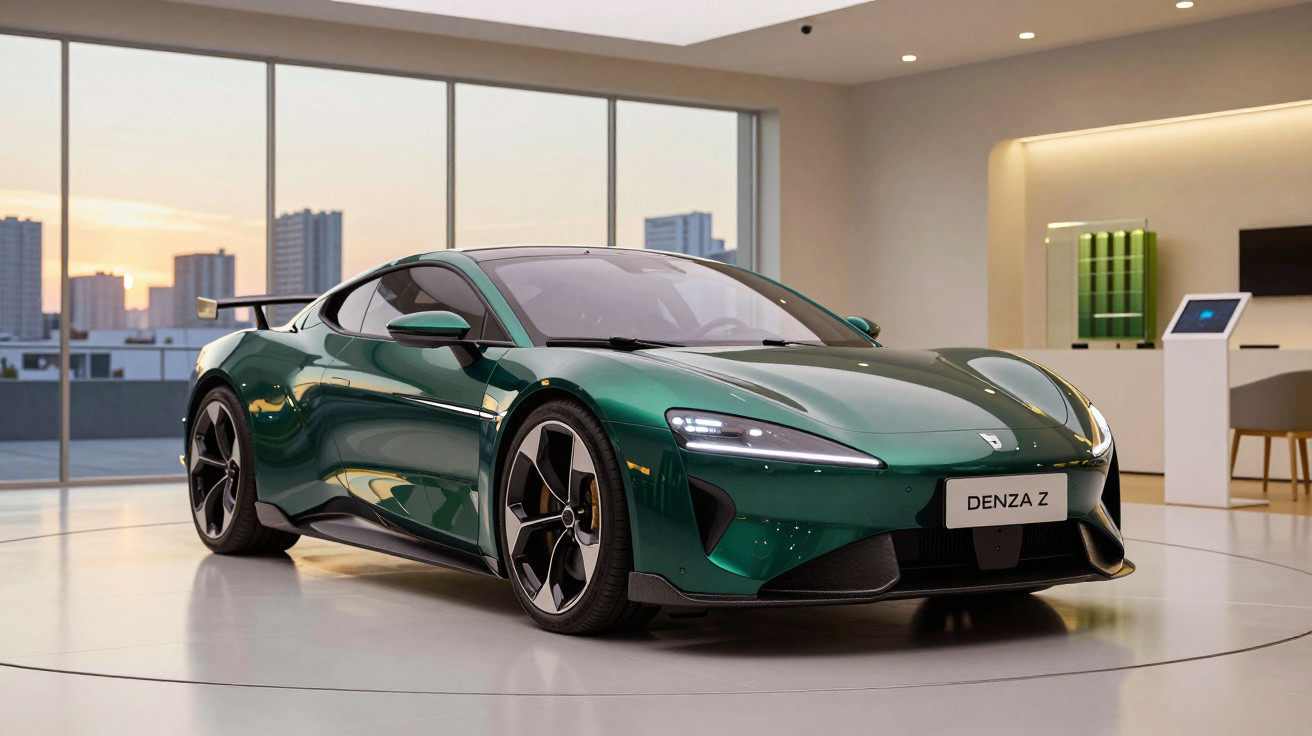
The Denza Z aims to challenge Europe’s finest supercars, but this short encounter left several questions unanswered.
When it comes to exceptional performance cars, names such as the Porsche 911 Turbo, Corvette Z06 and Ferrari 12Cilindri are almost unavoidable. Very few people would think to add a Chinese car to that select group.
Denza, the premium brand within the BYD Group, intends to change that and disrupt a segment that European and American manufacturers have dominated for decades. This is particularly true in Europe, where heritage and brand prestige still carry considerable weight in purchasing decisions.
Chinese brands may sometimes lack imagination when choosing names, especially as the final letter of the alphabet has long been linked with a Nissan sports car. Yet the Denza Z is not short of ambition or headline figures: 1,604 hp, 1,240 Nm and a claimed 0–100 km/h time of 2.25 seconds.
Denza remains almost unknown to prospective buyers in this rarefied market. Put simply, it hopes to become for BYD what Lexus is to Toyota or Genesis is to Hyundai: a more exclusive marque offering distinctive styling, luxurious cabins, exceptional performance and suitably elevated prices.
More for less with the Denza Z
The low-slung, sleek Denza Z will be offered as a coupé, a convertible and in an even more extreme Racing specification. The entry-level model is expected to cost just under €160,000, which is a substantial sum in absolute terms but considerably lower than several European rivals delivering comparable performance.
A Porsche Taycan Turbo GT with the Weissach package costs around €80,000 more while producing 500 hp less. On the other hand, it brings a stronger brand image, higher overall quality and dynamic ability that the Denza has yet to prove.
As an electric car, the Z also has another important selling point: a 76 kWh battery designed to take advantage of BYD’s ultra-rapid Flash Charging system.
Under ideal conditions and at a compatible charger, the company claims a peak output of 1,500 kW, enough to complete a charge in around nine minutes. It remains to be seen when this infrastructure will become available in Europe, and for how long the car can sustain output close to that figure.
To gain an initial impression of the Denza Z, we travelled to the Goodwood circuit in southern England during this year’s Goodwood Festival of Speed. This was not a full test, but rather three laps of its 3,860-metre layout, totalling a little over 10 kilometres.
Helmet on, seatbelt fastened, and with a Denza engineer in the passenger seat to prevent any overenthusiasm. Time to get going.
Before “turning the key”
Before setting off, there was enough time to assess the cabin. The front seats are comfortable, while high-quality leather covers much of the interior. Build quality is persuasive, although some plastics have no place in a car intended to take on Porsche, McLaren or Lamborghini.
The screens are also far too ordinary. They could have been fitted to a BYD Dolphin without anyone raising an eyebrow, which does little to create the sense of exclusivity expected from a supercar at this price.
The cabin is designed primarily for two people. The rear seats are mainly useful for extra luggage, or at most for children on short journeys. Driver and front passenger up to 1.90 metres tall have sufficient room, although even as a shorter person, it was not easy to settle into the Z while wearing a helmet.
Sedated horsepower
This first dynamic experience came with numerous restrictions. Boost mode was unavailable, stability control had to remain fully engaged, and power delivery was deliberately progressive. The outcome was something of an anticlimax. I did not experience the ballistic, almost unreal acceleration of other electric cars with more than 1,000 hp that I have driven.
A more comprehensive future test will have to establish whether the Z can genuinely translate its paper promises onto the road. And its promises are considerable.
There are two motors on the rear axle, each producing 340 kW (462 hp), plus a third motor at the front delivering 500 kW (680 hp). Combined output is 1,180 kW (1,604 hp), with maximum torque reaching 1,240 Nm. And this is only the entry-level version.
Denza claims 2.25 seconds from 0 to 100 km/h and a top speed of 300 km/h. We could not get anywhere near that figure, both because of the circuit’s limitations - its straights are especially short for a car with this much power - and the tight leash imposed by the test engineer.
Top speed is electronically restricted to manage energy consumption and battery temperature. With just 76 kWh, a modest capacity for a car with this level of performance, weight has been kept close to 2.2 tonnes.
The carbon-ceramic brakes, with six-piston calipers at the front and four-piston units at the rear, need some temperature before revealing their full capability. Once warmed through, however, they provide the expected stopping power and fade resistance.
The seats, meanwhile, could offer greater lateral support. The steering would also benefit from more feedback, particularly when some of its rivals have the most precise and communicative steering systems in the industry.
With every electronic system active, entering a corner a little too quickly triggers a clear stability-control intervention, cutting power delivery and restricting agility. Even so, it is apparent that the rear wheels do more of the pushing than the front wheels do of the pulling, helping the Z rotate through corners and giving it a less neutral character.
Potential still locked away
Several functions remained inactive on this pre-production car. These included the red Boost button on the right-hand side of the steering wheel and the Track Mode switch positioned opposite it.
According to Denza engineers, Boost makes throttle response 30% more aggressive for 20 seconds. Once activated, the instruments and central display change their layout to reflect the additional performance.
The paddles behind the steering wheel were not operational either. They will be used to simulate gear changes. That is a shame, as they could make the driving experience more engaging, particularly on a circuit.
Sophisticated suspension
The Z also introduces the DiSus-M intelligent damping system, paired with the e3 platform. Its dampers use magnetorheological fluid, the viscosity of which can be altered within milliseconds by a magnetic field, enabling almost instantaneous adjustments during both compression and rebound.
Ride comfort is convincing for a supercar and suggests the Z should cope reasonably well with road surfaces less perfect than Goodwood’s virtually immaculate tarmac. Suspension is independent at all four wheels, using double wishbones at the front and a multi-link arrangement at the rear. It also features air springs and variable damping.
For buyers who find 1,604 hp insufficient, Denza is preparing the Racing version. With dedicated tyres, top speed rises to 350 km/h and the 0–100 km/h sprint should take less than two seconds. It also gains an enormous rear wing, while the air springs are replaced by coil springs to improve high-speed stability.
Not expensive… for what it offers
Denza has not yet confirmed the final European price for the Z, but early estimates point to a figure just below €160,000. If confirmed, it will sit well below the more than €250,000 required for the Porsche Taycan Turbo GT, which offers 1,034 hp.
The gap becomes even larger when considering the 911 Turbo S, as the Denza could cost less than half of the more than €324,000 requested in Portugal. Yes, it uses petrol, but it is also the benchmark at this level and the car that comes closest conceptually to the Denza Z.
Of course, price - less than half - power - more than double - and acceleration do not tell the whole story. The Denza will need to show that it can approach Porsche levels of dynamic precision, overall quality and brand image.
Even so, at under €160,000, it will be difficult to accuse it of being expensive for what it promises. Orders are expected to open in certain European markets during 2026, with first deliveries planned before the end of the year, although its arrival in Portugal has not yet been confirmed.


Comments
No comments yet. Be the first to comment!
Leave a Comment