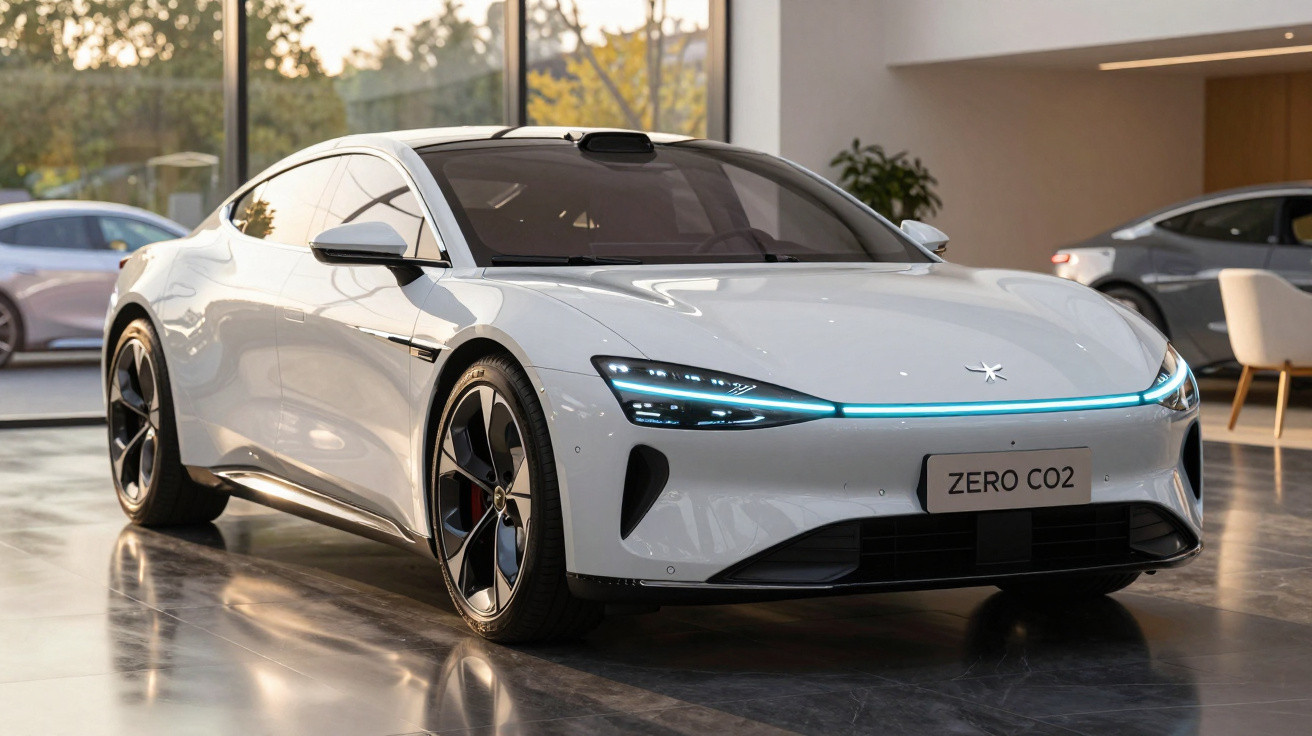
Discarding a petrol car that remains roadworthy and replacing it with an electric vehicle cuts carbon emissions, even if the petrol car is only a year old. Across the US vehicle fleet, making that change reduced emissions in 92 of 100 scenarios. The explanation lies less in the battery itself than in how vehicles use energy over their lifetimes.
Elliott Campbell, chair of environmental studies at UC Santa Cruz, and Roland Geyer of UC Santa Barbara assessed two possible paths for hundreds of vehicle models.
Under the first, an owner keeps driving the petrol car for its complete 16-year life. Under the second, they retire it early and use an electric replacement.
Building the car is the smaller cost
For a petrol car, most carbon emissions are produced through its exhaust during years on the road, rather than during manufacturing.
“The thing that is so unique about gas vehicles is that the vast majority of the energy goes into operating the vehicle, not building it,” Campbell told Earth.com.
This gives the petrol car a substantial advantage in the comparison. Its manufacturing emissions have already occurred and cannot be reclaimed, meaning both scenarios bear those emissions equally and they are removed from the calculation. By contrast, the study includes all emissions from producing the electric replacement, battery pack included.
“And even when we advantage the gasoline vehicle in this way, the EV still comes out as the clear winner,” Campbell said.
Driving produces the largest emissions
Consider an average American SUV powered by the average American electricity grid. Keeping it on the road for all 16 years establishes the benchmark.
If it is scrapped in its second year and replaced with an electric SUV, total emissions over the same 16-year period drop by 44%. Manufacturing the replacement creates an initial carbon cost. However, roughly three years of driving offsets that debt, with every subsequent year delivering savings.
Using the full range of vehicle efficiencies recorded by the EPA, replacing a fleet-average vehicle after its first year reduced emissions by 58%. The strongest combination achieved an 82% reduction.
Campbell and Geyer repeated the analysis with a separate database covering 459 vehicle models, producing almost identical results.
Swapping petrol for petrol took 18 years
For 20 years, conventional advice was to retain the older car. Studies of drivers in the United States and Canada estimated that replacing an older petrol car with a newer, more efficient petrol model took around 18 years to pay back.
That is approximately the vehicle's full lifespan, meaning the switch effectively never delivered a payoff.
Those earlier research teams compared one petrol engine with a marginally more efficient petrol engine. Campbell and Geyer compared it with a vehicle that uses no petrol at all.
Even hybrids generally remained behind
Campbell had expected the most efficient hybrids to be an exception. Replacing a car that already uses very little petrol appeared likely to be a marginal decision. Instead, it was not.
“I was shocked that even scrapping a hybrid gives big climate benefits,” Campbell said.
Retiring even a best-in-class hybrid continued to pay off on most electricity grids across the country.
The advantage became negligible, or turned negative, only in areas where local electricity generation emits more than 400 kilograms of carbon dioxide per megawatt-hour. Those areas account for roughly one-third of US electricity production.
Some drivers are exceptions
Two examples produced the opposite outcome. Replacing a plug-in hybrid car with a fully electric vehicle increased emissions by 11%, while replacing a plug-in hybrid SUV delivered a benefit close to zero.
The second exception involves vehicles driven infrequently. For cars, the threshold is about 7,054 kilometres annually; for SUVs, 6,837 kilometres; and for pick-ups, 10,794 kilometres. Below those distances, the new battery does not repay its carbon cost.
These thresholds are around one-third to one-half of the distance travelled by an average driver.
When Earth.com asked whether these exceptions would persist, Campbell said they would not. Cleaner grids and an effective battery-recycling sector should eliminate them, after which “the EV will come out ahead even in these edge cases.”
Rebates too small to matter
None of this means that scrapping a functioning car is affordable. Campbell and Geyer state clearly that, with current rebates, retiring a newer petrol vehicle is economically prohibitive.
California's Clean Cars 4 All scheme pays lower-income motorists to scrap older, more polluting vehicles, while Britain's ULEZ scrappage scheme operates on the same principle. The researchers argue that the emissions gains apply to vehicles far newer than those eligible under such programmes.
Campbell does not believe the conclusion applies to every product people own. He said that the arrival of a more efficient phone is not a reason to replace the one already in someone's pocket. A phone uses most of its energy during production, rather than through being driven around.
“The mantra of repair and reuse still makes sense in many other contexts,” Campbell said in his written answers to Earth.com.
Campbell and Geyer excluded two factors. No one has yet calculated the savings from battery recycling, because too few electric vehicles have reached end of life to sustain the industry needed to recycle them. Their figures also reflect today's electricity supply rather than the cleaner generation currently being developed.
Both exclusions make the electric car appear less favourable than it really is, so Campbell and Geyer expect the actual advantage to be greater. Resolving the issue will require a decade of retired battery packs passing through recycling facilities that barely exist at present.
The complete study appeared in the journal Science.












Comments
No comments yet. Be the first to comment!
Leave a Comment