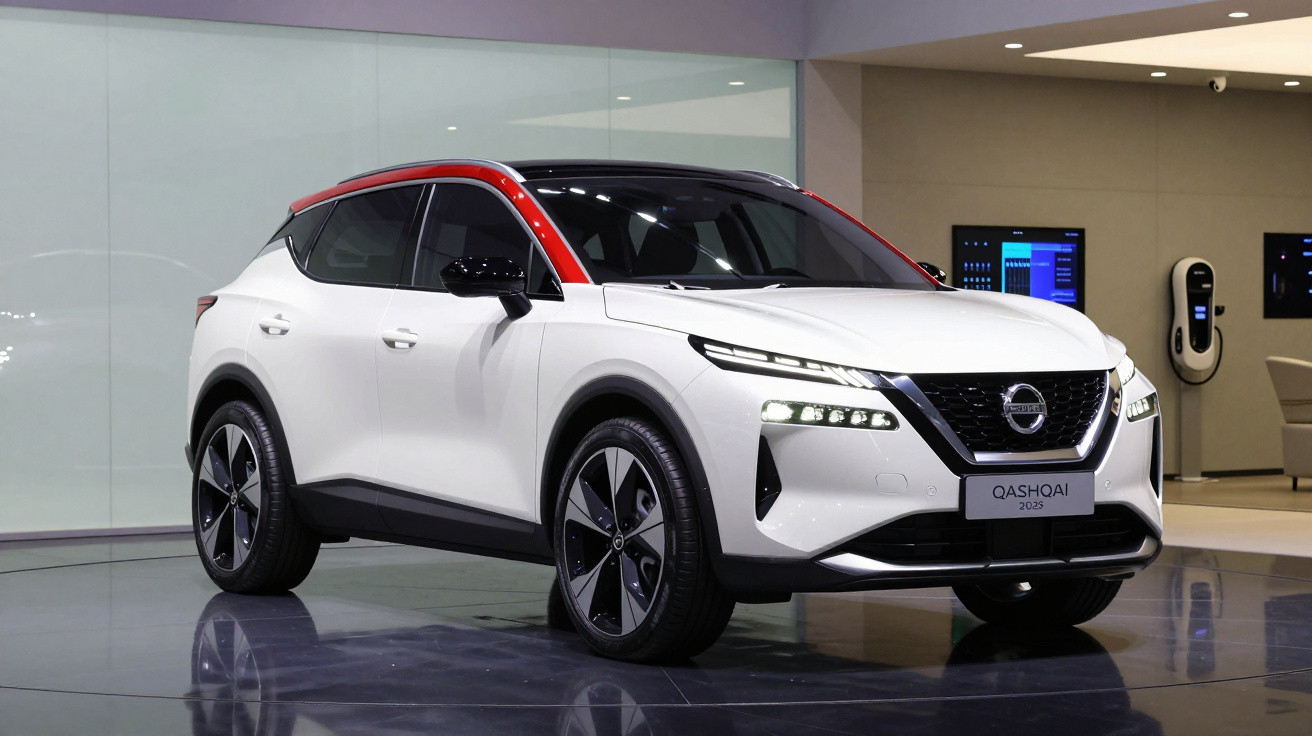
With more than three million units sold since its 2007 launch, the Nissan Qashqai enters its third generation with one straightforward aim: to retain the lead in the segment it created.
Visually, the Qashqai adopts an entirely fresh design that follows the latest styling direction from the Japanese marque. Key details include Nissan’s signature “V-Motion” grille and LED headlights.
Along the side, 20-inch alloy wheels are the major addition - until now, the Qashqai could only be specified with wheels up to 19 inches - while the rear lights feature a 3D effect. For personalisation, the new Nissan is available in 11 exterior colours and five two-tone combinations.
Larger inside and out
Built on the CMF-C platform, the Qashqai has increased in every dimension. It is now 4,425 mm long (+35 mm), 1,635 mm high (+10 mm) and 1,838 mm wide (+32 mm), while its wheelbase has grown to 2,666 mm (+20 mm).
The longer wheelbase has released an additional 28 mm of rear passenger legroom, which now stands at 608 mm. Meanwhile, the taller body has increased headroom by 15 mm.
The boot has also gained around 50 litres over its predecessor, now offering close to 480 litres. A revised arrangement for the rear suspension has also made it easier to access.
Completely revised chassis
The CMF-C platform has not only improved the Qashqai’s interior space. The new Qashqai also benefits from entirely new suspension and steering systems.
While every Qashqai uses updated MacPherson front suspension, the rear suspension differs between versions.
Front-wheel-drive Qashqais fitted with wheels of up to 19 inches use a torsion-beam rear axle. Versions with 20-inch wheels and all-wheel drive instead receive independent rear suspension with a multi-link layout.
According to Nissan, the steering has also been revised to deliver both sharper responses and improved feel. Finally, the new platform has enabled Nissan to cut 60 kg from the overall weight while increasing structural rigidity by 41%.
Electrification is the priority for the Nissan Qashqai
As we had already reported, the new-generation Nissan Qashqai has not only abandoned diesel engines altogether, but has also electrified every powertrain in its range.
The familiar 1.3 DIG-T is therefore paired with a 12V mild-hybrid system - this article explains why it is not a 48V system - and is offered in two power outputs: 138 or 156 PS.
The 138 PS version develops 240 Nm of torque and comes with a six-speed manual gearbox. The 156 PS model can be paired with a manual gearbox and 260 Nm, or with a continuously variable transmission (CVT).
With the CVT, the 1.3 DIG-T’s torque rises to 270 Nm. This is also the only engine-and-gearbox combination through which the Qashqai can be specified with all-wheel drive (4WD).
Finally, the “jewel in the crown” of the Nissan Qashqai engine line-up is the e-Power hybrid powertrain. In this system, the petrol engine serves solely as a generator and is not connected to the driven axle, with propulsion provided exclusively by the electric motor.
The system comprises a 188 PS (140 kW) electric motor, an inverter, a power generator, a small battery and, naturally, a petrol engine. This is an all-new 1.5-litre, 154 PS unit, and the first variable-compression-ratio engine to be marketed in Europe.
The end result is 188 PS and 330 Nm of torque, creating a “petrol electric car” that does without a huge battery by using the petrol engine to power the electric motor.
Technology for every need
Whether in infotainment, connectivity, safety or driver assistance, technology is certainly not in short supply in the new Nissan Qashqai.
Starting with infotainment and connectivity, the Japanese SUV features a 9-inch central display compatible with Android Auto and Apple CarPlay, the latter of which can be connected wirelessly.
A configurable 12.3-inch display acts as the instrument panel, supplemented by a 10.8-inch Head-Up Display. The NissanConnect Services app also allows various Qashqai functions to be controlled remotely.
Equipped with several USB and USB-C ports, plus a wireless smartphone charging pad, the Qashqai can also be fitted with Wi-Fi and operate as a hotspot for up to seven devices.
In terms of safety, the Nissan Qashqai features the latest version of the ProPILOT system. This includes functions such as adaptive cruise control with stop&go capability and traffic-sign recognition, a system that adjusts speed when approaching bends using navigation data, and even a blind-spot detector that intervenes through the steering.
Also on the technology front, the new Qashqai is equipped with intelligent LED headlights that can selectively switch off one or more of their 12 individual beams when they detect an oncoming vehicle.
How much does it cost and when does it arrive?
As is customary, the launch of the new Nissan Qashqai is accompanied by a special edition, named Premiere Edition.
Available with the 138 PS 1.3 DIG-T or the 156 PS version with an automatic gearbox, this model features two-tone paintwork and costs €33,600 in Portugal. The first examples are expected to be delivered in the summer.
Article updated on 27 February at 11:15 with the addition of the model presentation video.

Comments
No comments yet. Be the first to comment!
Leave a Comment