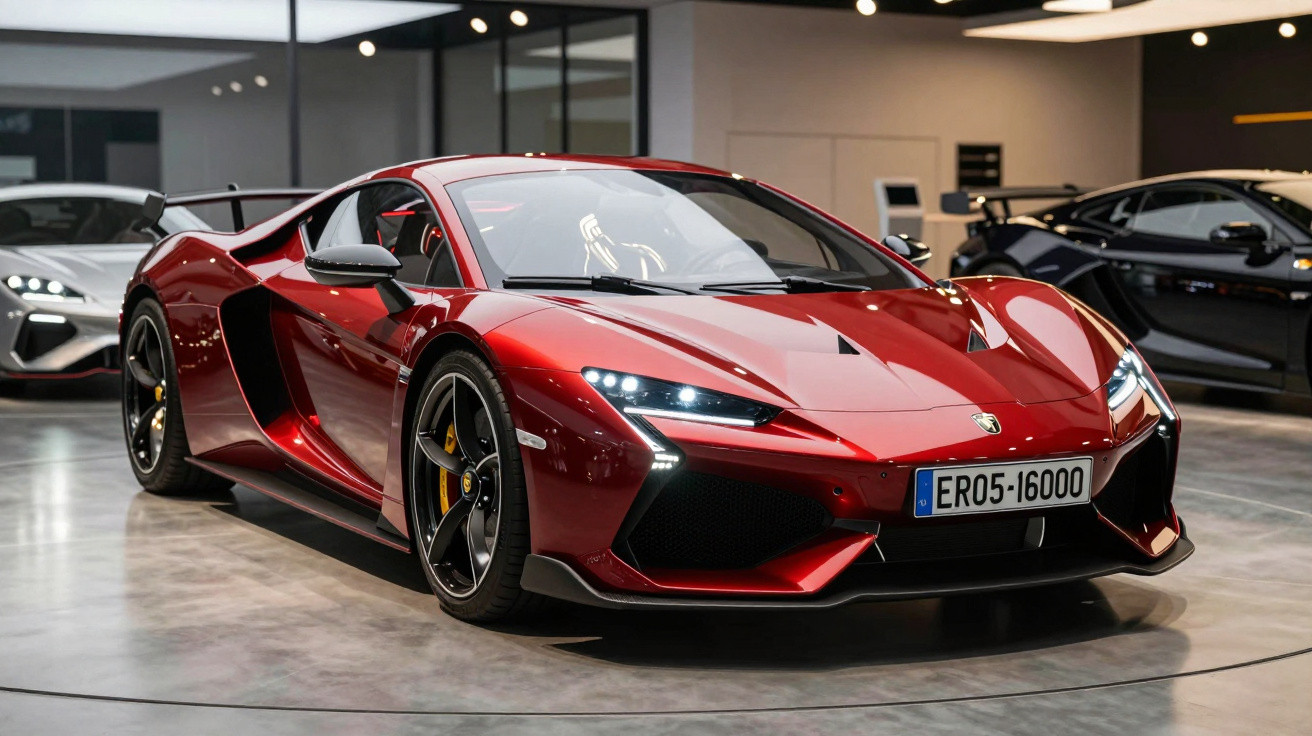
The dyno cell is cramped, white and filled with a hum like that of a hospital corridor. Then the technician presses the starter, and the entire building seems to take on a different form. It begins with a deep rasp: the familiar offbeat rhythm of a five-cylinder, the sound Audi devotees still play on YouTube at 2 a.m. Moments later, the throttle opens and the pitch rises, sharper and more furious, until your chest trembles with a mix of fear and exhilaration. At 16,000 rpm, it is no longer merely “engine noise”, but a metallic shriek, as though a MotoGP machine had consumed an old Quattro and chosen to survive.
You look at the laptop: 240 horsepower from an engine block you could nearly wrap your arms around.
Beyond this room, councils are prohibiting diesels and legislators are discussing zero emissions by 2035.
In here, petrol is battling for its final passport.
Europe’s strangest little rebel: a five-cylinder at 16,000 rpm
By any rational measure, this engine should not exist in Europe in 2026. It has five cylinders, displaces barely 2.0 litres, races beyond 16,000 rpm and produces 240 hp without a turbocharger anywhere in the equation. It resembles a student engineer’s wild sketch that somehow made it out of the classroom and on to a proper test bench.
At idle, its uneven rumble is immediate nostalgia for anyone raised on televised rally stages during the 1990s. Then the revs rise with a savage, near-electric urgency, the needle circling faster than your mind can follow the figures. It does not burble; it tears through the air like a buzz saw.
You immediately understand that this is not only about output; it is making a statement.
The project emerged from a part of Europe where compact workshops still carry the scent of cutting oil and burned clutches. A team of engineers, largely former OEM employees made redundant during the major “electrification restructuring”, were not prepared to spend their working lives calibrating battery thermal maps. They hired a warehouse, brought in a second-hand dyno and began sketching ideas on whiteboards stained with coffee.
Their ambition was almost childlike: to create the lightest, most rev-hungry petrol engine capable of meeting the letter of Euro 7 for track-led use and low-volume registration. There would be no hybrid system, turbocharger or gentle compromise. Only revs, intelligent combustion and uncompromisingly clean exhaust after-treatment. That is how this five-cylinder was born: assembled like a protest placard in forged aluminium and titanium.
From an engineering perspective, the 16,000 rpm headline conceals a quieter revolution. Its crankshaft is forged and cross-drilled, seemingly capable of enduring a minor war. The valvetrain parts are so light that you hesitate before touching them. Pistons run within cylinder walls coated like aerospace components, cooling passages weave through the block, and the lubrication system appears better suited to a superbike than a car.
Everything serves a single purpose: use less fuel for each horsepower, over a shorter period, with near-surgical accuracy. Where lawmakers see “NOx” and “particulates”, the engineers see “combustion geometry” and “spray targeting”. Same war, different language.
Petrol suddenly seems less dead than specialised: a niche craft being refined for survival.
How do you keep petrol alive when everything screams “EV only”?
The first “trick” is brutally straightforward: produce engines that are smaller, lighter and efficient enough to sip fuel like a city scooter while still providing enjoyment. This five-cylinder is a 2.0-litre unit weighing roughly what an old 1.2-litre engine did, yet it reaches twice the revs most commuter cars ever encounter. Reduced mass means lower pumping losses and less fuel used per kilometre when you are not at full throttle.
The second approach is to operate them only in the situations where they excel. Combined with a compact battery and a short-range electric system, such an engine could deliver the emotional side of driving, while electrons handle tedious stop-start traffic. The combustion engine becomes a special guest rather than the everyday workhorse.
That is Europe’s loophole: regulate the averages, and enthusiasts will optimise the peaks.
The usual mistake is to assume every vehicle must be either a fully electric car or an old-fashioned fuel-guzzler. That all-or-nothing view destroys nuance, and nuance is precisely where this compact five-cylinder belongs. You would not use it every day on congested ring roads; an electric motor would deal with those journeys quietly and cleanly. Once you leave the city, however, you release the mechanical intensity for which you actually paid.
Plenty of people purchase 400 hp SUVs and never take them beyond 3,000 rpm. Honestly, nobody truly drives that way every single day. The future imagined by these engineers is different: modest EV range for school runs and commuting, with a screaming petrol heart waiting for weekends, mountain roads and an empty autobahn at sunrise. Less guilt, more purpose.
One lead engineer, a reserved Italian who still has rally posters on his office wall, expresses the idea memorably.
“We are not trying to save petrol for everyone,” he says. “We’re trying to keep a corner of the world where engines still sing. If that corner is smaller, fine. But it must exist.”
He approaches a whiteboard and sketches a rough triangle:
- EV in the city: quiet, clean, simple.
- Petrol on the open road: emotional, intense, limited.
- Software in between: managing what runs, when, and how hard.
He argues that this triangle could allow small, clean, insane engines to remain viable under stringent regulations. They would not be everyday appliances, but cultural artefacts that people can still drive rather than merely watch on Vintage YouTube in 2040.
What this “last hope” really means for ordinary drivers
What, then, does a 16,000 rpm unicorn mean for someone driving a ten-year-old diesel Golf while nervously searching EV subsidies? In reality, quite a lot. Technology such as this engine does not remain confined to the laboratory: it filters down into smarter combustion methods, lighter materials and cleaner exhaust after-treatment for the next generation of downsized petrol engines designed for real-world use.
Your future hybrid city car may never see five figures on its rev counter, but it might use the same friction-reduction technology or intelligent cooling to consume much less fuel. It follows the pattern motorsport has established for decades: extreme concepts are tested at the limit, then discreetly adapted for ordinary cars.
We have all had that moment of realising that a supposedly dull hatchback produces more power than a hot hatch from the 1990s. This is how it happens.
There is also a social dimension that people do not always acknowledge openly. Many motorists still cannot afford a new EV, while others live in buildings where charging overnight is an impossibility. For them, petrol disappearing is not simply an environmental argument; it is a financial nightmare. These ultra-efficient, low-volume engines send policymakers a message: combustion can become smaller, cleaner and capable of coexistence.
That does not remove the need to decarbonise, but it expands the available toolkit. A Europe populated only by silent crossovers would feel sterile. A Europe in which a small number of wild yet exceptionally clean engines endure within intelligent hybrid ecosystems seems more believable-and, frankly, more human.
Ultimately, this five-cylinder is less a product than a question directed at the continent. How much are we prepared to give up to achieve zero tailpipe emissions on paper, and how much character are we willing to exchange along the way? Engineers are demonstrating that petrol need not mean smoke, waste and noise simply for the sake of noise. It can represent lightness, precision and controlled excess.
Some will call it denial: a nostalgic final stand before the inevitable. Others will recognise a form of European stubbornness that once gave us diesel, turbo F1, rally monsters and tiny city cars that refused to disappear.
The coming years will determine whether that scream in the dyno cell becomes a museum exhibit or a blueprint for a quieter, cleverer, yet still deeply mechanical future.
| Key point | Detail | Value for the reader |
|---|---|---|
| High-rev 5-cyl concept | 2.0L, 240 hp, 16,000 rpm naturally aspirated petrol engine | Demonstrates that petrol can be cleaner, lighter and still exciting in a post-Euro 7 world |
| Hybrid coexistence model | Use EV in the city, reserve combustion for emotional open-road driving | Provides a realistic vision for drivers unable or unwilling to go fully EV |
| Trickle-down tech | Advanced materials, friction reduction and combustion strategies | Suggests future affordable engines and hybrids with lower fuel consumption and emissions |
FAQ:
Question 1 Is this 5-cylinder, 16,000 rpm engine already on sale in Europe?
Not as a mass-market product. It currently exists as a prototype and development platform for low-volume, track-focused applications, intended to influence future road-legal hybrid sports cars.Question 2 How can a 16,000 rpm engine comply with strict Euro regulations?
It does so by combining highly efficient combustion, advanced catalysts and particulate filters, precise fuel injection, and software that controls when peak power can be used and for how long on public roads.Question 3 Will ordinary drivers ever experience this kind of engine?
Probably not at 16,000 rpm. However, many technologies developed for it could appear in more affordable hybrids and smaller petrol engines, improving response and efficiency.Question 4 Isn’t the future going to be 100% electric anyway?
Policy targets are moving in that direction, but many scenarios still include hybrids and low-carbon fuels, particularly in regions and segments where full electrification is slow or impractical.Question 5 Should I stop buying petrol cars now and wait for EVs only?
That depends on your budget, charging access and driving habits. If you cover long distances, lack convenient charging or enjoy the mechanical feel of driving, a modern petrol car or hybrid can still be a sensible option for the next decade.


Comments
No comments yet. Be the first to comment!
Leave a Comment