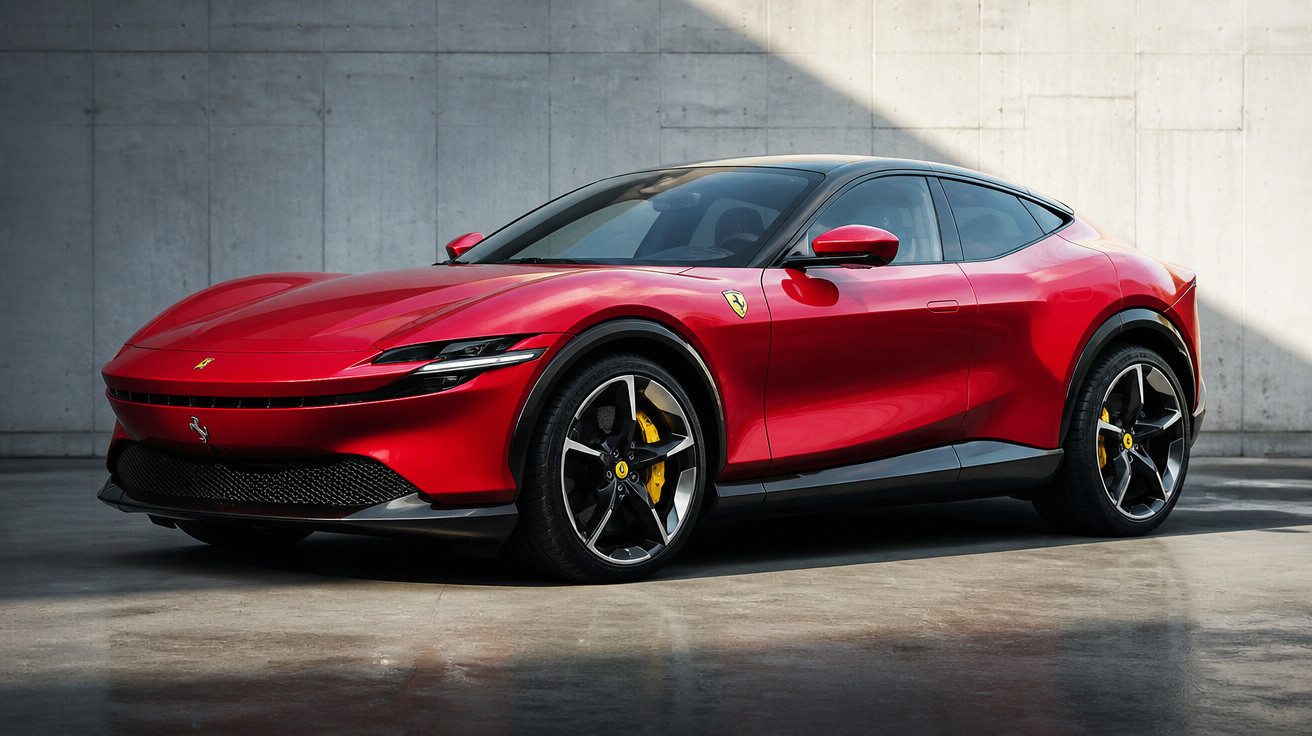
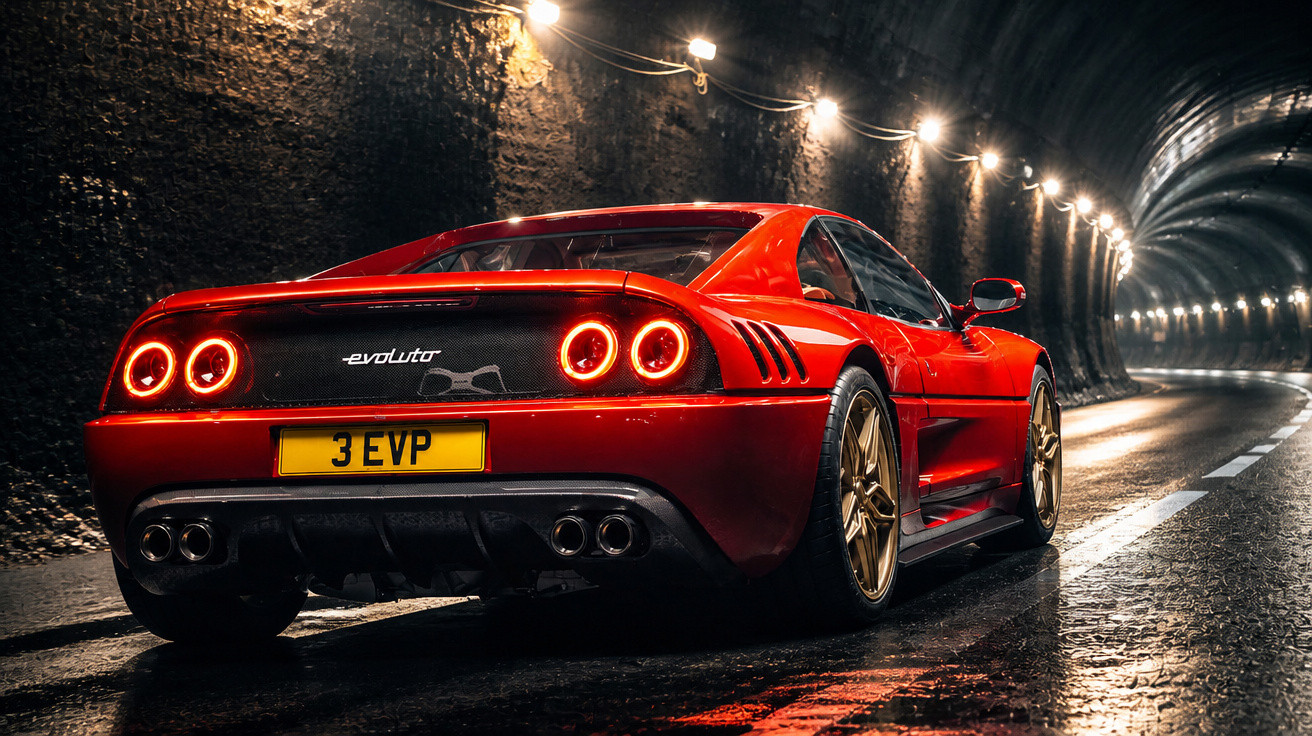
Image: render by Andrei Avarvarii for Top Gear
Just 45 seconds into our conversation, Ferrari CEO Benedetto Vigna asks what I most like about the new Luce. He holds my gaze with a titanium-plated intensity before breaking into a smile. So much for me being the person asking the questions…
There should be no mistake: this car is a venture into the unknown for the world’s most revered luxury car maker. Ferrari turns 80 in 2027 and, alongside producing some of history’s finest cars, it has spent those decades developing a client relationship that rivals can only envy. Customers are treated as family and, although the desire for Ferrari’s flagship models is limitless, it is demand that the firm manages with considerable skill.
Yet investors are uneasy about Ferrari’s move into electric power, while the market for premium EVs has yet to prove itself. If any company can change that, it should be Ferrari. We received the engineering briefing last October, while the internet has delivered its characteristically restrained reaction to this week’s interior unveiling. The latter has been shaped by Sir Jony Ive, Apple’s former chief design officer, and Marc Newson, his colleague in the LoveFrom design collective. They are selective about their collaborators, whose ranks include Airbnb, Apple, Moncler and, perhaps most intriguingly, Sam Altman’s Open AI. Ferrari has been on that list for the past five years.
Among the most significant product designers of the past half-century, Ive and Newson nevertheless joined a Ferrari design department already undertaking excellent, demanding work under the visionary Flavio Manzoni. Why, then, did Ferrari seek outside support for the styling of its first all-electric car?
Ferrari Luce and the LoveFrom collaboration
“You look around to see who has done a good job in terms of the user interface,” Vigna says. “I also worked with them at Apple. If you want to break the idea that electric means digital and too many screens, something that’s too difficult for the user, then work with the people who have the experience. This combination of analogue and digital is fundamental to the cars that we aim to do. John [Elkann] actually asked me about LoveFrom when we were talking about the Ferrari CEO position. We are talking about a new kind of car, a new kind of technology, so I think it’s good to work with them.”
Before Ferrari recruited him in 2021, Vigna was a prominent figure in technology and had spent part of his early career in California. He contributed to the development of a three-dimensional motion sensor, initially fitted in airbags before being adapted for the Nintendo Wii and the iPhone’s screen-rotation feature. He is an exceptionally intelligent, practical man with engineering embedded deeply in his outlook.
I mention that I travelled in a Waymo autonomous taxi the day before. “You did? I like to have a person driving, I don’t trust chips,” he replies sharply. Whether he is serious remains unclear. Discussing the Luce and the principles behind its development feels more straightforward, although it is fair to wonder how seamless the process was.
Left to right: Benedetto Vigna, John Elkann, Flavio Manzoni, Sir Jony Ive, Marc Newson
“We had meetings in which we explained the constraints, with a mechanical engineer, an aerodynamicist,” he replies. “There were some basic building blocks that had to be put in place, things we had to explain, the homologation criteria, for example. Then they came to us with ideas, and we were able to say, ‘this is OK, this is not OK'. There has been a bi-directional flow of information, with a continuous interaction between Maranello and the team in San Francisco.”
Bridging Maranello and San Francisco
Italian businesses are well known for operating differently from their American, British and Japanese counterparts. That alone is a valuable form of diversity. It can, however, create complications. “There are cultural differences,” Vigna confirms. “The beauty of working in hi-tech is that you deal with many cultures, and in a previous life I had 21 design centres around the world – in Turkey, Israel, the Czech Republic, India, Japan, Taiwan and China. You have all that culture, and each is talking in its own way.
“So I was able to act as an intermediary between here and Italy. It’s not just the language that is different. The time management is different. For me, it was no problem, but for an Italian who has never dealt with people in California it could be interesting, let’s say.
“I had to have a call early on to help them to integrate, but after that initial phase things went smoothly. I’ll give you an example: I might say ‘yes’ because I understood you, not ‘yes’ because I agree with you. We learned a lot about the materials used, but on a personal level we now have different people in the company that understand the culture. And that’s a big asset.”
Vigna is candid enough to acknowledge that working with LoveFrom has expanded his appreciation of design, both within Ferrari and more broadly. Ive and Newson tasked their team with creating a remarkable four-volume Ferrari brand book, charting the company’s past and its principal touchpoints. TopGear.com saw it during a visit to LoveFrom’s San Francisco headquarters; as might be expected, the work involved is extraordinary and extends far beyond standard mood boards.
“Personally, I wasn’t so immersed in design,” Vigna admits. “Do you know what design is if you’re in the technology world? It’s engineering. If you’re talking about a design centre, it means how to design a chip. You might not like this, but to me design was synonymous with styling. I got this completely wrong. Working on this collaboration, I got to appreciate the value of industrial design. Look, I’m a physicist. What I’ve learned is that design has the same depth to it as any other discipline.”
Do you know what design is if you’re in the technology world? It’s engineering
Ferrari’s electric future and ‘innovability’
On the uncertainty surrounding electrification, Vigna gives the impression of a ship’s captain whose route is set and who has no intention of altering course. Our discussion ranges across behavioural economist Daniel Kahneman’s work – his book Thinking, Fast and Slow is worth reading – before Vigna calls upon another celebrated name.
“Isaac Newton said that he could calculate the motion of heavenly bodies, but not the madness of people,” Vigna says. “We focus on what is under our control, and what we commit to. We believe that doing an electric car is important because we are a leading luxury company, and if we want to continue to be a leader we need to show that we are not afraid to embrace change.
“We are here to lead awareness, and to deliver unique emotion to our client. I also talk to them and you can see the pressure that is coming from their sons and daughters. We need to worry about the next generation, and act rather than just use words. Innovation and sustainability – what I call ‘innovability’ – is key. Also, if the client is happy, the investor is happy.”

Comments
No comments yet. Be the first to comment!
Leave a Comment