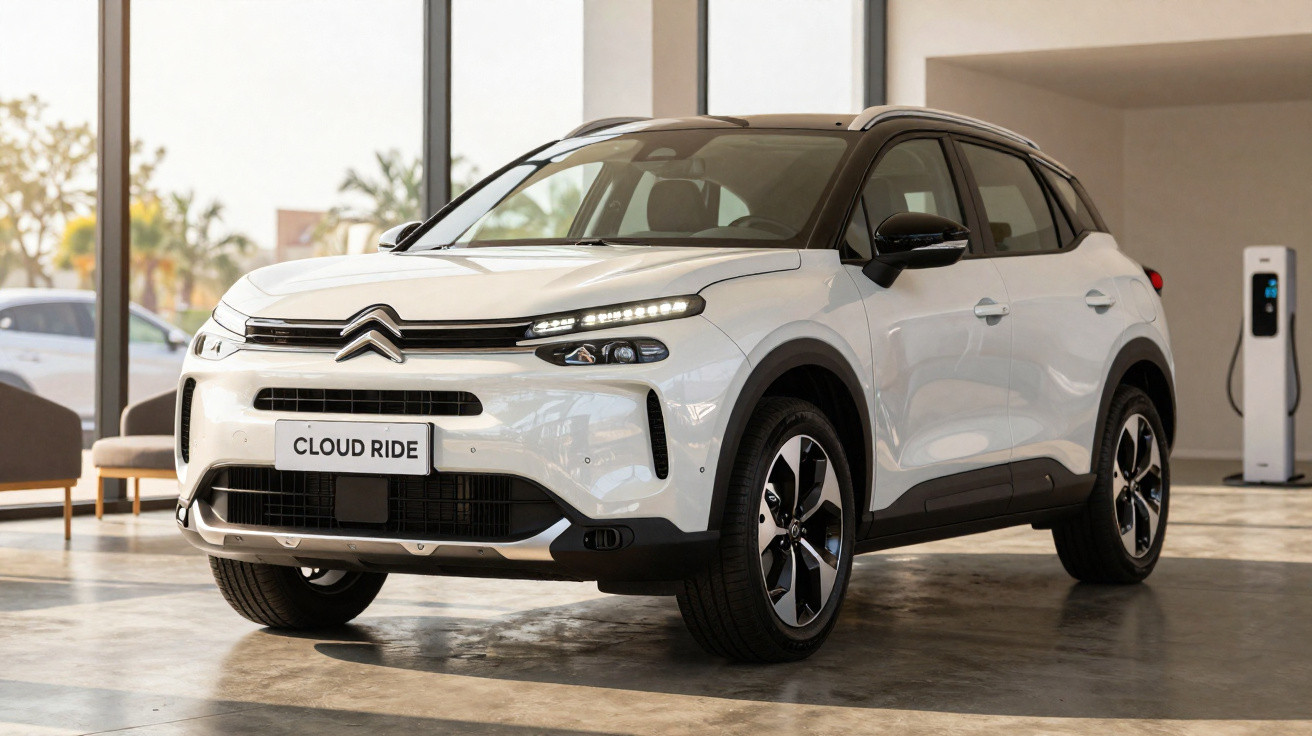
Citroën’s new C5 Aircross, particularly in electric Long Range form, makes no attempt to be the sportiest SUV available. It instead puts comfort, range and value first, while discreetly hoping you do not scrutinise a public rapid charger’s display too closely.
A steering wheel you could twirl with a pinky
The new C5 Aircross immediately stands out for its exceptionally light steering. Hardly any effort is required at the wheel: a delicate input is all it takes to guide the nose through a tight U-turn. The wheel is more conventionally sized and less miniature than that of its Peugeot relative, but it remains remarkably light in everyday use.
The steering is ultra-assisted: effortless in town, detached on a twisty back road.
This lightness suits the car’s overall character. The C5 Aircross is not intended for drivers who relish attacking bends. Its suspension prioritises suppleness over precision, something that becomes clear as soon as it encounters a speed hump or rough tarmac.
Suspension that turns bad roads into soft focus
Citroën applies its familiar “Advanced Comfort” philosophy here, with progressive hydraulic bump stops designed to soften impacts. Put simply, the suspension includes additional hydraulic cushions at the extremes of its travel, intended to absorb severe jolts before they enter the passenger compartment.
Around town, this produces a properly soft, floating ride across speed humps, tarmac joins and manhole covers. The dampers can still thump a little over sharp bumps at very low speeds, yet the overriding feeling is of a large SUV doing its utmost to isolate occupants from poor road surfaces.
The body moves around a fair bit in corners, but that’s the trade-off for this level of ride comfort.
There is a price for that softness: when driven harder, the C5 Aircross feels rather languid. It leans noticeably in corners and offers limited feedback about what the tyres are doing. That will be precisely the appeal for many buyers, especially those moving from older Citroën saloons. Enthusiastic drivers may feel differently.
At its best on the motorway
Point the C5 Aircross down a long dual carriageway or motorway and its purpose becomes much clearer. The electric Long Range model tested here is not notably rapid, taking just under nine seconds to reach 62 mph (100 km/h). That is sufficient for normal driving, although competitors with sharper acceleration will feel more energetic.
In return, the Citroën delivers effortless progress. Semi-autonomous driving comes as standard on the range-topping MAX trim: adaptive cruise control works alongside active lane-keeping, while the car can also make automatic motorway lane changes when the driver indicates.
Refinement is particularly strong. Despite the absence of laminated glass, wind and tyre noise are subdued, aided by the EV drivetrain’s lack of engine vibration. Even at 70 mph, the interior stays quiet and almost cocoon-like.
The C5 Aircross feels less like a high-riding SUV and more like a softly sprung long-distance train carriage.
Its integrated route planner manages electric range in a reasonably sophisticated manner, providing believable forecasts while accounting for motorway speeds. As a result, longer journeys can be planned without repeatedly checking the remaining-range display.
Big battery, mixed charging manners
Range that reassures
Built on Stellantis’ STLA Medium platform, the electric C5 Aircross in Long Range specification uses the same substantial 97 kWh battery pack as the new Peugeot 3008. Citroën claims a WLTP range of up to 680 km, equating to around 420 km of real-world motorway driving at consumption of approximately 23 kWh/100 km.
For readers in the UK and US, that works out at roughly 260 miles of fast-road range, sufficient for a London–Leeds or New York–Washington journey with a useful reserve. That kind of usable ability matters more than an eye-catching laboratory figure.
Charging that can frustrate
The 400V electrical architecture should, in theory, support DC rapid charging at up to 160 kW. During this test, however, the reality was more complicated. In one session, with roughly 40% charge remaining, the car stubbornly accepted about 50 kW despite the battery having been preconditioned. At a different charger with a similar state of charge, it sustained around 105 kW until 60%.
The charging curve felt inconsistent, sometimes decent, sometimes strangely flat, and never close to the promised 160 kW.
Such inconsistency adds some pressure to long-distance planning, particularly for drivers expecting brief stop-and-go charging breaks. Citroën could improve the software through future updates, but buyers should recognise that real-world charging rates may be unpredictable.
Charging at home is more reassuring. Using a wallbox, the C5 Aircross can accept up to 11 kW AC, a sensible provision for battery capacities of 73 or 97 kWh. With a dedicated domestic charger, an overnight recharge is achievable.
There is an oddity for drivers using off-peak electricity tariffs: charging can be programmed to begin at a chosen time, but not to end at one. The car then draws power steadily until it reaches either 80% or 100%. This is less adaptable than rival systems that offer detailed charging schedules.
Easygoing in town, with a few rough edges
Although it has grown compared with the previous generation, the new C5 Aircross remains reasonably easy to manage. At 4.65 m long and 1.90 m wide, it is not oversized by current SUV standards. Its tight turning circle helps, as does a sharp 360° camera system that clearly displays kerbs and bollards at low speed.
Outward visibility is less consistent. The bonnet extends a long way ahead and can feel daunting when edging into junctions, while the windscreen is comparatively narrow. A substantial C-pillar also restricts over-the-shoulder visibility, making it harder to reverse from angled parking bays.
The brake pedal requires some familiarisation too. Its initial movement is soft and spongy, which is not especially reassuring in stop-start traffic. Paddles behind the steering wheel provide three levels of regenerative braking, allowing more deceleration through the motor, but even the strongest setting does not enable genuine one-pedal driving.
Space, seats and that Citroën “sofa” feel
The cabin plays directly to Citroën’s traditional strengths. Space is generous in both rows, while the rear bench, now a single fixed unit rather than three separate sliding seats, has notably soft cushions and generously padded backrests with adjustable recline.
Rear passengers get a lounge-like feel, especially on longer journeys, with deep cushioning and plenty of legroom.
Losing the individual rear seats reduces the clever flexibility offered by the outgoing model, but everyday comfort has actually improved slightly. The small central tunnel means a middle occupant need not sit with their knees uncomfortably raised, although the middle backrest is firmer than the two outer seats.
Rear air vents are included, although passengers in the back cannot select their own climate temperature. The closely related Peugeot 3008, by contrast, is available with three-zone climate control.
Luggage capacity is ample. With the rear backrests in place, the C5 Aircross provides 651 litres of boot space. Folding the rear bench expands this to 1,668 litres, enough for several large cases, a pushchair and the inevitable assortment of bags that accompany family travel.
Design that dares to be different
Despite its focus on comfort, the C5 Aircross is still designed to make a visual statement. Its front lamps use a C-shaped light signature inspired by the facelifted Berlingo, now paired for the first time on a Citroën with Matrix LED technology. These headlights can mask portions of the beam to prevent dazzling approaching traffic, while retaining full main-beam illumination elsewhere.
Its profile features heavy plastic cladding for a mildly rugged appearance, while optional 20-inch wheels fill the arches more fully than is usual for the marque. At the rear, Y-shaped lights run into the C-pillars, creating a dramatic, near-concept-car appearance that is especially striking after dark.
Small coloured inserts on the bumpers and doors offer mild customisation, even though the overall colour palette is relatively muted for a Citroën.
Cabin tech up, perceived quality down
From the driver’s seat, the dashboard is far more contemporary than before. A broad, horizontal fascia is centred around a 13-inch portrait touchscreen, accompanied by a 10-inch digital instrument display and a head-up display.
The central screen is sensibly arranged, while climate functions remain constantly available through touch-sensitive shortcuts. This avoids having to work through menus simply to alter the fan speed, a welcome change when many competitors hide everyday controls behind several screen presses.
Perceived quality is where the C5 Aircross falls short. The upper dashboard is finished in hard plastic where softer materials might be expected. Front and rear door trims similarly make extensive use of rigid surfaces. Large sections of recycled fabric bring some warmth and visual interest, but cannot entirely disguise the cost-saving.
The interior design looks modern, yet some finishes feel more budget than the tech and price would suggest.
Gloss-black centre-console trim readily shows scratches and fingerprints, while the lacquered steering-wheel control pads do not feel particularly premium. None of these issues affect functionality, but they leave the C5 Aircross a step behind certain rivals for tactile quality.
Equipment and pricing: value as a weapon
Citroën presents the C5 Aircross as Stellantis’ more affordable family member. In France, pricing begins at €34,300 for the mild-hybrid petrol version and €39,490 for the electric model, placing it below equivalent Peugeot 3008 variants.
Equipment is generous even on the entry-level model, which includes adaptive cruise control, keyless start, the 13-inch touchscreen, dual-zone climate control and 18-inch alloy wheels.
Main trim levels at a glance
| Trim | Approx. starting price (France) | Key features |
|---|---|---|
| Base | From €34,300 (mild-hybrid) | Adaptive cruise, 13-inch screen, dual-zone climate, 18-inch wheels |
| Plus | From €37,240 | Rear camera, keyless entry, tinted rear windows, navigation, ambient lighting, rear air vents |
| Max | From €40,180 | Matrix LED lights, powered tailgate, 360° camera, head-up display, electric driver’s seat, heated steering wheel |
The electric Long Range battery fitted to the test car is not yet available in the Citroën. At present, ACC’s large 97 kWh packs are being prioritised for the Peugeot e-3008 and DS 8. Given the current differences in pricing, a C5 Aircross MAX with the long-range battery and full equipment could be priced high enough to lose eligibility for certain national EV incentives in countries such as France.
Who this “cloud on wheels” really suits
The new C5 Aircross is best suited to drivers who place more value on comfort, room and range than on crisp handling. That includes families covering long motorway distances, commuters whose daily routes include poor surfaces, and retirees replacing a large saloon with something higher and easier to enter.
- Drivers who tow regularly or expect sporty responses may be disappointed by the soft suspension and restrained performance.
- Those mainly driving in towns and suburbs will probably appreciate the plush setup, quiet interior and exceptionally light steering.
- For frequent long-distance trips, the large battery and relaxed motorway character are persuasive benefits.
Prospective owners should also understand two EV terms frequently associated with this model. WLTP range is a Europe-wide laboratory measurement that can be optimistic during fast motorway driving. This explains why the quoted 680 km becomes approximately 420 km at realistic cruising speeds. DC rapid-charging power is another consideration: the peak kW figure is only part of the picture, as it matters equally how long the car can sustain high power along its charging curve.
In a typical example, a well-behaved charging curve sustaining, say, 130 kW could allow a 10–80% recharge in around 30–35 minutes for a battery this large. If the car instead spends much of that session at 50–80 kW, the stop can easily extend to nearly an hour. For families travelling with young children in the rear, that difference has a meaningful effect on the practicality of an electric road trip.
The C5 Aircross addresses some of these concerns with comfort, space and strong real-world range, reducing the number of charging stops required. For motorists happy to accept its laid-back nature and an interior that feels more straightforward than upmarket, this softly sprung SUV could discreetly rank among Stellantis’ most rational purchases.



Comments
No comments yet. Be the first to comment!
Leave a Comment