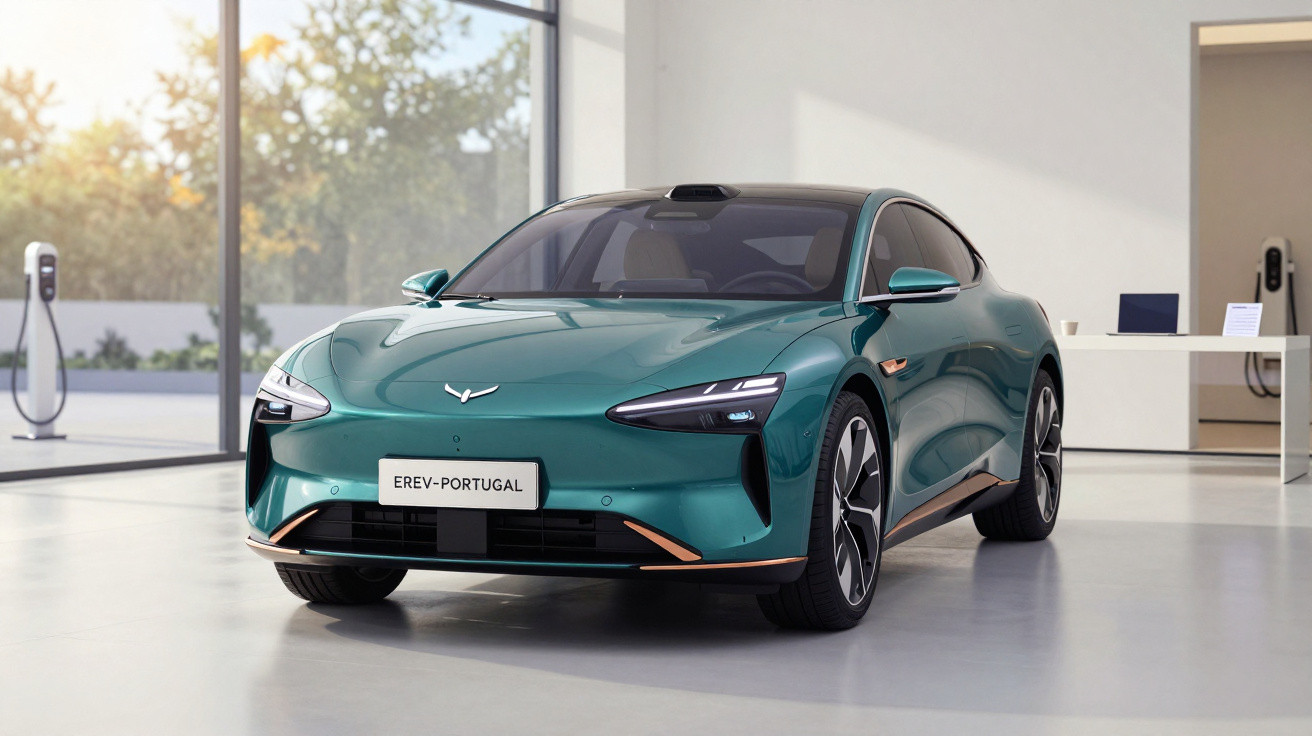
Electric vehicles with range extenders are becoming increasingly prominent, driven above all by Chinese manufacturers. Having already established themselves in their home market, several of these models are now beginning to arrive in Europe, where they are positioned as an alternative to conventional electric cars and plug-in hybrids.
What are EREVs, or electric cars with range extenders?
Known as EREVs (Extended Range Electric Vehicles), these cars can be charged from a socket or charging point and are always propelled by one or more electric motors. Their combustion engine has no connection to the wheels; it operates solely as a generator when the battery charge starts to run low, allowing longer journeys without having to stop and recharge.
At first glance, they appear to be genuine electric cars. That is exactly where the question arises: if the electric motor alone drives the car, are EREVs also exempt from IUC and ISV in Portugal?
EREVs and IUC exemption in Portugal
The answer is not determined solely by how power reaches the wheels. Although they are invariably driven by one or more electric motors, the presence of a combustion engine changes their tax treatment under Portuguese rules, even when it is used exclusively as a generator.
As a result, while fully electric cars are exempt from paying IUC in Portugal, EREVs do not qualify for the same arrangement. For tax purposes, they are generally treated in a similar way to plug-in hybrids.
How is IUC calculated for EREVs?
For EREVs registered as category B passenger cars, IUC is worked out under the same rules that apply to other combustion-engine cars first registered from July 2007 onwards.
The calculation is based on two factors: the engine capacity of the combustion unit and its approved carbon dioxide (CO₂) emissions. The higher these figures are, the greater the IUC charge will be. The resulting amount is then multiplied by a coefficient set according to the year of first registration.
In practical terms, many EREVs pay less IUC than a comparable car powered solely by a combustion engine, owing to their lower approved emissions and, in some cases, the smaller capacity of the combustion engine.
There is, however, no single amount that applies to every EREV. The tax always depends on each car’s approved specifications and first-registration date.
What about other tax benefits?
Although they are not exempt from IUC, EREVs may be eligible for the tax regime applied to plug-in hybrids. Once again, this depends entirely on the approved characteristics of each model.
For ISV, plug-in hybrids qualify for an intermediate rate equivalent to 25% of the tax when they have a minimum electric range of 50 km and official CO₂ emissions below 50 g/km.
From 2026, models approved under the Euro 6e-bis standard may retain this ISV reduction with emissions of up to 80 g/km of CO₂, provided they still offer at least 50 km of electric range.
For businesses, the reduced autonomous taxation rates still require a minimum electric range of 50 km and official CO₂ emissions below 50 g/km.
Therefore, an EREV, or electric vehicle with a range extender, is not exempt from IUC. Nor is it automatically entitled to the remaining tax benefits. The applicable regime is determined by the vehicle classification, electric range, approved emissions and approval standard.







Comments
No comments yet. Be the first to comment!
Leave a Comment