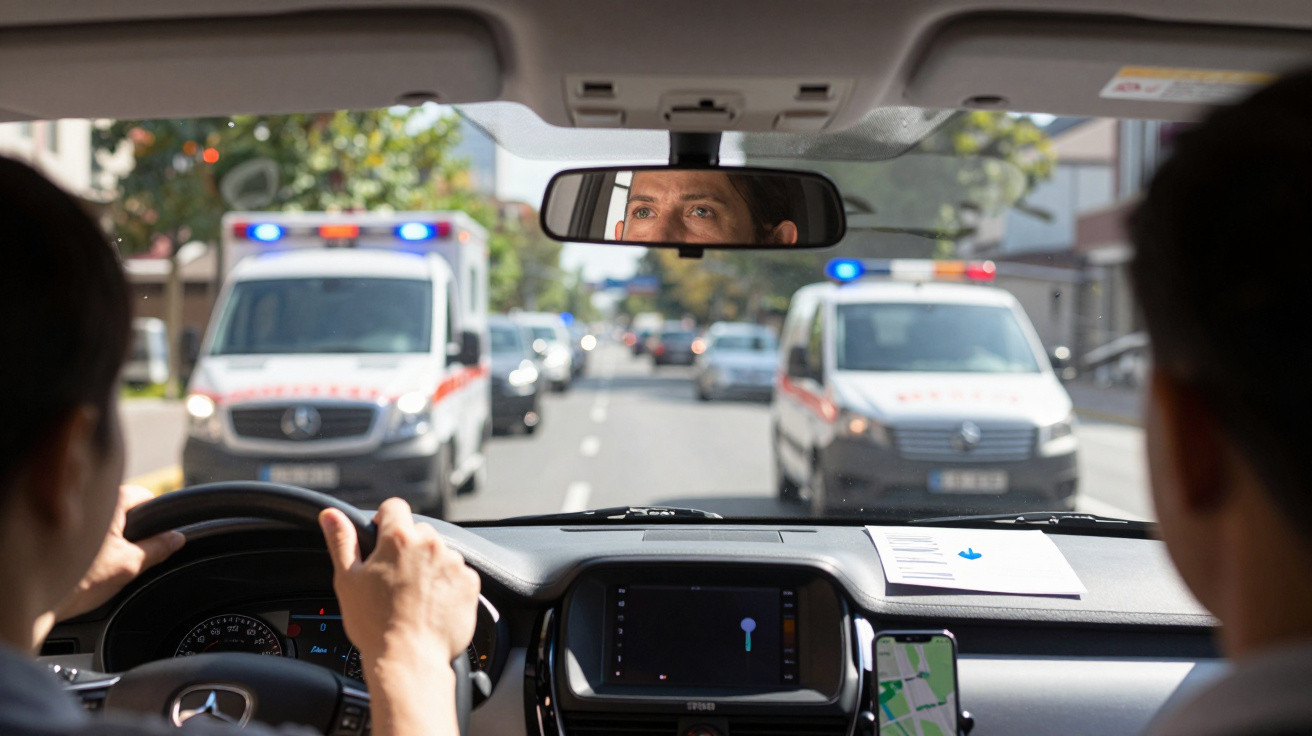
Blue flashing lights on German roads often cause chaos: some drivers brake sharply, while others attempt reckless manoeuvres – and both reactions can be wrong.
Anyone who drives will recognise the situation: a vehicle displaying blue lights suddenly appears in the rear-view mirror, its siren is wailing and other road users seem to be growing anxious. Some drivers panic and mount the pavement, while others rush through the junction before it is too late. Yet not every vehicle using blue warning lights is permitted to disregard every rule of the German road traffic regulations – and you are not always required to move aside abruptly either.
Blue lights do not automatically mean special rights: the basic rule
Many people instinctively assume that blue lights and a siren mean the vehicle has unrestricted special rights. Legally, however, this is not quite correct. Road traffic law draws a clear distinction between vehicles with genuine special rights and priority rights, and those granted only certain traffic exemptions.
The first category includes the familiar emergency vehicles that immediately come to mind:
- police
- fire and rescue services
- ambulance services / emergency doctors responding to an acute incident
- civil protection services and certain military or customs vehicles during an emergency
When responding to an urgent incident with blue lights and an emergency siren, these vehicles may depart from traffic rules under strict conditions – for example, by passing a red light or exceeding the speed limit – provided they do not seriously endanger others.
“Many vehicles with blue lights have only limited traffic exemptions – not genuine priority at any cost.”
There is also a second category: vehicles travelling in the public interest which, despite displaying blue lights, do not have complete priority. They may make their journey somewhat easier, but must generally still comply with traffic lights and priority rules.
Vehicles with blue lights that do not have absolute priority
A surprisingly large number of vehicles fall into this grey area: they display blue lights but do not have full special rights. Other road users often overestimate their status or mistake them for fire and rescue vehicles.
Common everyday examples
- private patient transport ambulances that are not attending a direct emergency
- medical journeys transporting blood or organs in less critical circumstances
- cash and valuables transport vehicles operated by certain institutions
- vehicles used by on-call doctors
- utility company vehicles responding to electricity or gas faults
- safety vehicles operated by rail or local public transport providers
- winter service vehicles, including snowploughs and gritting lorries
- motorway and road maintenance service vehicles
- certain military or oversized special transports travelling with an escort
All of these may, in certain circumstances, use blue lights and often a multi-tone siren. Nevertheless, the same core traffic-light and priority rules apply to them as to any ordinary car. They may weave through slow-moving traffic, but they are not licensed simply to ignore red lights.
The key point is this: genuine special rights may apply in individual situations only where there is a truly urgent incident and the correct signals are activated – namely blue lights together with the siren. In everyday circumstances, many vehicles using blue lights operate in an intermediate area where consideration and co-operation are needed, without motorists having to take substantial risks.
How should you react when blue lights appear in your mirror?
The situation can be confusing for drivers. Nobody wants to obstruct an ambulance, but serious penalties may also follow if you blindly drive through a red light or brake suddenly. A few basic principles can help you keep a clear head when it matters.
When a vehicle with full emergency rights approaches
Where blue lights and an emergency siren clearly indicate an urgent response, you must act in a way that allows the emergency vehicle to pass as quickly and safely as possible, without placing yourself or anyone else in danger.
- Ease off the speed gradually rather than braking abruptly.
- Move towards the right where possible to create space.
- In roadworks, look for gaps early.
- On motorways, create or keep clear an emergency corridor.
At red traffic lights, pass the stop line only when it is clearly safe, no one will be endangered and the traffic conditions allow it. Anyone who edges blindly into a junction without a clear view risks carrying the main responsibility in an accident – even if a vehicle using blue lights is pressuring them from behind.
When a vehicle with blue lights has only limited exemptions
The legal position is different for vehicles without full special rights. You are not legally required to make way at any cost.
| Scenario | What drivers should do |
|---|---|
| Blue lights and siren in heavy urban traffic | Remain calm, move gradually towards the right and avoid reckless manoeuvres |
| You are waiting at a red light with a blue-light vehicle behind you | Stay in your lane and move forward only if cross traffic can be assessed clearly |
| On a rural road, blue lights approach from behind | Reduce speed slightly and use a suitable place to pull over or stop briefly |
“Nobody expects you to drive through a red light or make a risky move onto the pavement for every vehicle with blue lights.”
The law expects consideration, not behaviour that puts you at risk. Deliberately blocking a vehicle can still lead to trouble, for example for coercion or obstruction. By contrast, anyone who acts sensibly and defensively remains on relatively secure legal ground.
Why emergency sirens often sound so similar
There is a practical everyday difficulty: the sound alone does not always make it clear whether a vehicle is travelling with full special rights or merely using exemptions. Many systems use two- or three-tone signals that are difficult for non-specialists to tell apart.
Vehicle types also overlap. An ambulance may be operating as straightforward patient transport or as an emergency ambulance attending an acute incident. The former often has only limited rights, while the latter has genuine special rights. To other drivers, the vehicle can look identical from the outside.
The safest approach is therefore to pay attention to the signals, react defensively and avoid becoming flustered. Drivers who anticipate the situation can make space quickly without exposing themselves to legal or physical danger.
Legal risks for motorists – and blue-light drivers
If you clearly refuse to allow an emergency vehicle with full special rights to pass, serious consequences may follow: a fine, penalty points and, where damage occurs, potentially criminal allegations. The cost can be even greater if people are harmed because the vehicle was blocked.
Drivers of blue-light vehicles also have responsibilities. Anyone who wrongly claims special rights, uses signals improperly or ignores red lights in circumstances where only limited exemptions apply will often bear considerable liability following an accident. Well-known court decisions show that blue lights are not a free pass.
For ordinary road users, this means they may rely on emergency drivers to carry responsibility too. No one has to take risky action merely because a vehicle with a siren is pressing them from behind. Their own safety and that of other road users remain the first priority.
Practical everyday tips for dealing with blue lights
If you feel uncertain, a few straightforward habits can make every encounter with blue lights less stressful:
- Check your mirrors regularly so that vehicles using blue lights are spotted early.
- In a traffic queue, plan an emergency corridor before emergency vehicles arrive.
- Do not set the radio or music so loudly that sirens are completely drowned out.
- Stay alert at junctions even when your own light is green, as an emergency vehicle may be crossing.
It is also helpful to briefly explain what is happening to children and passengers when an emergency vehicle approaches from behind. Panicked remarks inside the car are distracting and needlessly raise stress levels.
Those who drive extensively for work – such as couriers, taxi drivers or delivery drivers – benefit from knowing the difference between genuine special rights and simple traffic exemptions. A clear assessment of the situation helps drivers respond confidently: consideration, yes; putting yourself at risk, no.




Comments
No comments yet. Be the first to comment!
Leave a Comment