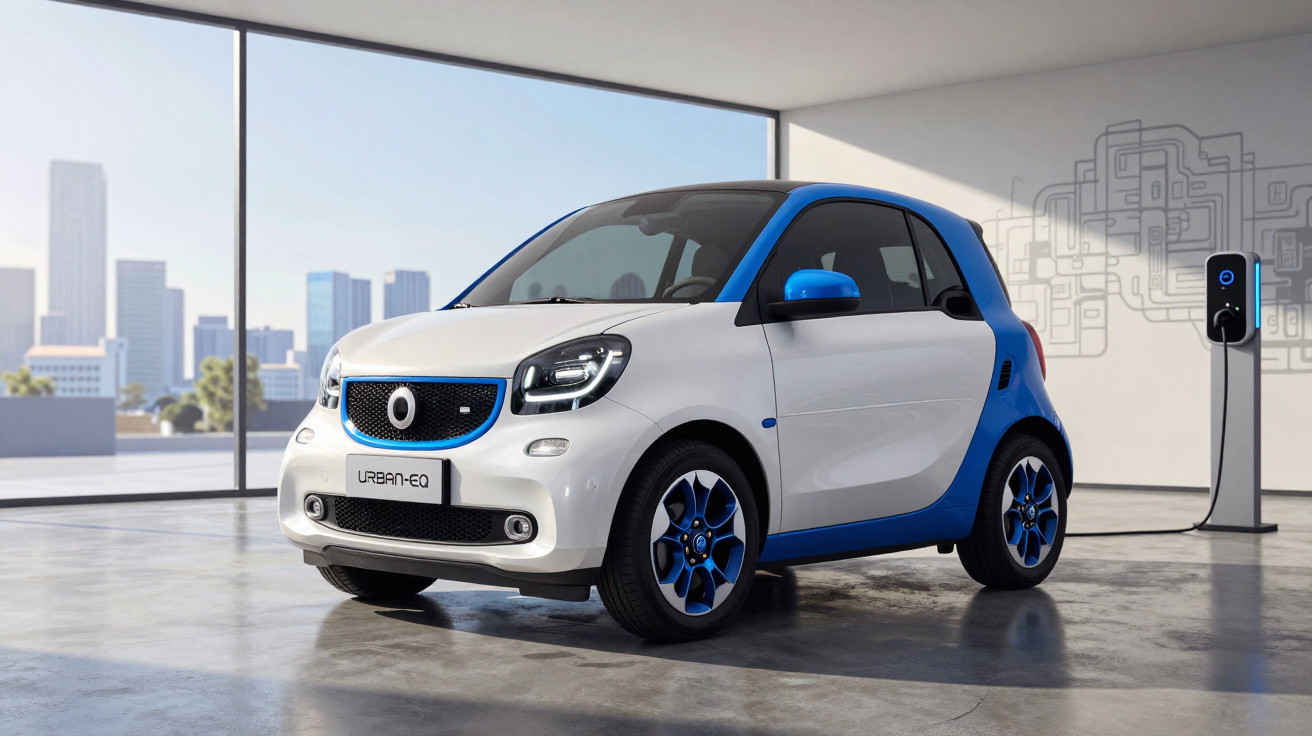
There is nowhere an electric car is more effective than in the city, and there is no better urban car than a small one. That combination makes the Smart EQ fortwo an obvious option for anyone seeking an electric city car. But is it really that straightforward?
Before addressing that question, it is worth putting Smart’s current position into context. Since the start of 2020, the brand has only built and sold electric cars, following the Chinese company Geely - owner of Volvo and Lotus - taking a 50% stake in the business and securing production of the next generation of the little city car in China.
The first “child” of this “marriage” will be an SUV, due to arrive in 2022. Once revealed, it will become the largest model in the brand’s history and will use Geely’s new dedicated electric-car platform, SEA (Sustainable Experience Architecture).
According to Autocar, this SUV will be similar in size to the MINI Countryman. Mercedes-Benz will handle the design, while Geely will take charge of development and manufacturing.
But back to the question that opened this test: no, it is not quite so simple, and I hope to explain why over the next few paragraphs…
Let’s talk about range…
The Smart EQ fortwo is powered by an 82 hp electric motor supplied by a 17.6 kWh lithium-ion battery, which delivers a “modest” 133 km of WLTP range.
How quickly the battery charge disappears naturally depends on the pace of driving, but during this test I recorded an average consumption of under 15 kWh/100 km. Given that I drove in what could be described as a “normal” manner throughout, that is a respectable figure.
My only recurring concern involved the ECO button, which I made sure to press every time I got into the car. This mode limits power output - although it is overridden by fully depressing the accelerator - and manages the air conditioning to improve system efficiency.
Add the ability to recover some of the energy produced while braking and decelerating to recharge the battery, and it becomes clear that around 120 km of real-world range is achievable.
Let’s address the “elephant in the room” - or in this text: range. Is it short? Yes. Is it enough for city use? Yes. That does not mean living with a Smart EQ fortwo in an urban setting requires no effort. Actually, not effort: planning.
If you organise your weekly routine, however, it is very easy to live with a Smart EQ fortwo in the so-called urban jungle, provided there is somewhere to charge it, whether at home, at work or nearby. Then again, that applies to this electric car and virtually all of its rivals.
Agile and eager
Having dealt with the Smart EQ fortwo’s “Achilles’ heel”, it is time to return to why this model is so easy to live with in the city.
Its ability to turn on its own axis within a turning-circle diameter of under nine metres is remarkable, and something no other car currently on sale can match.
That makes turning around on the city’s typically narrow streets a “piece of cake”, as is parking. In this respect, though, the Smart fortwo has stood out ever since its original launch in 1998.
Ride comfort is better than it has ever been and, combined with the silence of electric propulsion, creates a calm driving environment I was never able to experience in a combustion-engined Smart.
And I have not yet mentioned this little electric car’s “launch”, which can put even some sports cars in their place over the first few metres: it reaches 60 km/h from rest in 4.8s. Its 0-100 km/h time? Nobody cares about that… (11.6s).
Taken as a whole, the Smart EQ fortwo is not only convincing in town, but can even be entertaining to drive, largely thanks to the punch it delivers when pulling away from traffic lights. Outside the city, though, this compact city car begins to lose its appeal, at least for me.
Beyond the urban jungle: from lion to prey…
While the Smart EQ fortwo takes a leading role in the urban jungle, proving more effective, quicker and nimbler than everything else, it rapidly changes from predator to prey once outside it.
On open roads, despite its improved stability - helped by the batteries being positioned beneath the passenger compartment - the stability control still intervenes at the slightest provocation, and the front axle frequently struggles for traction.
Its 130 km/h top speed permits motorway trips, but this is where every weakness of the Smart becomes apparent, starting with the range, which drops sharply in these conditions.
How long does charging take?
As one of the electric cars with one of the smallest batteries on the market, at 17.6 kWh, it benefits from short charging times.
Fitted as standard with a 4.6 kW onboard charger, the Smart takes six hours from a domestic socket to fully replenish the battery - plug it in overnight and unplug it in the morning, like a smartphone… - while a wallbox cuts this to just 3.5 hours.
For an additional €995, however, buyers can choose a 22 kW onboard charger, speeding up the process and allowing the battery to go from 10% to 80% capacity in only 40 minutes.
What about space?
The Smart EQ fortwo has only two seats, yet they can comfortably accommodate two adults taller than 1.80 m without their elbows or shoulders touching, as often happened in the model’s first two generations.
In that regard, life with a Smart EQ fortwo will never be an issue, even if the boot provides limited room, at only 260 litres. But that is the price of owning such a compact car, along with all the benefits that brings.
Is the Smart EQ fortwo the right car for you?
Are you looking for an electric city car that will be used almost exclusively in town, and do you cover few kilometres each day? If so, the Smart EQ fortwo deserves a place on your “watch list”.
It is very pleasant to use, compact and exceptionally easy to drive. In the city, it is always like a “fish in water”. Its agility is striking, enhanced by the electric powertrain, which lets it reach 60 km/h in only 4.8s.
Do not expect an engaging driving experience or a model that can corner at very high speeds; it was not designed for that. It does, however, provide an extremely relaxed drive - provided the road surface is in good condition, as the suspension setup remains somewhat firm - and that matters much more than dynamic ability when driving in town.
It is true that range can quickly become a problem: all it takes is an unforeseen situation requiring you to drive a little faster or travel a little farther. Yet the Smart EQ fortwo aims to be king of the city, and there are few alternatives that can equal it there.
There is still the price to consider: the Smart EQ fortwo starts at €22,845, automatically making it something of an indulgence, since its French “cousin”, the Renault Twingo Electric we tested recently, offers two additional seats and more range (190 km) for almost the same money (from €23,200).





Comments
No comments yet. Be the first to comment!
Leave a Comment