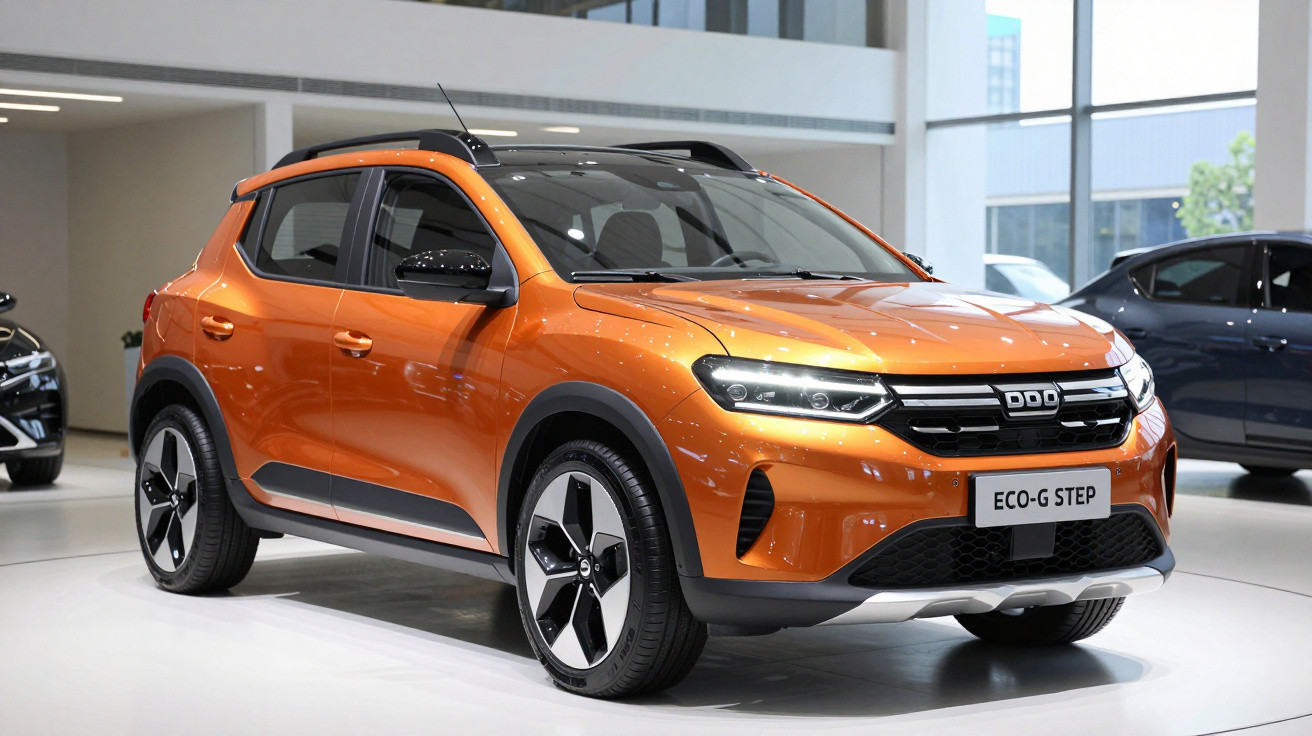
The new Dacia Sandero’s price is one of its strongest selling points, but the used market can tell a very different story.
From budget proposition to European market leader, the third-generation Dacia Sandero, introduced in 2021, marked a considerable step forward over its predecessors. It emerged as a far more mature and rounded product, moving beyond its low-cost label.
It gained a modern platform, more room, improved road manners and an interior presentation that no longer makes price the sole justification for choosing it.
The outcome? Undeniable success. It was Europe’s best-selling car in 2024 and also reached the top spot in Portugal that year. It led private-car sales too, with limited exposure to fleet and rent-a-car business.
The low-price argument remained, as it had with earlier generations, but it is worth noting that most buyers opted for the more adventurous-looking - and more expensive - Sandero Stepway. For this buying guide, we have focused on the bi-fuel petrol/LPG engine, which promises lower fuel bills.
Indeed, the 1.0 TCe ECO-G is the Sandero that best delivers the Dacia formula: it is inexpensive to run, provides a very long range and does not demand major compromises in performance.
On Pisca Pisca, examples of this generation can be found at prices close to €13,000, while newer, better-equipped cars can approach €19,000. There is plenty of choice, but that does not mean every Sandero represents good value.
It no longer feels like a cheap car
The biggest transformation in this generation lies beneath the bodywork. The Sandero moved to the CMF-B platform shared with the Renault Clio, albeit in a simpler and more economical specification.
That is immediately apparent from behind the wheel. It feels more substantial, comfortable and predictable than its predecessor, while its driving position is more natural. It remains a car designed with cost in mind, but it no longer gives the impression of being an outdated product.
In 2022, Dacia introduced its new visual identity, including the DC emblem and a redesigned grille. These changes are mainly cosmetic, so there is no strong technical reason to pay extra for a later example.
New driver-assistance systems arrived in 2024 to comply with European regulations. They include lane-keeping assistance, speed-limit recognition and driver-attention monitoring.
This year, the Dacia Sandero received a more substantial update, bringing several powertrain changes in particular, including a new ECO-G with a 1.2-litre, 120 hp engine. It has already arrived in Portugal and can be explored in greater detail in the article below:
Simple exterior, more desirable Stepway
The standard Sandero is understated and can easily go unnoticed. The Stepway adds body cladding, increased ground clearance and modular roof bars, turning it into a sort of small crossover.
It does not dramatically improve its usefulness, but it is more appealing and enjoys stronger demand in the Portuguese market. It should also be easier to sell on, provided you do not pay an excessive premium.
Before buying, look for mismatched paint shades, uneven panel gaps and evidence of hard use. Even where mileage is lower, the car’s overall condition should carry more weight.
On a Stepway, check that the roof bars operate correctly. They can be rotated for use as crossbars, though their mountings can be damaged through poor handling.
The paint is not especially durable either. Minor scratches, stone chips and wear around contact points are relatively common.
Spacious Dacia Sandero cabin, few luxuries
Inside, there is no attempt to conceal its budget origins. The plastics are hard and sound insulation is merely adequate, although build quality is generally solid.
Comfort and Expression versions use fabric across the dashboard and door panels, making the cabin more welcoming. They also include the equipment that genuinely matters, such as air conditioning, an infotainment system and smartphone integration.
Space is one of the Sandero’s strongest arguments. Four adults can fit without difficulty, while the boot is sufficiently large for family use. The LPG tank is housed where the spare wheel would normally sit, so it does not take away usable capacity.
With mileage, unwanted noises may develop around the dashboard, doors or boot area. These are not normally serious, but test the car over cobbles or a poor-quality road.
Also check the central screen, Bluetooth, and Apple CarPlay or Android Auto. Freezing screens and connection failures can occur, although they are usually resolved with an update or reset.
LPG is where this Sandero makes most sense
At least until 2025, the third-generation Dacia Sandero range was limited to a 999 cm³ three-cylinder engine. The entry-level SCe was naturally aspirated and produced just 65 hp, but the more popular choice was the turbocharged 1.0 TCe. The LPG version develops around 100 hp and 170 Nm, while the petrol model has 90 hp. A more powerful 110 hp version arrived later.
The LPG Sandero is available exclusively with a six-speed manual gearbox. Its shift action is not particularly quick or precise, but sixth gear helps reduce engine revs on the motorway.
Performance is adequate, although do not expect much enthusiasm, especially with a full load aboard. That said, the engine responds well in town and on the open road. In LPG form, it even feels more willing than the petrol version.
Comfort is among its best attributes. The suspension copes well with poor surfaces and the handling is predictable, although the Stepway exhibits more body roll. Steering is light and does not provide much feedback, but the Sandero is always easy to drive.
Its limitations become more noticeable on the motorway. Wind and tyre noise enter the cabin, while the engine becomes audible when it has to work at higher revs.
Does it really save money?
Yes, as long as you have easy access to LPG filling stations. Spritmonitor, which records real-world owner fuel consumption, shows an average of 7.36 l/100 km. That is around 1.2 litres more than the petrol figure, but LPG’s considerably lower price substantially reduces the cost per kilometre.
There is an important detail, however: the car always starts on petrol before switching to LPG. It is therefore wise not to keep the petrol tank permanently near empty.
Is the Dacia Sandero ECO-G reliable?
Overall, yes. No serious or widespread internal issues are known with the 1.0 TCe ECO-G, and its timing chain removes the need for regular timing-belt replacement.
However, the LPG system adds components and potential failure points. There have been reports of switching difficulties, inaccurate fuel-level readings, uneven running, injection warnings and unexpected changes back to petrol operation.
This does not mean that injectors, the reducer or sensors fail on every Sandero. It simply means the system should be tested carefully.
Start the car from cold and wait for it to switch automatically to LPG. The changeover should be smooth, without hesitation or dashboard warnings. Then switch manually between petrol and LPG, accelerating progressively through several gears.
If you notice misfiring, power loss or uneven running, do not accept the explanation that “they all do that”. It could be caused by a spark plug, ignition coil, sensor, injector or an issue with gas pressure.
Check the annual servicing too and look for invoices relating to work on the LPG system. A service consisting only of oil and filter changes does not reveal the full picture.
How much should you pay?
There is a certain irony to used Dacia Sandero pricing. Demand is high and depreciation is low, resulting in higher values than expected. It is even possible to find used Sanderos priced above equivalent new ones. That is good news for sellers, but not for buyers.
If you are looking for one, compare its price with that of a new Sandero, particularly with more recent 2024 and 2025 cars. The difference may be too small - or non-existent - to justify buying second-hand.
For example, Pisca Pisca and Motor CV analysis puts the average value of a 2025 example at €18,300. That is more than the €17,650 asked for a new Dacia Sandero Stepway Expression ECO-G 120, already fitted with the new 1.2-litre, 120 hp engine. At that point, the used purchase may no longer make sense.
The chart below offers a clearer view of how prices have developed. Even so, do not focus solely on the year: trim level, Stepway specification, mileage and history can all have a major effect on value.
For a 2021 or 2022 car, a price between €13,000 and €15,000 seems reasonable, provided it has a complete history, shows no signs of intensive use and its LPG system works faultlessly.
What might repairs cost?
Routine maintenance is straightforward and relatively inexpensive. A service including oil and filters should cost between €170 and €250 at an independent garage, and roughly €250 to €350 through the official network.
Front discs and pads may cost €200 to €300 outside the dealer network, or between €320 and €450 at a dealership. A complete clutch can be around €600 to €850 at an independent garage and close to €1,000 through the official network.
For the LPG system, a simple fault involving a sensor, connection or solenoid valve may cost between €100 and €250. Replacing injectors or regulator components could cost €300 to €600 at a specialist garage, and more through the manufacturer.
Do not replace parts without a specific diagnosis. A faulty spark plug or ignition coil can create symptoms similar to those of an LPG injector fault.
What about recalls?
Early examples were involved in campaigns concerning the bonnet latch and a potential fuel-system leak. Not every Sandero was affected, and one of the campaigns was linked to a specific engine.
Consult the PiscaPisca/Motor CV report for details of the recall campaigns and ask Dacia, using the chassis number, whether any work remains outstanding.
You can also access the Recall platform, enter the registration number or VIN, and verify whether the example you are considering has completed every required campaign.
Our choice
We would choose an older Dacia Sandero Stepway ECO-G Comfort or a newer Stepway Expression.
The Stepway is not objectively much better than the standard Sandero, but it has a more appealing appearance, greater ground clearance and useful roof bars. It is also the most sought-after version, which should make it easier to sell on.
Comfort or Expression trim includes the everyday essentials: air conditioning, an infotainment system, smartphone integration and parking sensors. Essential specification only makes sense if it costs clearly less. It is too sparsely equipped, and that initial saving may feel less convincing after a few months.
That said, we would not rule out a standard Sandero Expression. If it costs €1,500 or €2,000 less than an equivalent Stepway, it is probably the smarter purchase.
Alternatives
If you want a contemporary LPG alternative, the Renault Clio, which shares the same mechanicals as the Sandero, is the only option. It offers better interior quality, sound insulation and handling, but the selection of LPG cars is not as broad.
The SEAT Ibiza 1.0 TSI offers as much, or more, space, is more enjoyable to drive and has a more polished cabin. However, because it is petrol-only, it cannot match the Sandero ECO-G’s cost per kilometre.
There are other, older used-market alternatives originally equipped with LPG. Discover them here:


Comments
No comments yet. Be the first to comment!
Leave a Comment