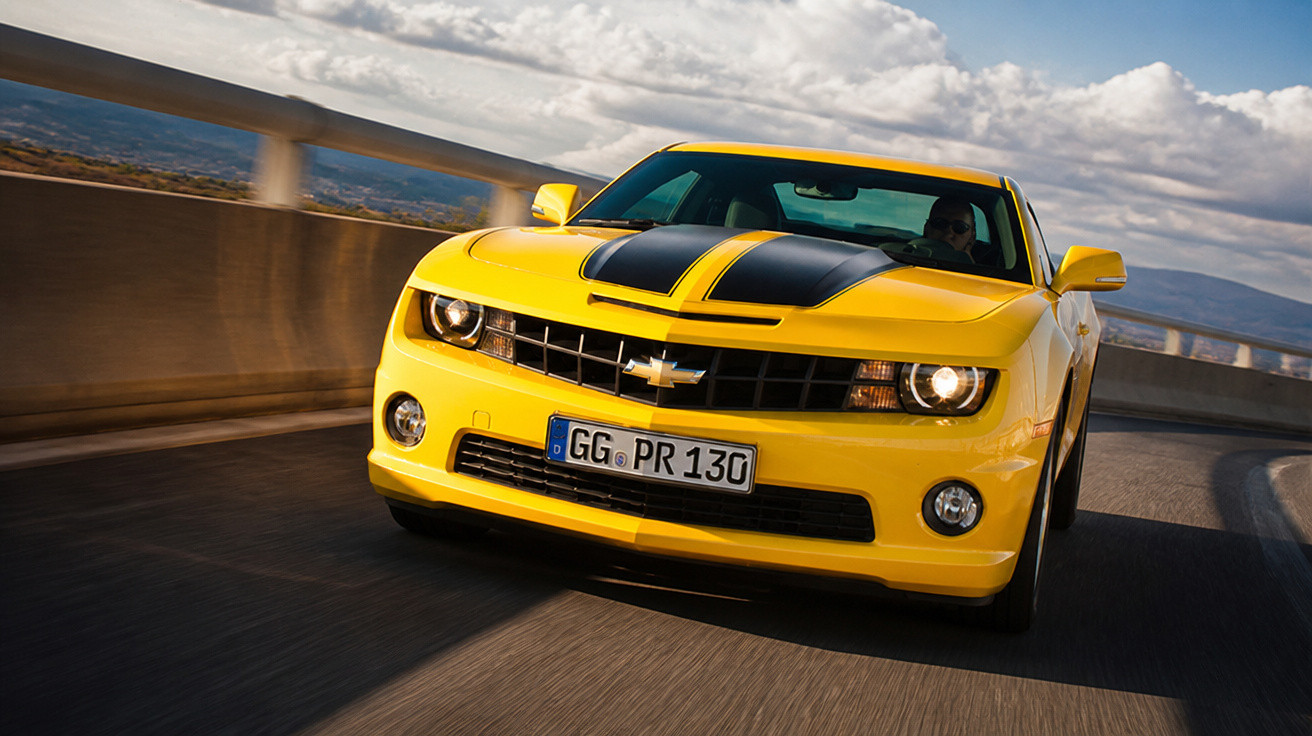
This is unmistakably a muscle car. Its sides have the bulk of Geoff Capes, its grille is loud and oversized, its wheels demand sunglasses, and the steering wheel sits on the wrong side. Yet one ingredient is absent: something antiquated, something springy, something rather hopeless – a leaf-sprung, live-axle rear end.
Beneath the 2011 Euro-spec Chevy Camaro sits a 4.5-link independent rear suspension, just as you would expect from a proper car. That is standard equipment on the US-spec version, of course. What may be less familiar is that the Euro model receives its own extremely stiff dampers, along with anti-roll bars that have been both relocated and reshaped.
Euro-spec Chevy Camaro handling
As a result, it manages something previously unthinkable for an American muscle car: it corners. It actually CORNERS! Its previous pig-in-muck enthusiasm for body roll has been eliminated and, despite being developed at James' least favourite holiday destination – the Nürburgring – it covers open roads with the composure of a GT.
That improvement carries a sizeable, intimidating cost. In America, the old saying that anyone with a job – any job – can afford a Camaro remains broadly accurate. Prices there begin at £15,000, although that buys the wheezy V6. In Britain, the hard-top costs just £5 short of £35,000, while the convertible is £39,995. Zoinks.
Our European versions, offered as both a coupé and a convertible, are closer in specification to the £22,540 USDM 2SS. Two engines are available: the LS3 and L99, paired with six-speed manual and automatic gearboxes respectively. They are largely identical, although the automatic has VVT, which makes its 0-62mph time 0.2 seconds, erm, slower.
Both engines displace 6.2 litres. The manual produces 432hp, while the automatic delivers 405hp. The manual coupé reaches 62mph in 5.2 seconds and the convertible does so in 5.4 seconds. Automatic figures are 5.4 seconds for the coupé and 5.6 seconds for the convertible.
Performance and equipment
It does not feel especially rapid, however. Only when driving the manual and holding each gear longer than seems remotely healthy does it genuinely feel as potent as a 911.
European-spec equipment also includes 20-inch alloy wheels, low-profile Pirelli PZeros and four-piston Brembo brakes. Manual cars gain a Hurst short-throw gearshift, while automatic versions receive Active Fuel Management, which deactivates four of the eight cylinders when the car is not being worked hard. Our test car returned 20.1mpg, which is not completely dreadful.
Price, cabin and practicality
The price remains a problem, though. It is more than £10,000 above that of the American equivalent, which feels steep for a few anti-roll bars and dampers – especially as the steering wheel has not even been moved, with every version remaining left-hand drive.
The cost looks still less convincing from inside. A gentle prod makes the A-pillar trim and plastic door cards flex, while uneven stitching is everywhere. With the roof lowered, the convertible's hood also flaps about. That is disappointing, since poor cabin assembly is not typical of GM's current range: the Volt and Cruze were put together very well.
The Camaro does accommodate four people, doesn't it? Not really. There are strong visual hints that it should, principally the two rear seats. Try to install an actual human being with legs, though, and half their face will be pressed into the headlining while the rest of their body adopts the position required for an intrusive medical examination.
Still, none of that truly matters. In the UK, buying any muscle car is about visual pheromones and cultural associations. If you are seriously contemplating one, these words will have no meaning. Neither will these: "economy" and "practicality". That is precisely the point. A purchase like this sits beyond judgement, and this one even goes round corners.



Comments
No comments yet. Be the first to comment!
Leave a Comment