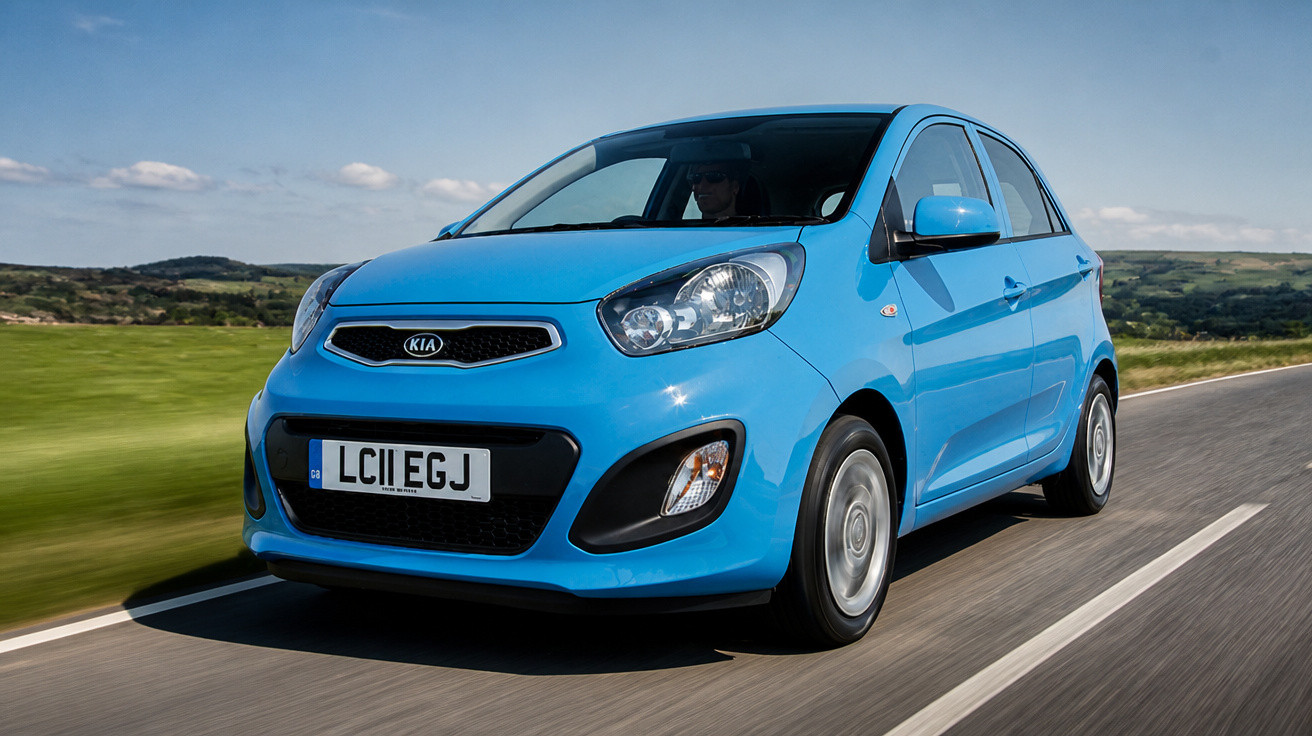
For the past seven years, the Kia Picanto may have been the brand's best-selling car, yet the outgoing model was, frankly, rather awkward-looking. This completely new version puts that right. With Peter Schreger, designer of the original Audi TT, now leading the styling team responsible for cars including the new Sportage, Kia is rapidly shedding its former image.
Kia Picanto styling and practicality
While the old model looked narrow and undernourished around its wheelarches, the new Picanto has a more substantial stance – and, frankly, looks properly good. A strong crease running from the rear light towards the top of the front wheel helps conceal the tall body sides and shallow glasshouse, while the chunky nose gives the impression of a larger car.
It uses the same underlying architecture as the Hyundai i10, but the Kia wears its bodywork with greater confidence, thanks to sharper and more pronounced creases. The new Picanto is 6 cm longer than its predecessor and, combined with more efficient interior packaging, this increases boot capacity from 157 litres to 200 litres.
There are two engines and three trim grades, simply called 1, 2 and 3. However, choosing your ideal engine and specification is not as straightforward as it ought to be: you cannot mix every engine with every trim level. Want the smallest engine in the highest specification? You are out of luck. Rather than list every possible combination, here is the simple answer.
The strongest choice is the level 2 trim paired with the 1.25-litre EcoDynamics petrol engine, complete with stop/start. It costs £10,195, emits 100g/km of CO2, returns an average of 65.7mpg and reaches 62mph from rest in a respectable 11 seconds. Standard equipment includes 14-inch alloy wheels, air conditioning, fog lights and electric windows.
The smaller 1.0-litre three-cylinder has a lively character, but takes 2.9 seconds longer to reach 62mph while improving CO2 emissions by only one gramme. It is, however, the sole engine offered with level 1 trim, with this pairing priced at £7,995. Choose it and you will have steel wheels and manually operated windows.
Ride and electric power steering
The new platform brings softer front springs with more travel than before, meaning the Picanto deals with speed humps and broken road surfaces more effectively. It can bob about on quicker roads, although a firmer rear torsion beam prevents it from hopping off into the brambles.
Every model has electric power steering. Its assistance reduces at higher speeds to cut the energy taken from the engine and improve fuel economy. Around town, where a light and easily turned steering wheel is welcome, it works well enough. On the motorway, though, it is less agreeable, requiring frequent corrections to keep the car pointing straight ahead.
Later this year, and for the first time in the Picanto's history, a three-door model will arrive. It ought to look better still. It may not be as cute as the Fiat 500 or Ford Ka, but the fact that it can be mentioned alongside them demonstrates just how far Kia has progressed. Need one final reason to buy? Whichever version you choose comes with a hugely reassuring seven-year warranty. Cheap and cheerful is fashionable again.
Dan Read
We like: Large-car looks in a small-car package
We don't like: The unusual electric power steering
The verdict: Distinctively styled and genuinely capable city car. Kia is on a roll
Performance: 0-62mph in 11.0secs, max 106mph, 65.7mpg
Tech: 1248cc, 4cyl, FWD, 84bhp, 89lb ft, 930kg, 100g/km CO2
Tick this on the options list: Level 2 trim
And avoid this: The automatic 'box

Comments
No comments yet. Be the first to comment!
Leave a Comment