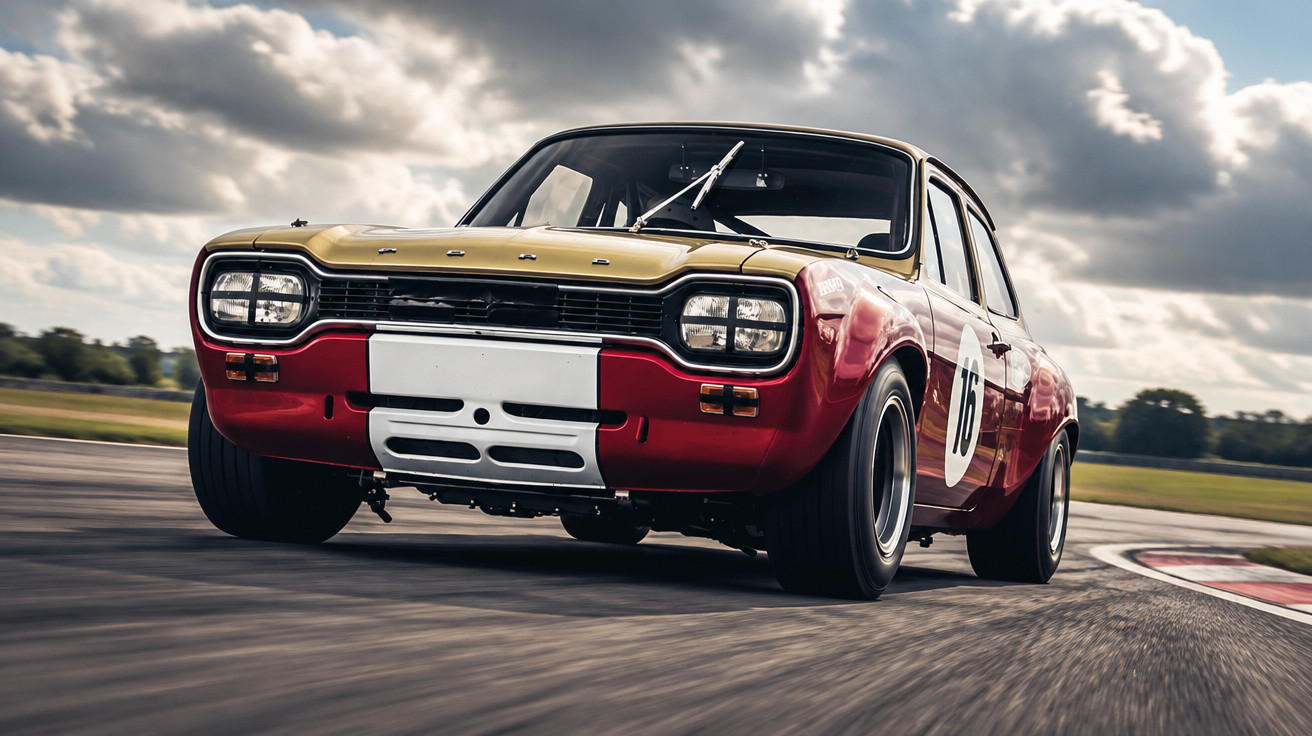
It is 1968. If you are contesting the British Saloon Car Championship and are not called Frank Gardner, you are out of luck: you have already been beaten. That season, there was only one route to speed – the Alan Mann-prepared Ford Escort. In its debut competition year, Gardner won all but two of the 11 rounds.
Racing cars are not usually quick straight away. Engineers, mechanics and designers normally need time to understand their quirks and unlock their ability. Unless, it seems, you are Alan Mann. A naturally gifted and inventive engineer, Mann established his own operation in 1962. Two years later, Ford appointed him as its official European racing partner. His team ran everything from Mustangs and Falcons to Cortinas, GT40s and this fabled Group 5 Escort.
Alan Mann Ford Escort Group 5 engineering
Group 5 came about as near as touring car racing could get to having no limits. The Escort’s celebrated blistered arches were formed to accommodate wider tyres, while an entirely new multi-link rear suspension was developed. Its steering column was repositioned to give it a more direct angle, and the steering rack was mounted within the engine crossmember. Reportedly, the car shared rather more with the GT40s campaigned by Mann than one might expect.
Completing this radical specification was a 1.8-litre Lotus Twin Cam producing approximately 230bhp. The outcome was a compact, lightweight, beautifully balanced and exceptionally keen racing car. Finished in Mann’s unmistakable red-and-gold livery, it looked every bit as delightful as it drove. Very few cars are as striking when cornering as this one.
Photography: Olgun Kordal
Ford provided Alan Mann with six cars for that season. By the end of the next year, four had gone back to Ford, another had been changed to a different specification, while the celebrated championship-winning XOO 349F stayed with Mann. It has remained there ever since. Alan died in 2012, but his son Henry still maintains and races the car.
The Alan Mann 68 Edition replica
This is not that original, however. The car here is an exact nut-and-bolt recreation. Every part of the original was scanned after it had been dismantled, allowing it to be reverse-engineered precisely in its original form. When both cars are parked side by side, there is only one way I can distinguish them: one carries a roll cage. That is the new car, because historic racing regulations now require one.
Nor is it a solitary build. The intention is to create 24 identical replicas. There is a satisfyingly circular aspect to the story: in the 1960s, Alan Mann was Ford’s official racing partner, and Boreham Motor Works – now owner of Alan Mann Racing – has recently become Ford’s official restomod partner. You may already have heard of the other rapid Fords it has planned: a reinterpreted Group B RS200 and a £295,000 fast road Escort, powered by a 295bhp 2.1-litre twin-cam engine capable of 10,000rpm.
This car is not a restomod, though. It is a non-road-legal piece of period machinery, and Henry is keen for its owners to race it. After all, that is what it was built to do – and exactly what it feels built to do. I would prefer to begin gently, but the Escort has no interest in that. Its design may be old, but it is a racing car with one pace only, and it is not ‘pitlane pootle’. The competition twin-plate clutch requires revs for a clean getaway, first gear can be awkward to select, vibrations are plentiful, and as I amble on to the circuit it genuinely seems as though every wheel is trying to head in a separate direction. For the first few hundred metres, I questioned the sense of such a faithful recreation.
Then I had the time of my life. Like every proper racing car, it needs to be driven hard before it comes alive. Put load through the engine and pressure into the suspension, and the entire car suddenly sharpens up.
Driving the Alan Mann 68 Edition at Thruxton
Just as you would expect, the experience is authentically period. This is not a car where you simply accelerate, brake and steer while it delivers ruthless precision in return. You are occupied constantly: balancing steering against throttle, working the gearlever through its four-speed – yes, only four – gate, and preparing for the next bend. Even travelling in a straight line demands focus; the Alan Mann 68 Edition, as this car is properly known, would rather be cornering.
I expected broad, flowing steering movements and imagined it would settle agreeably into turns. Initially, that is not what happens. It weighs just 795kg without fluids and has a short wheelbase, meaning every tiny input immediately and noticeably changes both its direction and pace. Nothing about it is relaxed or leisurely. Going quickly is not a matter of huge angles and armfuls of opposite lock, but of working with the balance right at its limits.
The brakes are far more powerful than anticipated, yet this is not a machine to trail-brake all the way to the apex. Instead, you come off the brakes earlier, turn in, then get back on the power at once to alter the line and trajectory. It is tremendous fun, although it feels slightly nervous through longer, quicker corners. At Henry’s suggestion, we soften the rear dampers.
The change is dramatic. Through the fast curves that characterise Thruxton, the Escort now settles neatly on its outside rear wheel and drives through, nose raised and tail lowered, seemingly placing all the load through that single tyre. Those photographs we have all seen of touring cars from the era, four-wheel-drifting through bends and appearing almost to wag an unweighted front wheel in the air? That is precisely how this feels, and it is completely brilliant. The complete 1960s experience.
This is a special car. Wonderfully vivid and fantastically engaging, one with genuine historic importance
It is utterly involving, and considerably more entertaining than any modern quick, focused ’n’ flat racing car. Its suspension works in a different way: rather than being designed to keep the platform level and neutral at every moment, it allows you to shift the load around. That lets you use the car’s weight to help release the engine’s full potential.
Inside my period helmet, the four-cylinder engine barks with a loud, aggressive note. It is an eager, hard-charging unit, although 205bhp at the UK’s fastest circuit means spending plenty of time flat out in fourth. Even so, 205bhp from 1.8 litres, using Weber carburettors and only two valves per cylinder, is impressive. In slower corners, what stands out is the throttle’s immediate response and the effect it has not merely on speed, but on balance. You are also continually working the gears and attempting to perfect heel ’n’ toe downshifts with the sharp clutch and a gearlever thinner than most indicator stalks. The shift is vague and imprecise at low speed, but once moving I did not miss – or even botch – a single change.
This is an exceptional car: vividly alive, hugely engaging, genuinely historically important and supported by a terrific story. Its price will be frightening, but opportunities to drive something that is not merely period-correct, but accurate to the most minute detail, are vanishingly rare. It is emphatically authentic and faithful to what came before it. It placed me in a time capsule. The prospect of lining up alongside a group of other touring cars and tearing strips off one another may be among the most entertaining things you could possibly do in a car.






Comments
No comments yet. Be the first to comment!
Leave a Comment