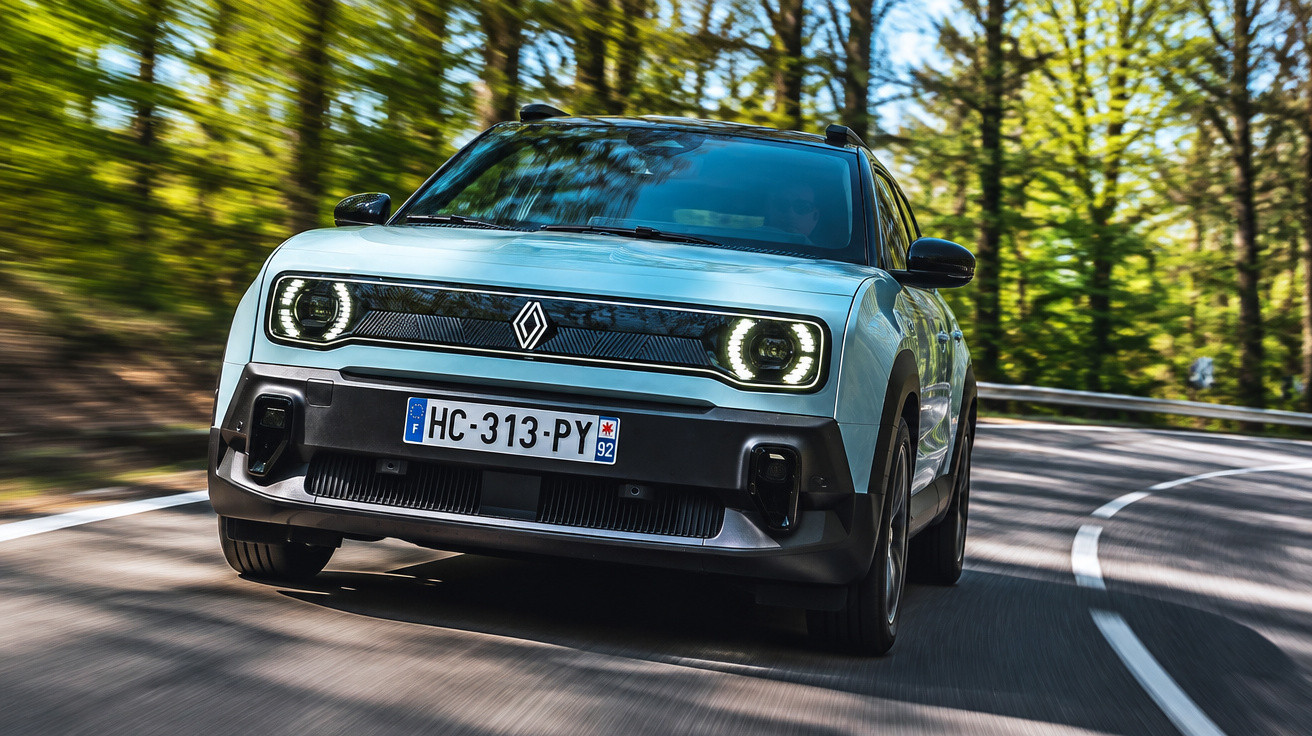
Renault 4 heritage and the Atlas Mountains
Morocco, sometime in the mid-1990s: a white Renault 4 is climbing the 2,200m Tizi n’Tichka pass through the Atlas Mountains, on the way to the Sahara. I am asking a lot of its rudimentary engine and brakes, using the brief straights between hairpins to slip past the other white Renault 4s. “It’s like being on a car launch,” remarks my passenger, familiar with the antics of young and foolish road testers when handed a fleet of matching new cars. These, however, are not new cars. They are battered hire vehicles. For years, a white Renault 4 was Marrakech’s default budget rental car.
The original R4, introduced in 1961, spent decades dutifully tackling similarly unglamorous work across French-influenced regions of the world. It was affordable, adaptable – the world’s first hatchback – straightforward, robust and completely free of pretension. Renault shifted an extraordinary 8.1 million of them. Yet the 4’s success has largely faded from memory, perhaps because most have now rusted away, along with our recollection of them. The new model therefore needs to succeed on its own four wheels, not simply trade on reflected glory.
That is particularly true because, in spirit, this new 4 is not really a 4 at all. Not because it is electric, but because it isn’t particularly inexpensive. Anyone seeking a modern Renault 4 – a vehicle engineered with a ruthless focus on saving every centime – will soon have one: the electric Twingo.
Photography: Huckleberry Mountain
The first 4 was effectively a crossover long before that category existed. Today, the best place to spot a surviving example is probably beside an apparently abandoned French farm, at the end of a steep and rutted track. Renault is therefore entirely sensible to position the new 4 in the same manner. It is a small-family crossover of useful proportions, with an 80mm longer wheelbase than the new 5.
Renault 4 space, practicality and design
With the driver’s seat raised slightly, there is sufficient room for an adult’s extremities – toes, kneecaps and scalp – in the rear. The boot offers a deep 420 litres, while the front passenger seat folds flat for DIY timber or a cello. Part of the bumper rises with the tailgate to make the opening deeper. It can even tow a 750kg trailer. At only 1.8m wide across the body, the R4 feels easy to place on tight streets and country lanes.
You do not need to be automotive Inspector Clouseau to establish that this is a close relation of the current R5. Nearly everything beneath its bodywork is shared, apart from the longer wheelbase, an additional 50kg – still impressively light for an EV of this size – and mildly revised springs and steering. All UK versions receive a 148bhp motor and 52kWh battery. Renault’s excellent infotainment and control system is also carried over, including its gratifyingly plentiful physical switches.
Its exterior, though, is completely different. It repeatedly references its 1961 predecessor. For anyone keeping count, the old car’s face consisted of one chrome surround, round lamps at either end and a grille in the centre; the chrome has now become an LED perimeter strip. The panel gap between this feature and the wings echoes the separation between the original’s wings and its front-hinged bonnet-and-grille assembly. Its tall, relatively flat sides feature ribbed door panels, as on the R4 GTL. The backwards-sloping rear-door glass and trapezoidal final side window preserve the distinctive cadence of the old car’s glazing. An upright tailgate and slim, tall rear lamp units finish the effect.
Driving the Renault 4
Once settled into the supportive seat, I am reminded that every electric Renault needs to be operated delicately with fingertips and toes. The steering is light at low speeds, while the brake pedal delivers plenty of response from a very gentle first touch.
I quickly alter the drive modes to soften the accelerator’s initial response, because our test car embraces its crossover role with optional Goodyear all-season tyres. Perhaps they are still fresh and waxy, but they do not offer vast traction on the dry, dusty roads around Paris. The inside front wheel will readily spin when exiting tight bends.
That is a minor issue beside the car’s strengths. Its springs are slightly softer and more composed than the 5’s, yet the steering remains reasonably quick and accurate, working with the suspension to guide the car smoothly into and through corners. Initially, the steering seems rather detached, but increasing the cornering load brings feedback from the tyres. It communicates the work of the sophisticated multi-link rear suspension, which keeps the car precise and well balanced from front to rear. It does its job cheerfully.
Naturally, this results in a ride that is fairly busy. It is not harsh, however, and deals with sizeable bumps and dips without fuss. Both tyres and suspension are quiet, helping to mask disturbances from the road surface. Nor do bumps push the car off its chosen line.
There is ample power for suburban driving and B-roads, although performance fades at motorway speeds. A day spent in villages and open countryside, without attempting to drive gently but also without motorway sections, returned the equivalent of 215 miles. The WLTP range is 248. For a car at this price, that is entirely acceptable.
Value, heritage and Electric Car of the Year
In the UK, the 4 will cost between £27,000–£32,000. Every version gets a 52kWh battery, 148bhp, a heat pump, the large central display and 18in alloy wheels. As Omoda, Leapmotor, GWM Ora, Haval and others arrive with dramatic Chinese structural cost advantages, Renault can still pay French factory workers thanks to its own scarcely concealed weapon: heritage. It is opening its catalogue of much-loved historic designs, including the 4, 5 and Twingo.
Come for the looks... stay for the value, easy ownership, smart tech and genuinely happy drive
Some detractors argue that this reveals a lack of imagination among Renault’s designers, suggesting they are simply copying and pasting old forms onto modern mechanicals. First, though, why would Renault not use a heritage for which those new rivals would gladly trade anything? Second, making these shapes look convincingly contemporary while retaining their old spirit is genuinely difficult.
Back in 1961, the R4 was likened to a pair of jeans: a highly practical all-purpose item for which nobody would judge you. It suited the fluid social mood of its first decade. This mid-specification R4 wears quasi-denim trim. I have just come across an old photograph of Jane Birkin and Serge Gainsbourg, he in jeans and an unbuttoned denim shirt, she in cut-offs, playfully moving through golden French sunlight. Yet this is an era of artfully worn, strategically ripped £500 designer denim, so the comparison no longer quite works.
None of this classic-car connection need matter if automotive design history and cultural significance leave you cold. The new Renault 4 is a clever modern small car in its own right, visibly distinct from the tide of generic-looking models arriving at dealerships across the country. In the EV era, design is becoming ever more important.
Renault’s masterstroke is creating not one but two small EVs that are excellent cars, rather than relying solely on styling. The R5 is already our Car of the Year, but the R4 edges ahead – taking both Best Compact EV and the major prize, our overall Electric Car of the Year – because it combines the R5’s appeal with more space. Come for the looks... stay for the value, easy ownership, smart tech and genuinely happy drive.

Comments
No comments yet. Be the first to comment!
Leave a Comment