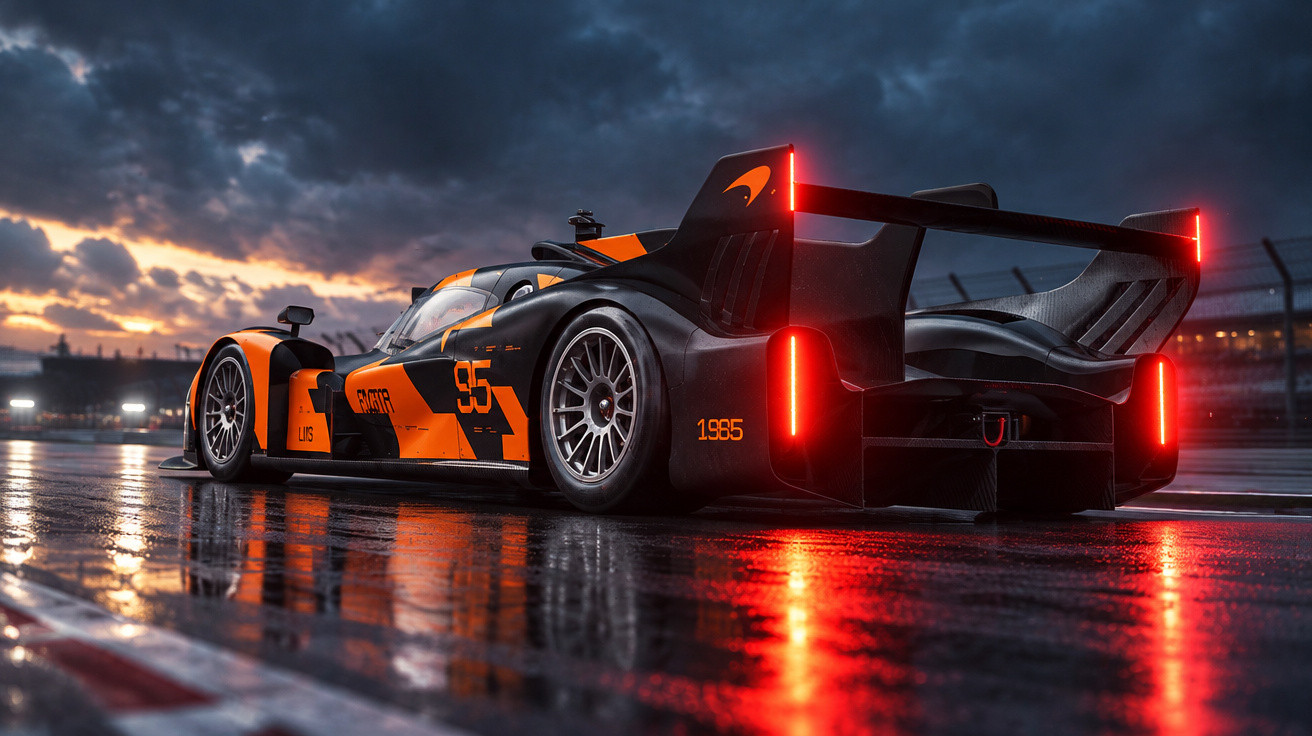
What’s this, then? Very orange…
Papaya, in fact. This is McLaren’s still-unnamed contender for the 2027 24 Hours of Le Mans. McLaren Racing CEO Zak Brown – more commonly heard congratulating Lando and Oscar from the F1 pit wall – unveiled it today at Le Mans, ahead of this year’s race.
Why reveal a race car for an event you will not enter for another two years?
The reason is that 2025 is 30 years since McLaren arrived at the Le Mans 24 Hours as a rookie outfit and claimed first, third, fourth, fifth and 13th places on its first attempt. Its weapon that year was the GTR version of the McLaren F1, a road car whose creator – Gordon Murray – had always insisted was not designed for racing, as doing so would have compromised its design.
Nevertheless, it won at the first time of asking, giving McLaren motorsport’s ‘Triple Crown’: victories in the Monaco GP, the Indy 500 and the Le Mans 24 Hours. McLaren is still the sole team to have achieved that trio, and in 2027 it will be the only manufacturer able to repeat it.
No pressure, then?
Indeed. McLaren is well aware that it will be joining the top-flight Hypercar field very late. BMW, Cadillac, Ferrari, Peugeot, Porsche and Toyota have already been racing there for several years, while more recent arrivals Alpine, Aston Martin and Lamborghini have all found it difficult. By the time 2027 arrives, Genesis will have completed a year of competition, while mighty Ford will be making its debut too.
Far from coincidentally, McLaren’s news emerged only hours after the ACO, Le Mans’ organisers, and the FIA formally confirmed that the Hypercar rules will continue until the end of 2032. McLaren will therefore have at least six seasons to race its new machine – and will arrive fresh against opponents that have been established for roughly half a decade.
McLaren will work with United Autosports, the race team co-owned by Zak Brown, to prevent its Formula 1 programme from being distracted. United Autosports has won the LMP2 category at Le Mans and in the World Endurance Championship.
Right, right – give us the details.
There are few at present, but McLaren Racing will field the car under the LMDh branch of the ‘Hypercar’ regulations. LMH permits a bespoke car, the approach selected by Ferrari, Toyota and Peugeot. All the others – now including Ford’s upcoming racer and McLaren – have chosen LMDh, which incorporates a range of off-the-shelf components. For cost reasons.
Among those standardised parts is the carbon-fibre monocoque chassis, which must be supplied by one of four approved manufacturers. McLaren has picked Dallara, which already supplies Cadillac and BMW and is also McLaren’s current IndyCar partner.
What are the chances of a McLaren F1-style V12?
Zero. It will use a twin-turbo V6, although its capacity remains unconfirmed. Regulations limit output to 671bhp, so the challenge is to produce that number as efficiently as possible.
Could it be the McLaren Artura’s 120-degree V6? Probably not. Ferrari does use its 120-degree V6 across the 499P racer, F80 and 296 road cars, but McLaren made this decision long after its road-car engine had been conceived. McLaren Automotive will, however, work with McLaren Racing on the new V6’s development.
McLaren will have plenty on its plate between Le Mans and Formula 1
Absolutely – and Le Mans is only the flagship race in the wider World Endurance Championship. McLaren also has its IndyCar operation and a Formula E team.
Could McLaren’s F1 drivers land a race seat?
Top Gear put that exact question to Zak Brown. Smiling, he replied: “Lando [Norris] and Oscar [Piastri] have both given strong hints they’d like to do Le Mans one of these days, but I think right now they’re laser-focused on the Formula 1 world championship.
“But I don’t think there’s a racing driver in the world that doesn’t fancy having a go at Le Mans, and Oscar and Lando are definitely two of those, so let’s see.”


Comments
No comments yet. Be the first to comment!
Leave a Comment