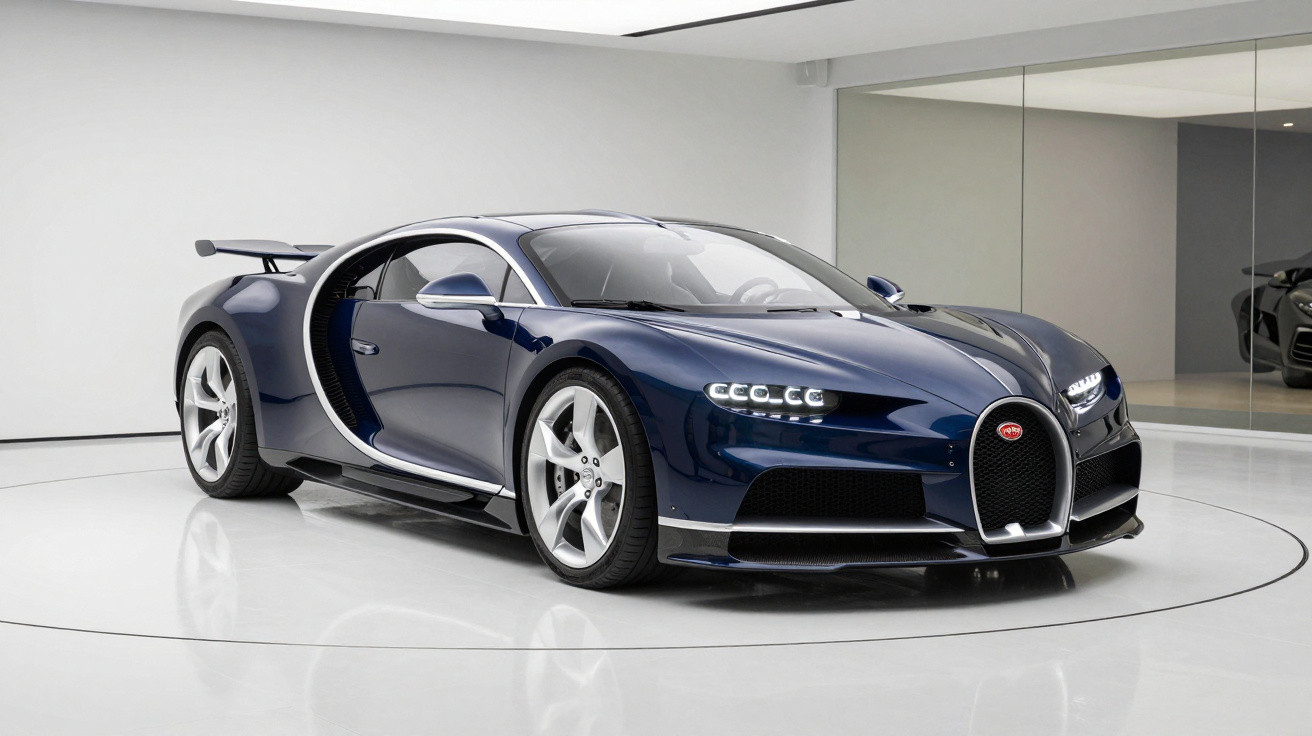
For almost two decades, the W16 engine served as the “heart” of Bugatti models. It powered everything from the Veyron and Chiron to the Divo, Centodieci, Bolide and, more recently, the W16 Mistral. It was with the latter that the French marque marked what appeared to be the W16’s final farewell from its road cars.
Or so we believed. Bugatti has now sprung a surprise with the Destrier, a new model using the iconic 16-cylinder engine. Unlike the brand’s other cars, however, it is not a limited-run model restricted to a few dozen examples.
Instead, it is a unique example. This is the third one-off from the ultra-exclusive Solitaire programme, following the Brouillard and the F.K.P Hommage.
A new interpretation of the Bolide
While it shares the Bolide’s carbon-fibre monocoque, the Destrier was created to stir emotion rather than chase lap-record glory. It retains the structural platform and W16 engine, but every other aspect has been developed to make it a collector’s piece.
Rather than using the oversized wings, aerodynamic add-ons and extreme solutions usually associated with track-focused hypercars, Bugatti has chosen a far more elegant, sculptural direction.
“The Destrier is not a car to be understood; it is a car to be felt with the heart.”
Frank Heyl, Bugatti’s head of design
Standing one metre tall and fitted with 20-inch wheels at the front and 21-inch wheels at the rear, the Destrier has muscular proportions. Viewed from the side, a new version of Bugatti’s traditional C-line flows along the entire body before connecting with the horseshoe grille.
At the rear, the Bolide’s fixed wing has been replaced by a subtler arrangement inspired by the exclusive Chiron Profilée. Its side profile is especially striking: the cabin appears set between the front wings, while the body narrows behind the doors before widening again over the rear axle.
A tribute to the Type 57
According to the French manufacturer, the Bugatti Destrier draws inspiration from the legendary Type 57, the model that spawned both the Type 57G Tank, winner of the 24 Hours of Le Mans, and the iconic Type 57SC Atlantic.
Its exterior also brings together polished aluminium details and darkened carbon-fibre components.
Inside, the atmosphere feels closer to haute couture than a competition car. The Bolide’s exposed carbon fibre has been removed in favour of brown leather, Alcantara and a three-dimensional fabric developed specifically for this project, featuring copper threads woven into a circular pattern.
The door handles, air vents, door sills and steering-wheel centre are made from hand-hammered aluminium, referencing the armour of the medieval knights that inspired the Destrier name.
The W16’s definitive farewell?
Despite its extensive visual transformation, the Destrier retains exactly the same engine beneath its bodywork as the Bolide: the iconic 8.0-litre quad-turbo W16 producing 1600 hp.
Unlike the hypercar on which it is based, though, its purpose is not to set records. The Destrier was conceived as a one-off creation celebrating the W16 engine’s legacy and the French manufacturer’s hand-crafted expertise.
The new Bugatti Destrier will make its public debut during Monterey Car Week in the United States.















Comments
No comments yet. Be the first to comment!
Leave a Comment