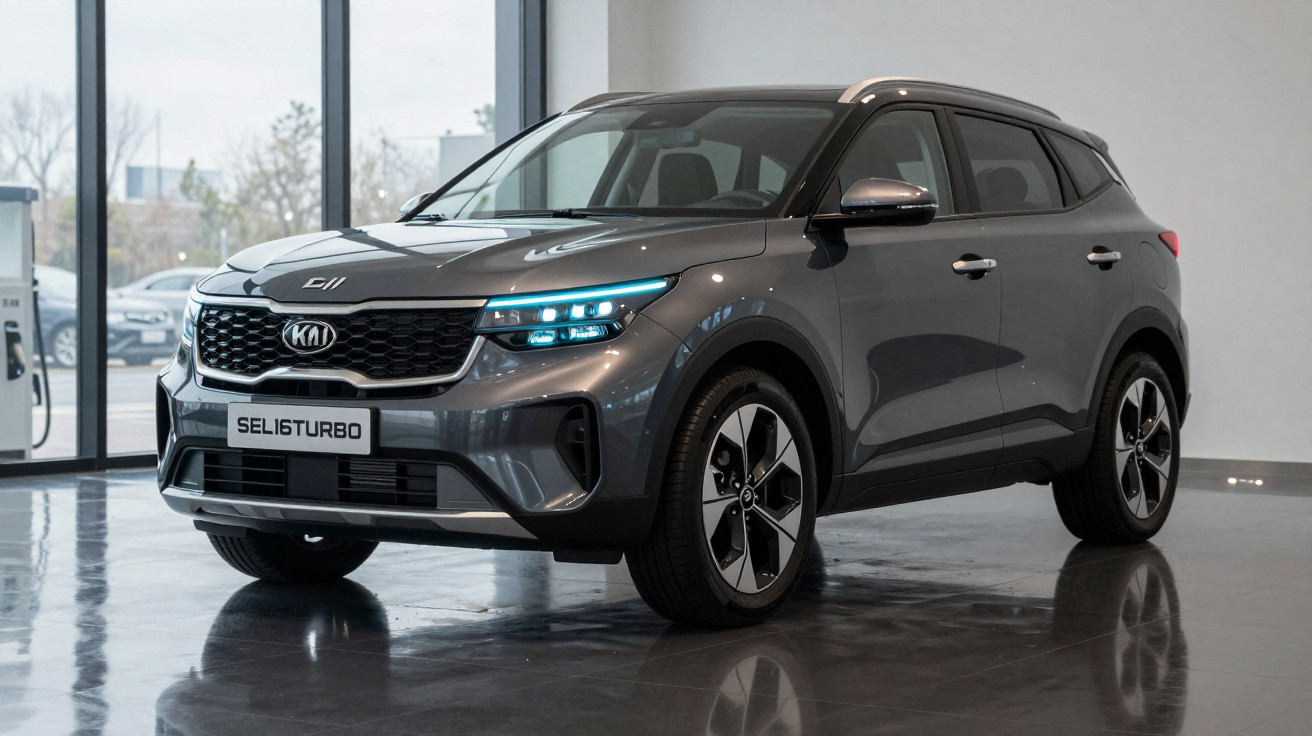
The Kia Seltos 1.6 Turbo does without electric assistance. It is 100% petrol-powered.
The new Kia Seltos has finally arrived in Portugal. It is Kia’s second best-selling car worldwide, yet it enters a fiercely competitive segment - including competition within its own showroom.
In Kia’s line-up, it faces two strong alternatives: the K4 estate and the Sportage, an SUV that needs no introduction. The former is substantially cheaper and roomier, while the latter is slightly larger but also more expensive.
The Seltos sits somewhere between them and, after spending a week with it, I can say it need not fear being overshadowed by its siblings. Over the next few paragraphs, I will explain why.
It looks electric, but it is not
The Kia Seltos places considerable emphasis on styling. Not because it lacks other strengths - we will get to those… - but mainly because it needs to establish clear separation from its larger sibling, the Kia Sportage.
It is marginally smaller than the Sportage in every dimension, but the biggest distinction lies in its bodywork. Its sharper, more assertive lines are clearly intended to appeal to families seeking something with a more rugged appearance.
It has also borrowed certain touches from Kia’s electric models, particularly the flush door handles. Those features, along with some of the exterior detailing, may suggest an electric vehicle, but the Seltos could hardly be further from one.
There are no visible exhaust outlets at the rear, although the design still conveys a sense of toughness. Thankfully, none of these choices has compromised the space offered by the Kia Seltos. At 4.4 m long, it is far from a small car.
The right quality and plenty of space
Kia does not make bad interiors. The materials are appropriate - no more than that - but the standard of assembly is what impresses. Everything inside the Seltos feels solid and robust. Step into one and you will understand what I mean.
Its design is more interesting than that of the more conservative Nissan Qashqai or the more… German Volkswagen T-Roc. Looking back within the brand, it does not have the refinement of the Sportage, but it still feels reassuringly well built.
The dashboard combines two 12.3-inch displays: one for the instrument cluster and another for the infotainment system. Both offer clear graphics and are simple and quick to use.
A 5.3-inch climate-control display sits between them. The issue is that the steering wheel partly obscures it. Fortunately, Kia has retained physical controls for temperature and ventilation, which are far more practical than relying solely on a touchscreen.
There is ample room for two adults in the front. Rear legroom is generous too, although headroom becomes more restricted for passengers taller than 1.80 m. Three adults can sit abreast, though the central tunnel takes away foot space from whoever sits in the middle.
Equipment levels are extensive in both the Sport version (€33,990 with the current offer) and this better-equipped X-Line version (€39,490 with the current offer). The top-spec model is perhaps only worth choosing if you specifically want the automatic gearbox. And if your budget allows it, I think you probably will…
Kia Seltos 1.6 Turbo: precise, comfortable and thirsty
One of this Kia Seltos’s key features is its engine. It is not a small unit - quite the opposite. This is a 1.6 Turbo four-cylinder producing 180 hp, with no form of electric assistance. It is one of the Hyundai Motor Group’s most widely used engines around the world.
It offers plenty of pulling power and responsiveness, but it also has a considerable thirst. Official consumption is 7.0 l/100 km, while emissions reach 158 g/km of CO₂. In town, expect 7.7 litres; on an open road, it is possible to achieve under six litres. The weight of your right foot will determine the outcome.
That said, there is a slight delay in response between the accelerator and gearbox. It disappears in Sport mode, but in the normal driving mode it requires some acclimatisation or anticipation. Volkswagen’s DSG gearboxes still do this better.
Even so, the driver always feels there is power in reserve. It completes the 0–100 km/h sprint in 8.8 seconds and reaches a top speed of 208 km/h. Perhaps more importantly, it is very easy to maintain high average motorway speeds without effort.
Putting the engine aside, there is more to praise, particularly the sound insulation and ride comfort. It is not as accomplished as the Sportage, but neither is it miles behind.
When the pace increases, the Seltos also feels more… free-moving. More dynamic. It remains predictable at all times, but may be a little more engaging for the driver. This is despite its torsion-beam rear suspension arrangement. Had nobody told me, I would not have noticed. It is well tuned.
Neither expensive nor cheap
Kia knows that the Seltos is neither expensive nor cheap. It is especially difficult to call it cheap when some Chinese-brand rivals are being offered at aggressively low prices. Perhaps for that reason, Kia has given the Seltos a generous level of standard equipment.
In this article, we detail some of the Seltos’s standard equipment. Above all, Kia is charging for the confidence it knows people have in its products. The engine is robust, the solutions are thoroughly proven - it uses the Niro platform - and the driving experience leaves little to criticise.
A car like the one I tested is priced at €42,000, although Kia usually has offers available that can bring the price of this Seltos below €40,000. Given everything this model provides, that is fair enough.

Comments
No comments yet. Be the first to comment!
Leave a Comment