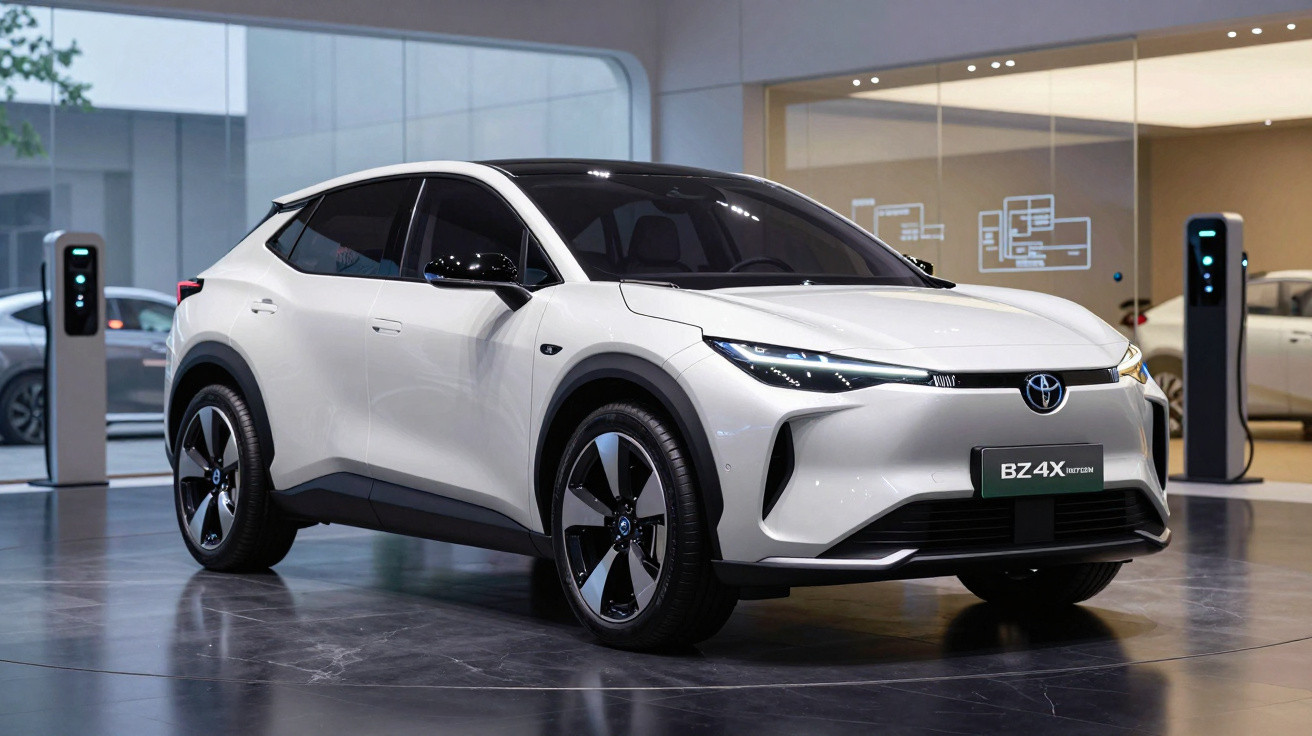
Toyota has announced the first update for the bZ4X, a model the Japanese manufacturer introduced in 2022. This year brings a range of changes, most notably substantial improvements to the battery, power output and driving range.
The update arrives midway through the model’s lifecycle. The bZ4X has been the best-selling electric car in Norway - where EVs already account for more than 90% of total sales - and is the fourth best-selling electric vehicle in its segment.
The headline changes are larger new batteries and more powerful motors, although the cabin has also been improved. Alongside this fully electric model, the Japanese brand has also unveiled another EV: the new Toyota C-HR+.
New batteries and improved efficiency
The Toyota bZ4X is now offered with two battery choices: a 57.7 kWh unit for the entry-level front-wheel-drive version, producing 123 kW (167 hp) and claiming up to 445 km of WLTP range; plus a larger 73.1 kWh battery for the more powerful variants.
The all-wheel-drive model, which uses two electric motors, now delivers 252 kW (343 hp) and has an estimated range of 520 km. However, this version will not be sold in Portugal.
What has changed with the batteries
Improvements to cell energy density, together with the addition of silicon carbide semiconductors, have enabled Toyota to increase the electric system’s overall efficiency.
Despite the performance gains, Toyota says battery durability and reliability have not been compromised. The warranty remains unchanged: 10 years or one million kilometres, whichever comes first.
Should degradation exceed 30% during that period, the brand will replace the component. However, according to Toyota, “it is not expected that degradation will even come close to this figure”, one of the brand’s engineers told us. “We have worked with batteries and electrical systems for more than 25 years and have an in-depth understanding of how our components behave,” he concluded.
Stronger performance and capabilities
As a result of these updates, the Toyota bZ4X is not only more energy-efficient but also quicker. The most powerful version completes the 0–100 km/h sprint in just 5.1 seconds, placing it among the brand’s fastest models.
Towing capacity has also doubled to 1,500 kg, making this SUV more adaptable for drivers who need to pull heavier loads.
Charging has been further optimised on the updated bZ4X. Toyota has fitted a battery preconditioning system intended to improve rapid-charging efficiency in cold conditions.
In higher-specification models, the onboard AC charger has been upgraded to 22 kW, cutting charging times when connected to a compatible wallbox. DC rapid charging remains at 150 kW, allowing the battery to be replenished from 10% to 80% in around 30 minutes.
Updated interior and refined aerodynamics
While the exterior design receives only minor aerodynamic revisions at the front, the cabin has undergone more noticeable changes.
Toyota has streamlined the digital instrument display and fitted the bZ4X with a new 14-inch central screen, which now incorporates the climate-control functions.
Market availability
Toyota has yet to disclose precise launch dates, but has confirmed that the updated bZ4X will be available in several European markets after this summer. There is also no indication yet of pricing for Portugal.


Comments
No comments yet. Be the first to comment!
Leave a Comment