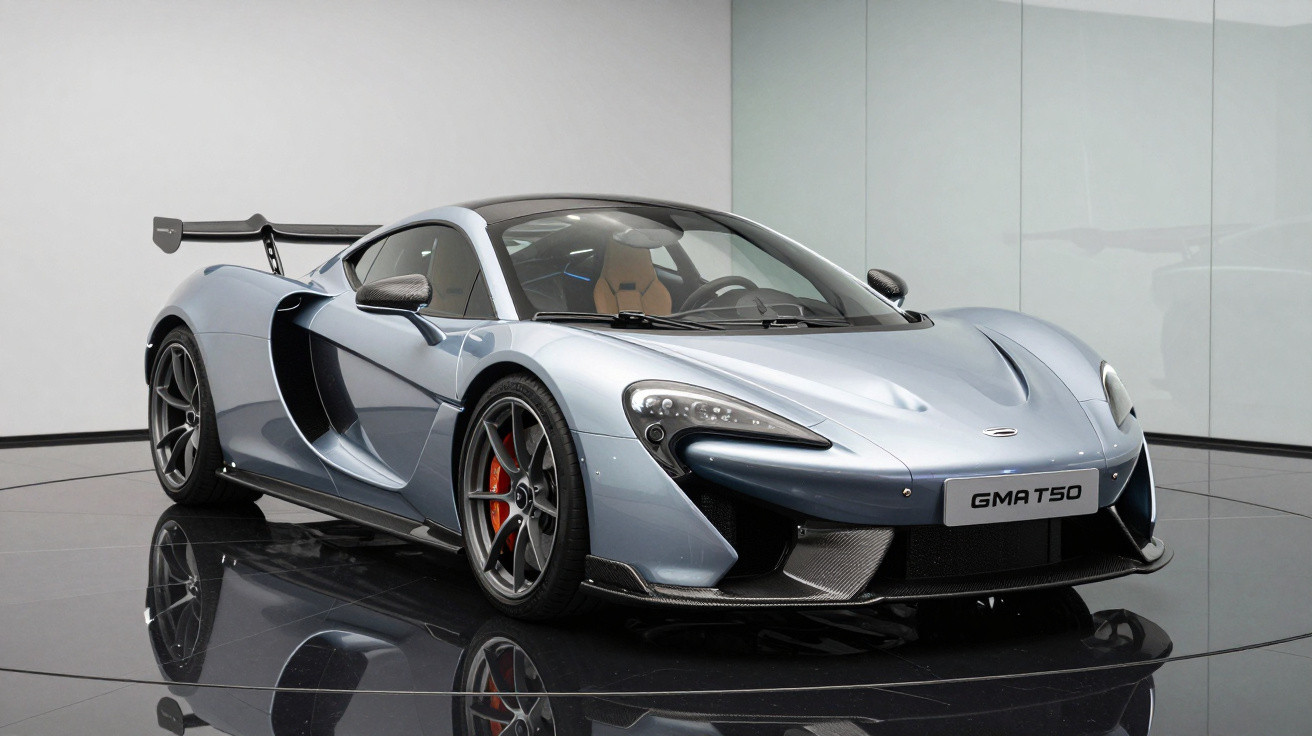
There it is at last… the Gordon Murray Automotive T.50, or GMA T.50 for short, has finally been unveiled. After months of anticipation for what is being billed as the true successor to the McLaren F1 and the “purest, lightest supercar ever made”, we can now see the complete picture.
Before examining this machine through its figures, one uncertainty can be put to rest: its definitive name is the rather anticlimactic T.50 - although that does not mean it cannot gain the same reverence as names such as F40 or F1.
It is the project number, marking the 50th project begun by Gordon Murray. The number also coincides with the 50 years of his career that he is now celebrating. What a way to mark the occasion…
Without further delay, here is this analogue machine explained through the contrasting coldness of its numbers:
986
Some may call it an obsession, but in the automotive world, weight is a positive obsession. It is one of the reasons Gordon Murray is so admired. With every fluid onboard and ready to drive, the GMA T.50 weighs just 986 kg. When did we last see a supercar weighing less than one tonne?
Even the stripped-back Ferrari F40 has a kerb weight above 1200 kg. To put it into perspective, 986 kg is slightly below the 1000 kg of a Mazda MX-5 1.5 compact sports car… and the T.50 has three seats and a V12 behind its occupants.
Breaking down the 986 kg into some of its principal components:
- 150 kg - the carbon-fibre monocoque and body panels together;
- 178 kg - the naturally aspirated 4.0 V12 engine. Made from steel, aluminium and titanium, it is the lightest production V12 ever created;
- 80.5 kg - the six-speed manual gearbox, around half the weight it would have carried as a dual-clutch transmission;
- 7.8 kg - each 19″x8.5″ front wheel;
- 9.1 kg - each 20″x11″ rear wheel;
- 13 kg - the combined weight of all three seats;
- 3.9 kg - the bespoke 700 W Arcam sound system with 10 speakers.
12,100
Stratospheric. The 12,100 figure is the rev limit of the 3994 cm³ naturally aspirated V12 developed by Cosworth’s specialists.
Peak output arrives a little lower down: 663 hp at 11,500 rpm. Maximum torque of 467 Nm is delivered at a lofty 9000 rpm. Concerns that this could be a peaky engine are eased by the fact that 71% of its torque is available at a far more civilised 2500 rpm.
Furthermore, the GMA T.50 V12 has two dedicated maps that can be selected through one of the driving modes. In GT mode, revs are restricted to 9500 rpm and output to 600 hp, making the T.50 easier to use in urban driving.
Further V12 figures:
- 166 hp/l - the highest specific output ever achieved by a production V12;
- 14:1 - one of the highest compression ratios in an Otto-cycle engine;
- 0.3 s - the time needed to rise from idle to the red line;
- 178 kg - the lightest production V12 ever made.
6
Mated to the 4.0 V12 is an Xtrac-developed six-speed manual transmission - yes, with three pedals and an H-pattern gate. Compact and exceptionally light at 80.5 kg, it uses an aluminium casing and promises a very short shift throw through its titanium gear lever. The mechanism remains visible from the cabin, another detail that makes the T.50 that little bit more special.
The first five ratios are shorter to make the most of acceleration, while sixth is substantially taller and intended for open roads or motorway cruising.
672
With 663 hp moving only 986 kg, the result is a power-to-weight ratio of just 1.48 kg/hp, or, in more British terms, 672 hp per tonne.
That figure is around 40% lower or higher, depending on the value being considered, than that of a “typical” supercar. According to Gordon Murray Automotive, an average supercar weighs 1436 kg, so it would need roughly 300 hp more than the T.50’s 663 hp to match its power-to-weight ratio. In other words, it would require more than 960 hp, bringing additional complexity and… more weight.
40
Within the GMA T.50 aerodynamic arsenal, the main attraction is the rear fan, which measures a substantial 40 cm in diameter. It is a solution similar to that used on the Brabham BT46B Fan Car, the Formula 1 single-seater designed by Gordon Murray himself in 1978. Murray says this is a more refined interpretation of the system he created more than 40 years ago, as it enables several modes with different effects.
As well as dominating the rear view with its 40 cm diameter, the fan spins at 7000 rpm thanks to a 48 V electric motor.
The fan offers six modes: two automatic settings, Auto and Braking, plus four driver-selectable modes - High Downforce, Streamline, V-Max and Test:
- Auto - the “normal” setting. The T.50 operates like any other supercar with passive ground effect;
- Braking - automatically places the rear spoilers at their maximum angle, greater than 45°, while the fan runs at full speed alongside the diffuser’s open valves. This mode doubles downforce and can remove 10 m from the braking distance at 240 km/h. It overrides every other mode whenever necessary;
- High Downforce - prioritises downforce, increasing it by 50% to improve traction;
- Streamline - cuts aerodynamic drag by 12.5%, allowing a higher top speed and lower fuel consumption. The fan runs at maximum speed, extracting air from above the T.50 and forming a virtual tail to reduce turbulence;
- V-Max Boost - the most extreme T.50 setting. It uses elements of Streamline mode but, thanks to the ram-air effect, allows the V12 to produce 700 hp for short periods in order to enhance acceleration;
- Test - used only when the T.50 is stationary. Its purpose is to test and confirm the correct operation of the entire system, comprising the fan and several moving elements such as the rear spoilers and diffuser ducts/valves.
3
It could not have been any other way. If the GMA T.50 is the true successor to the McLaren F1, and Murray created both the F1 and the T.50, the driver’s seat had to be central, flanked by two others - three seats in total.
When it is time to explore this supercar’s dynamic abilities on the road, the benefits of the central driving position should become clear: better weight distribution, improved positioning and alignment of the steering wheel and pedals, and superior visibility.
Those advantages are reinforced by the T.50’s compact dimensions. It occupies as much road space as a Porsche Cayman, far less than other supercars:
- 4.352 m long
- 1.85 m wide
- 1.16 m high
- 2.70 m wheelbase
The GMA T.50’s low mass eliminated the need for more complex and heavier adaptive-damping or air-suspension systems. Instead, the T.50 uses forged aluminium double wishbones at both ends, while its steering is unassisted except during parking manoeuvres.
Its four contact patches are supplied by Michelin Pilot Sport 4 S tyres - 235/35 R 19 at the front and 295/30 R 20 at the rear - fitted around aluminium-alloy forged wheels that are also exceptionally light for their size, as noted above.
For stopping power, the GMA T.50 uses Brembo carbon-ceramic discs - 370 mm x 34 mm at the front and 340 mm x 34 mm at the rear - gripped by air-cooled six-piston Brembo aluminium-alloy front calipers and four-piston rear calipers.
228
Gordon Murray does not usually overlook practical matters in his creations, even where supercars such as the T.50 are concerned. It is no surprise, then, that the GMA T.50’s luggage capacity has been revealed. There are 228 litres of luggage space in total, rising to 288 litres with two occupants onboard and a specific suitcase for that purpose - a respectable figure somewhere between a city car and a supermini.
These practical considerations are even more apparent when looking at its ground clearance: 12 cm at the front and 14 cm at the rear. Those measurements are on a par with a conventional car, removing the need for complex and heavy suspension-lift systems simply to avoid scraping costly carbon-fibre spoilers and diffusers on even the gentlest entrance ramp.
120
Access to the cabin is via dihedral doors, while the interior could scarcely be more focused. There are no luxuries, only what matters.
From the central seat, the driver faces a three-spoke carbon-fibre steering wheel and an instrument panel made up of two non-touch screens plus a central analogue rev counter measuring 120 mm in diameter, with a design more akin to watchmaking. Even the rev-counter needle is machined from a solid block of aluminium.
The brake and clutch pedals are each sculpted from solid aluminium, featuring a web-like pattern to save weight and provide a non-slip surface. The accelerator pedal, meanwhile, is machined from a solid block of… titanium.
100
Only 100 examples of the GMA T.50 will be built, although production will not begin until later in 2021 - there is still much development work to complete before then - with the first cars scheduled for delivery in 2022.
Despite a starting price of more than €2.61 million before taxes, most examples have already been ordered. Following this unveiling, we believe the remaining cars will have no trouble finding owners.








Comments
No comments yet. Be the first to comment!
Leave a Comment