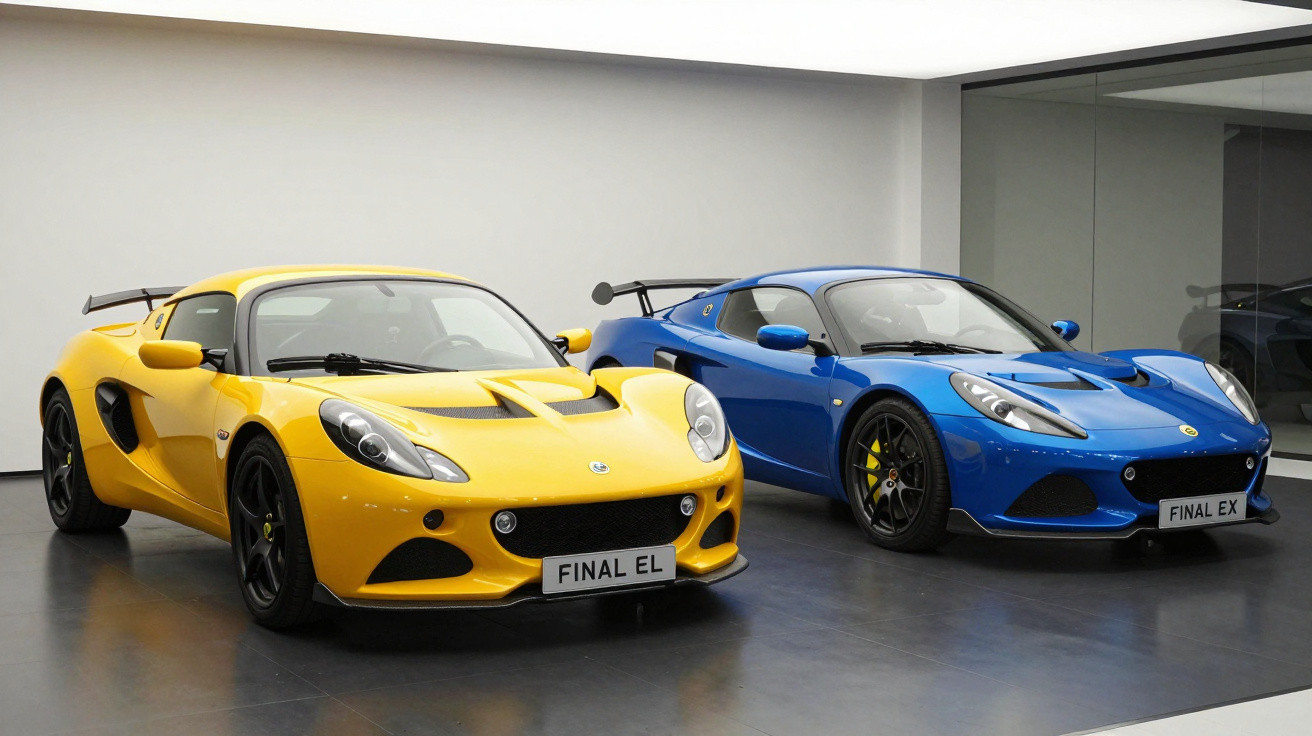
A new era is about to begin at Lotus, but it means another must come to an end. That transition will take place this year, with production of the Elise, Exige and Evora already confirmed to be ending, while the Evija and the as-yet-unnamed Type 131 arrive. Before then, however, there is still room for a special farewell Final Edition for both the Elise and Exige - the Evora will be unveiled later.
These are the brand’s longest-running models. Although they have received numerous developments and iterations over the years, they remain fundamentally the same cars - still using the same aluminium platform - that were launched 25 years ago in the case of the Elise, and 21 years ago for the Exige.
Their respective Final Edition models bring exclusive styling additions, extra equipment and… more power.
Lotus Elise Final Edition
Starting with the more compact Elise, two versions bring the 25-year career of one of the most significant sports cars ever to a close: the Elise Sport 240 Final Edition and Elise Cup 250 Final Edition.
Both feature Toyota’s 2ZZ engine, a 1.8-litre supercharged inline four-cylinder unit that has powered the Elise throughout this century. For the first time, both also gain a digital TFT instrument display.
They also share a new flat-bottomed steering wheel trimmed in leather and Alcantara, a small “Final Edition” plaque, and distinctive new upholstery and stitching for the seats and cabin. Finally, they are offered in exclusive colours that recall the model’s past, including Azure Blue - the same shade used on the 1996 model - the brand’s motorsport division black, and classic British Racing Green.
The Lotus Elise Sport 240 Final Edition is based on the Sport 220, but receives an extra 23 bhp, taking output to 243 bhp (and 244 Nm of torque). Combined with its low 922 kg DIN weight, this allows it to reach 100 km/h in just 4.5 seconds.
Helping to keep weight down are exclusive 10-spoke forged wheels, which are 0.5 kg lighter than those fitted to the Sport 220. Selecting the carbon-fibre panels, lithium-ion battery in place of the standard unit, and polycarbonate rear screen reduces the 922 kg figure to 898 kg.
The Lotus Elise Cup 250 Final Edition, the Elise intended for “track days”, receives no extra power but gains additional downforce. Its new aerodynamic package - comprising a front splitter, rear wing, rear diffuser and side extensions - enables it to generate 66 kg of downforce at 160 km/h and 155 kg at its 248 km/h top speed.
It also gains new 10-spoke M Sport forged wheels, while Bilstein sports dampers, adjustable anti-roll bars, a lithium-ion battery and a polycarbonate rear screen are all standard. Choosing the same carbon-fibre parts available for the Elise Sport 240 Final Edition brings its final DIN weight to 931 kg.
Lotus Exige Final Edition
The more extreme and powerful Exige expands its Final Edition range into three separate versions: Exige Sport 390, Exige Sport 420 and Exige Cup 430.
Each remains faithful to the 3.5-litre V6, also supercharged and also supplied by Toyota. They all share the equipment already mentioned for the Elise: the new digital TFT instrument display, a new steering wheel, seats with new upholstery and the “Final Edition” plaque. Their exclusive colours also draw on the model’s history: Metallic White and Metallic Orange.
The Lotus Exige Sport 390 Final Edition replaces the Sport 350. Output rises to 402 bhp (and 420 Nm of torque), an increase of 47 bhp over its predecessor. Weighing just 1138 kg (DIN), it reaches 100 km/h in only 3.7 seconds and has a top speed of 277 km/h. It can also generate a maximum of 115 kg of downforce at top speed.
The Lotus Exige Sport 420 Final Edition adds 10 bhp over the Sport 410, producing 426 bhp in total (and 427 Nm of torque). It is the fastest Exige, capable of reaching 290 km/h and completing 0-100 km/h in a mere 3.4 seconds. It is also marginally lighter than the Sport 390, at just 1110 kg (DIN).
It is fitted with adjustable Eibach anti-roll bars and Nitron dampers adjustable in three directions. Its brakes have also been upgraded, using AP Racing four-piston forged callipers and two-piece J-hook discs.
Finally, the Lotus Exige Cup 430 Final Edition is the circuit-focused version. It retains the same power and torque figures as the familiar Cup 430 - 436 bhp and 440 Nm - but stands apart through its aerodynamic package: 171 kg of downforce, allowing it to generate as much downforce at 160 km/h as the Exige Sport 390 produces at 277 km/h, its top speed. It weighs 1110 kg (DIN), takes 3.3 seconds to reach 100 km/h and has a top speed of 280 km/h.
Competition-specification carbon fibre is used for the front splitter, front access panel, roof, diffuser surround, enlarged air-intake apertures, rear wing and rear engine cover. The steering has revised geometry, while the chassis incorporates the same adjustable components and braking system as the Exige Sport 420. The track-driving experience is further enhanced by a distinctive soundtrack courtesy of the titanium exhaust system.
Once production finally ends, combined sales of the Elise, Exige and Evora will total around 55,000 units. That may not sound like much, but it represents more than half of all Lotus road-car sales since the company was founded in 1948.


Comments
No comments yet. Be the first to comment!
Leave a Comment