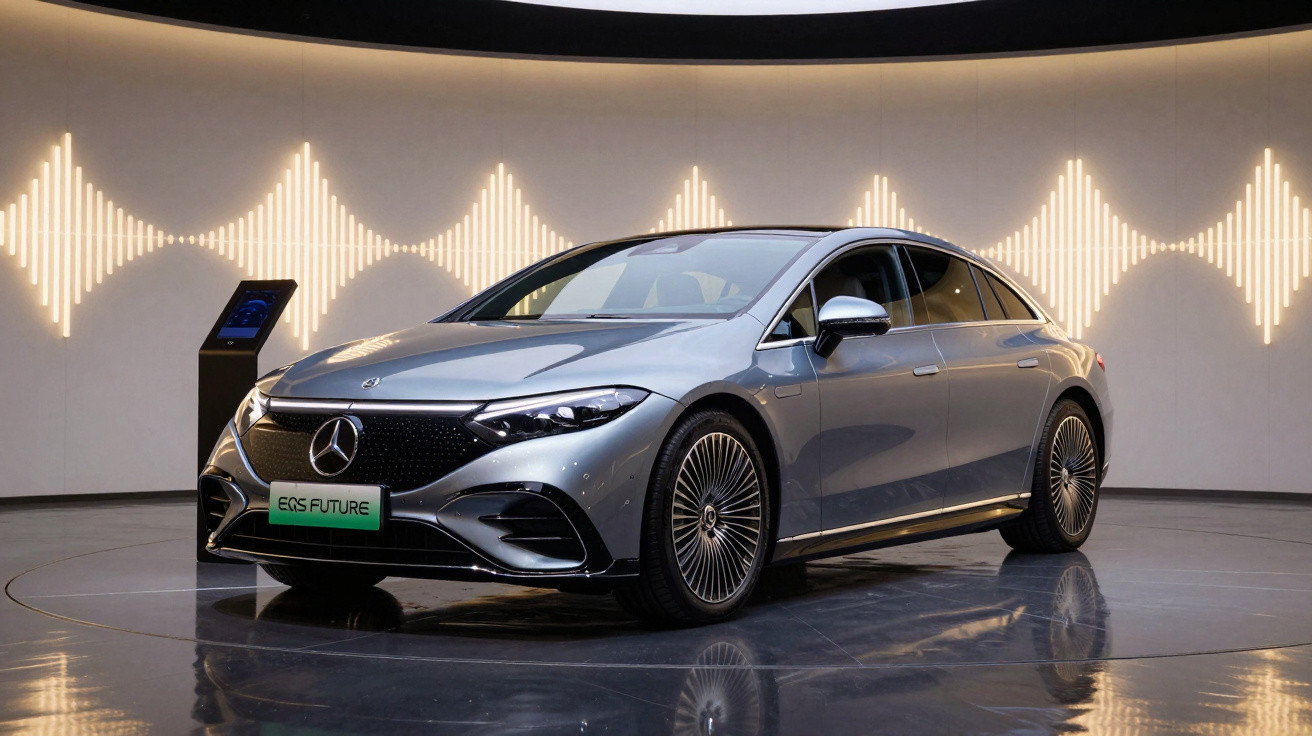
The Mercedes-Benz EQS, the German brand’s new electric flagship, will be fully unveiled in a few weeks’ time. That has not, however, stopped a number of details about this all-new model from emerging in advance.
Following the reveal of the concept in 2019, we had the chance to drive it in early 2020, when we learned that the EQS would introduce the MBUX Hyperscreen: an apparently uninterrupted giant display measuring 141 cm wide, although it is actually made up of three OLED screens. It can now be seen fitted within the production model’s cabin.
The Hyperscreen will be an optional feature on the new EQS. Mercedes-Benz has also used this opportunity to reveal the standard interior of its new model, shown in the images below, which adopts an arrangement similar to that seen in the S-Class (W223).
Alongside the visual impact created by the Hyperscreen, the new cabin features a steering wheel identical to that of the S-Class and a raised centre console separating the two front seats. There is an open space beneath it, as there is no transmission tunnel, while room is provided for five occupants.
The new Mercedes-Benz EQS is expected to offer more interior space than the S-Class, thanks to the dedicated EVA electric-vehicle platform on which it is based. With no combustion engine at the front and the battery positioned within the generous wheelbase, the wheels can be pushed closer to the body’s corners. This creates shorter front and rear overhangs while maximising the space available to passengers.
The most aerodynamic Mercedes of all
As a result, the EQS architecture gives it exterior proportions that differ from those of the conventional S-Class. The Mercedes-Benz EQS has a “cab-forward” profile, with the cabin positioned further forward. Its passenger compartment is defined by an arched “one-bow” line, or “one arc” according to the brand’s designers, with the A- and D-pillars extending towards and over the front and rear axles.
This smoothly styled electric saloon also promises to have the lowest Cx, or aerodynamic drag coefficient, of any Mercedes-Benz production model. With a Cx of just 0.20, achieved with the 19″ AMG wheels and in Sport driving mode, the EQS improves on the figures recorded by the updated Tesla Model S (0.208) and the Lucid Air (0.21), its most direct rivals.
Although it cannot yet be viewed in its entirety, Mercedes-Benz says the EQS exterior will be defined by the lack of creases and a reduced number of lines, with smooth transitions between every section. A distinctive light signature is also expected, featuring three illuminated points joined by a light bar. At the rear, another light bar will link the two lamp units.
Absolute silence? Not quite
Particular attention has naturally been paid to occupant wellbeing. Not only are high levels of ride and acoustic comfort expected, but the cabin air quality is also set to be better than that outside. The new Mercedes-Benz EQS can be fitted with a large HEPA (High Efficiency Particulate Air) filter, approximately the size of an A2 sheet at 596 mm x 412 mm x 40 mm. Available as an option within the Energizing Air Control package, it prevents 99.65% of micro-particles, fine dust and pollen from entering the cabin.
Finally, as it is fully electric, near-silent progress on board is to be expected. Mercedes nevertheless intends the EQS to provide an “acoustic experience”, with an optional sound generated while driving that adapts to the driver’s style or the selected driving mode.
When equipped with the Burmester sound system, two “soundscapes” are available: Silver Waves and Vivid Flux. The first is described as a “clean and sensual sound”, while the second is “crystalline, synthetic, but humanly warm”. There is also a third, more intriguing choice: Roaring Pulse, which can be activated through an over-the-air update. Inspired by “powerful machines”, it is the most “sonorous and extrovert” option. An electric car that sounds like it has a combustion engine? It appears so.



Comments
No comments yet. Be the first to comment!
Leave a Comment