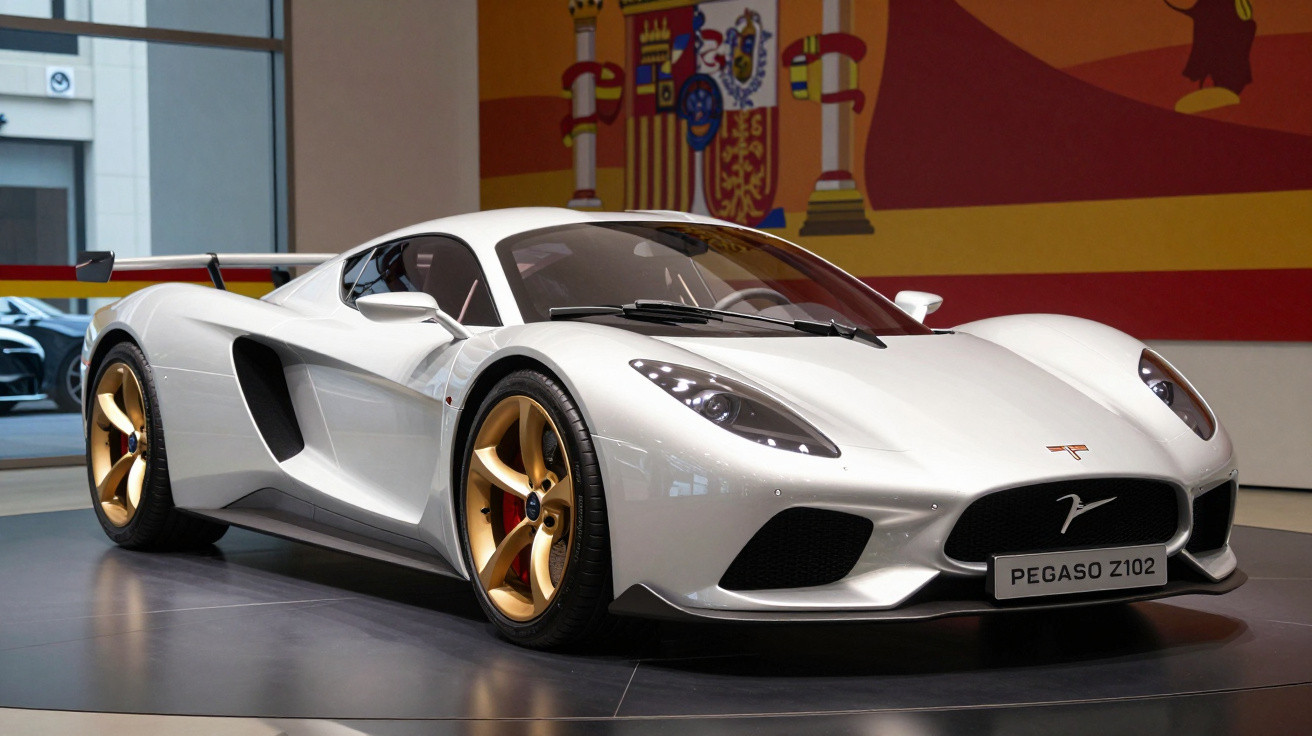
When Spain’s motor industry is mentioned, the names that usually come to mind are SEAT or, more recently, CUPRA, alongside the revived Ebro and Santana brands.
Yet there was a period when Spain dared to take on Ferrari, Maserati and Jaguar in the most exclusive area of automotive engineering. It did so through Pegaso, a marque that, for several years, stood alongside some of the industry’s most illustrious names.
The surprising part? Pegaso was never truly a sports car manufacturer. Its core purpose was building lorries.
The brand created to rebuild a country
Pegaso was founded in 1946 as part of ENASA (Empresa Nacional de Autocamiones), the state-owned company established to make use of the former Hispano-Suiza facilities and restore industrial capacity to a Spain scarred by the Civil War and the Second World War.
Its initial mission was straightforward: to produce lorries, buses and engines suited to the needs of a recovering economy.
That changed when Wifredo Ricart arrived. Having spent several years at Alfa Romeo, where he worked alongside Enzo Ferrari, not always harmoniously, the Spanish engineer returned home convinced that a sports car could showcase the capabilities of the country’s engineering sector.
“Who wants a prancing horse when they can have a flying horse?”
- Wifredo Ricart
The plan appeared almost unrealistic in a nation still dealing with post-war economic hardship. However, Ricart believed that the technology created for an exceptional car would ultimately benefit the entire industry.
That vision became reality in 1951 with the launch of the Pegaso Z-102.
Pegaso Z-102: a laboratory on wheels
Ricart never viewed the Z-102 as a car intended for mass production. Every example was conceived as an ongoing exercise in refinement, putting engineering and quality ahead of volume.
ENASA manufactured almost every component in-house. Only a small number of items, including the brakes and part of the Bosch ignition system, came from outside suppliers. This was an unusual approach for a manufacturer whose principal business remained the production of heavy vehicles.
Its technical sophistication was striking. The steel chassis delivered high torsional rigidity and accommodated an advanced aluminium V8 engine with four overhead camshafts, dry-sump lubrication and liquid-sodium-cooled exhaust valves, a solution used in aircraft engines. The five-speed manual gearbox was installed by the rear axle in a transaxle arrangement, providing more balanced weight distribution.
Three V8 versions were offered during production: 2472 cm³, producing 160 hp or 180 hp; 2816 cm³, delivering 200 hp or 260 hp; and 3178 cm³, with 210 hp or 280 hp in the versions fitted with a Roots supercharger.
In the lightest cars, weighing close to one tonne, this produced an exceptional power-to-weight ratio for the early 1950s.
International recognition followed in 1953. At Jabbeke in Belgium, a supercharged Z-102 Touring driven by Celso Fernández set several international records.
Over the flying kilometre, it recorded an average speed of 243.079 km/h, beating the figure previously achieved by the Jaguar XK120. From then on, Pegaso was presented as the world’s fastest production car.
As exclusive as a Ferrari
The Z-102’s exclusivity went far beyond its mechanical specification. Early examples used bodywork designed by Medardo Biolino, but Ricart soon recognised that the car’s true potential lay in sending its chassis to Europe’s finest coachbuilders.
Italy’s Touring produced several of the Z-102’s most elegant bodies, using its Superleggera construction method. French firm Saoutchik created some of the most extravagant versions, while Spain’s Serra was responsible for a range of open-bodied designs.
The outcome was an unusual degree of variety. Although they shared the same mechanical basis, it was difficult to find two identical Pegasos. Just 86 units were produced between 1951 and 1957.
Its successor, the Z-103, sought to simplify the Z-102’s complex formula through a more conventional V8 layout. The project progressed little beyond the experimental stage, and only three examples were completed, making it one of the rarest cars ever built in Spain.
Despite the prestige it earned, the venture was difficult to justify. Each car required substantial investment in engineering and specialised labour, while production numbers were virtually symbolic.
The Z-102 was never designed to make a profit. Its purpose was to demonstrate that Spanish engineering could rival Europe’s finest manufacturers. In that respect, it succeeded.
Innovation took a different direction
The end of Pegaso sports cars did not mark the end of the marque’s technical boldness. Its readiness to explore new solutions was simply redirected towards heavy vehicles.
One of the clearest examples was the Pegaso Z-207, known as the Barajas because of the location of the factory where it was built, on the outskirts of Madrid. Introduced in 1954, it was among the most advanced lorries of its era. Equipped with a direct-injection V6 diesel engine, a light-alloy block and independent front suspension, it could carry between five and six tonnes at speeds of up to 90 km/h.
But innovation was the enemy of financial viability. Its engineering was far ahead of market realities: it was an expensive, complex lorry that was difficult to repair at a time when most workshops lacked the resources to deal with such advanced solutions.
A few years later came the Comet, developed in partnership with Britain’s Leyland. It was a more sensible lorry, simpler and cheaper to manufacture, with an emphasis on durability and ease of maintenance. The formula worked. The Comet became a commercial success and helped strengthen Pegaso’s reputation.
The 1980s brought the Pegaso Troner. Launched in 1987, it once again raised the bar for comfort, aerodynamics and build quality, and is still remembered as one of the Spanish motor industry’s most significant lorries.
Iveco’s acquisition of ENASA in 1990 marked the beginning of Pegaso’s gradual disappearance. Over the following years, the Spanish name was progressively replaced by that of the Italian company.
Today, Pegaso is chiefly remembered for the lorries that helped modernise road transport in Spain.
For several years, however, a brand established to build heavy vehicles showed the world that it could also create some of the most sophisticated, fastest and most exclusive cars of its time.



Comments
No comments yet. Be the first to comment!
Leave a Comment