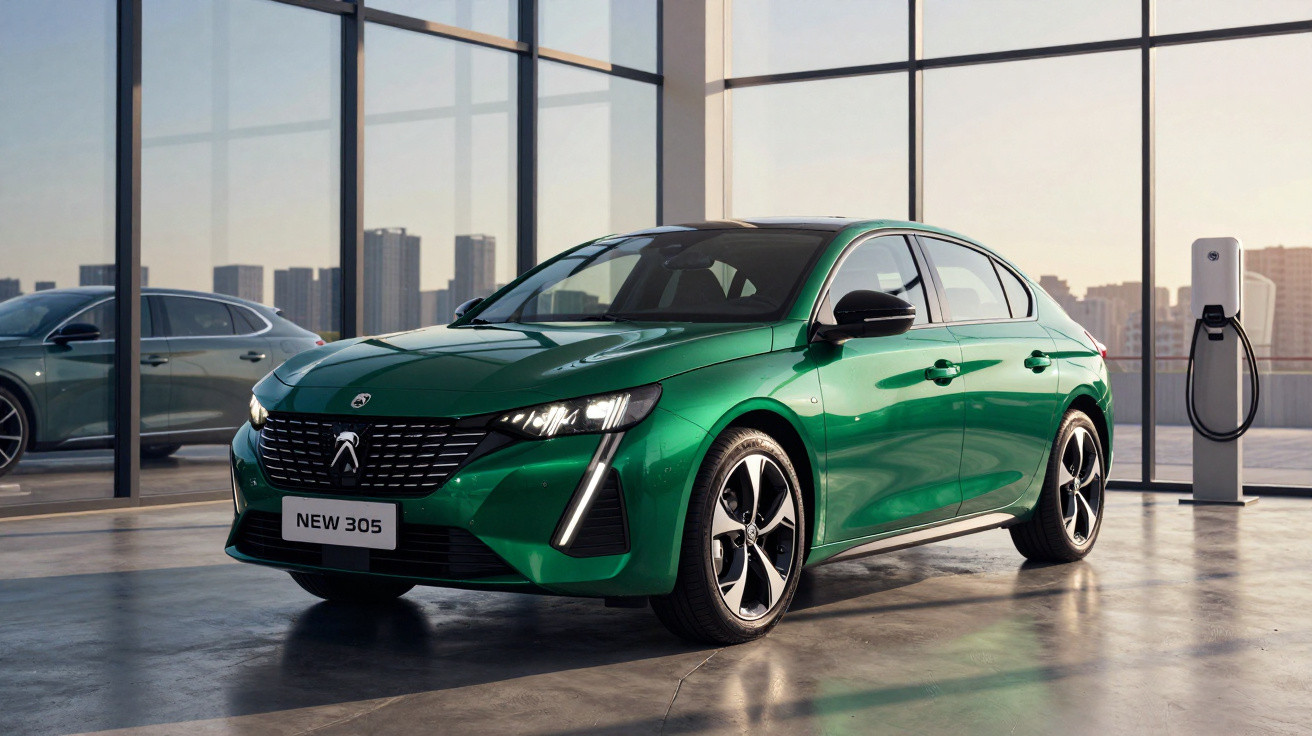
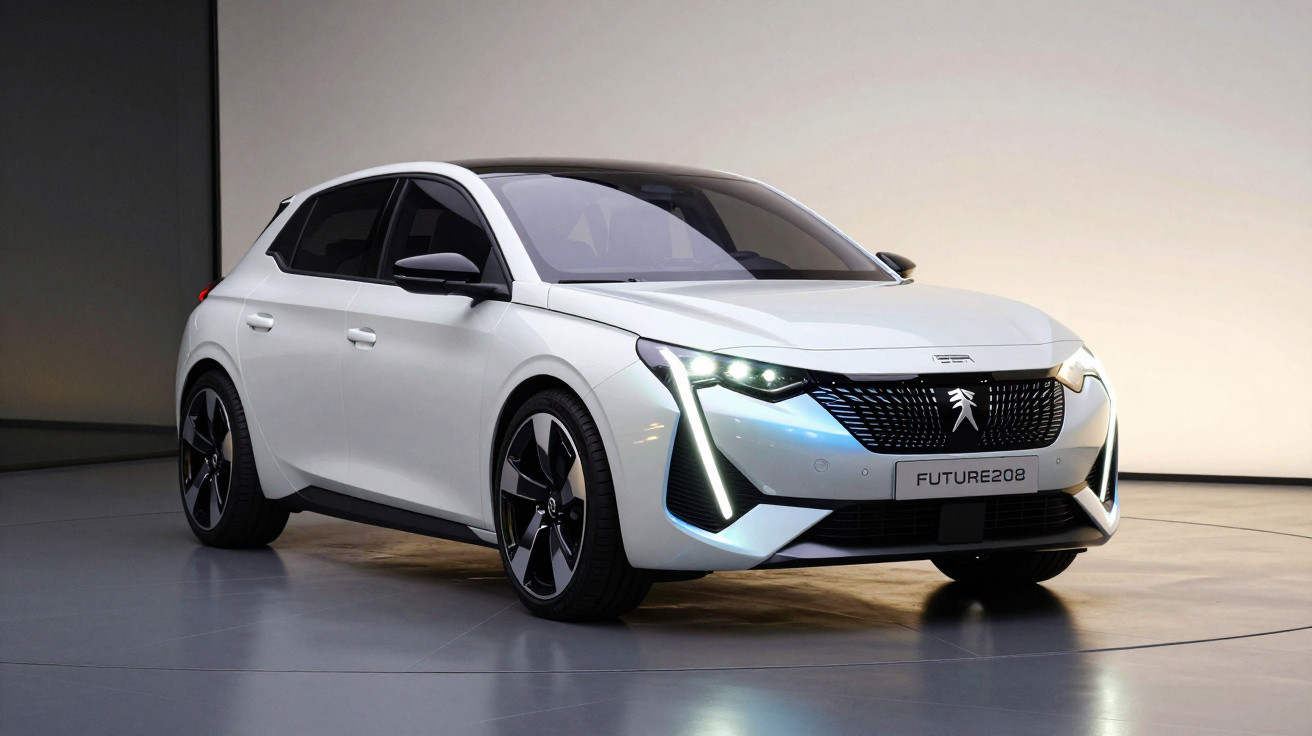
The new Peugeot 308 has just been unveiled, reflecting the French brand’s drive to move further upmarket. In this third generation, the compact family car from the ‘lion brand’ adopts its most sophisticated look yet. There are major developments elsewhere too, with its technology offering now more extensive than ever.
Raising its positioning and status has long been a stated aim for Peugeot. That ambition is embodied by the brand’s new crest and logo. The result is a model that appears to have everything required to continue giving the Volkswagen Golf a “hard time”.
With more than 7 million units sold, the 308 ranks among Peugeot’s most important models. It is therefore no surprise that it was selected to debut the marque’s new badge, displayed proudly at the centre of the generously proportioned front grille. It also appears on the flanks, behind the front wheel, recalling a certain Italian brand…
Larger in almost every direction
The new 308 sets itself apart from its predecessor through more expressive styling and a generous array of details and decorative touches. The changes extend well beyond appearance, however. Although the new Peugeot 308 continues to use the EMP2 platform of its predecessor, it has been extensively revised. In this third generation, the new 308 has grown in almost every dimension.
It is 110 mm longer, at 4,367 mm, while its wheelbase has increased by 55 mm to 2,675 mm. It is also 48 mm wider, measuring 1,852 mm. However, it is 20 mm lower, with a height of 1,444 mm.
Its profile is consequently sleeker, a quality also highlighted by the more sharply raked A-pillar. It does not simply look more aerodynamic: it genuinely is. Aerodynamic drag has been lowered through the optimisation of various areas, from the underbody cladding to the careful design of the door mirrors and pillars. The Cₓ is now 0.28, while the S.Cₓ (frontal area multiplied by the drag coefficient) falls to 0.62, almost 10% lower than its predecessor.
The increased exterior dimensions are reflected in the cabin, with Peugeot claiming more knee room for rear passengers. The boot is marginally smaller in this new generation, however: 412 l rather than 420 l. There is now a 28 l storage compartment beneath the floor.
Peugeot 308 interior retains the i-Cockpit
As has been customary for almost 10 years, the interior of the new Peugeot 308 remains centred on the i-Cockpit. Its instrument panel is always digital and measures 10 inches, adopting 3D technology from GT trim upwards. It is positioned higher than usual and paired with a compact steering wheel.
Besides being small, the steering wheel has an almost hexagonal shape and now incorporates sensors that can detect the driver’s grip, complementing the new driving assistance systems. It can also be heated and includes controls for the radio, media, telephone and driving aids.
In this generation, the air vents have also been moved higher up the dashboard, a more effective position that places them directly in front of the occupants. This “pushes” the 10-inch infotainment display lower down and closer to the driver’s hand. Also new are the configurable touch-sensitive buttons directly beneath the screen, which act as shortcut keys.
As with the brand’s latest launches, the new Peugeot 308’s cabin has a sophisticated, almost architectural appearance. The centre console in versions fitted with the automatic gearbox (EAT8) is particularly notable, dispensing with a conventional selector in favour of a discreet toggle for switching between R, N and D, alongside buttons for P and B mode. Driving modes are selected using another button positioned further back.
It must deliver as well as look the part
According to Peugeot, the more upmarket positioning it seeks for itself and its new model will also result in a more refined driving experience. To achieve this, the brand has optimised the car’s structural rigidity through greater use of industrial adhesives, while also giving more attention to refinement and sound insulation.
The windscreen can be heated, and the glass is thicker both front and rear. The front side windows can also feature acoustic laminated glass, depending on the version. The seats promise improved ergonomics and comfort, having received the AGR label (Campaign for Healthy Backs), and can optionally include electric adjustment and a massage system.
On-board comfort is also enhanced not only by the presence of a FOCAL audio system, but also by the introduction of a system that monitors cabin air quality and automatically activates air recirculation when needed. In GT trim, this is supplemented by an air-treatment system, called Clean Cabin, which filters pollutant gases and particles.
Two plug-in hybrids available from launch
When the new Peugeot 308 reaches the market in a few months’ time - with indications pointing to its arrival in key markets from May - it will be offered from the outset with two plug-in hybrid powertrains.
They are not entirely new, having already appeared in other models from the former Groupe PSA. Both combine a 1.6 PureTech petrol internal-combustion engine, producing either 150 hp or 180 hp, with an 81 kW (110 hp) electric motor. This produces two versions:
- Hybrid 180 e-EAT8 - 180 hp of maximum combined power, up to 60 km of range and CO₂ emissions of 25 g/km;
- Hybrid 225 e-EAT8 - 225 hp of maximum combined power, up to 59 km of range and CO₂ emissions of 26 g/km
Both use the same 12.4 kWh battery, which reduces boot capacity from 412 l to 361 l. Charging times range from just over seven hours, using a 3.7 kW charger and a domestic socket, to almost two hours with a 7.4 kW charger and wallbox.
The remaining internal-combustion powertrains are familiar offerings:
- 1.2 PureTech - 110 hp, six-speed manual gearbox;
- 1.2 PureTech - 130 hp, six-speed manual gearbox;
- 1.2 PureTech - 130 hp, eight-speed automatic gearbox (EAT8);
- 1.5 BlueHDI - 130 hp, six-speed manual gearbox;
- 1.5 BlueHDI - 130 hp, eight-speed automatic gearbox (EAT8);
Semi-autonomous driving
Finally, as expected, the new Peugeot 308 significantly strengthens its driving assistance package with Drive Assist 2.0, enabling Level 2 semi-autonomous driving. This option will be available towards the end of the year.
Drive Assist 2.0 includes adaptive cruise control with a Stop&Go function when equipped with the EAT8, lane-keeping assistance, and three additional functions: semi-automatic lane changes, from 70 km/h to 180 km/h; advanced speed recommendations based on road signs; and speed adaptation in bends, up to 180 km/h.
The list does not end there. Depending on the version, standard or optional equipment may include a new 180° high-definition rear camera, 360° parking assistance using four cameras, adaptive cruise control, automatic emergency braking capable of detecting pedestrians and cyclists by day or night from 7 km/h to 140 km/h, a driver attention alert, and more.



Comments
No comments yet. Be the first to comment!
Leave a Comment