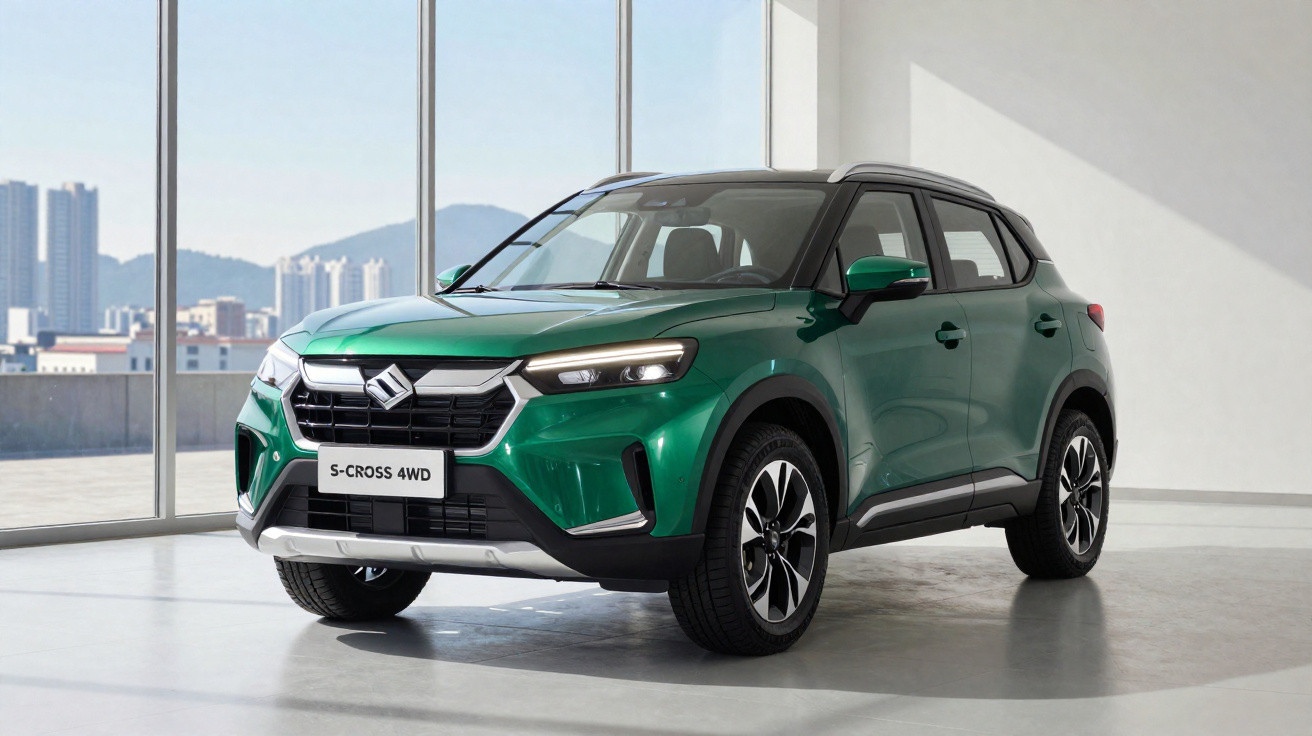
The second-generation Suzuki S-Cross enters the domestic market with an even tougher job than its predecessor, which arrived in 2013.
Not only has this segment continued to expand with new offerings, but those models have also kept advancing in equipment and size.
That leaves the new S-Cross in an unusual position. Its second generation uses the same platform as before, inheriting the first S-Cross’s dimensions down to the millimetre.
Where its 4.3 m length placed it alongside C-SUVs around 10 years ago, its external measurements and cabin dimensions now align it more closely with the segment below: B-SUVs. That class has grown too, and Suzuki already competes in it with the Vitara.
With the S-Cross sitting somewhere between the two segments, we set out to assess the case made by this second generation. For now, it is offered solely with a turbocharged petrol mild-hybrid powertrain, although it also brings all-wheel drive - an uncommon feature at this end of the market.
Economical, but not only that
It makes sense to begin with the powertrain, which is already familiar from the previous S-Cross, the Vitara and even the Swift Sport. The 48 V 1.4 turbo mild-hybrid engine, paired here with a six-speed manual gearbox, does not disappoint in Suzuki’s Japanese crossover.
Producing 129 hp at 5500 rpm and 235 Nm from 2000 rpm to 3000 rpm, with a further 10 kW (14 hp) potentially supplied by the electric motor-generator, it may not be the “king of the specification sheet”. In real-world use, however, it proves very well suited to a model with the Suzuki S-Cross’s character.
It accelerates with reassuring ease, while its in-gear response highlights both the engine’s flexibility and the manual gearbox’s well-chosen ratios.
The gearbox itself also makes no attempt to “hide” its Japanese roots, offering a pleasantly mechanical shift action. It does not quite reach Mazda standards, but it is likely to win over an enthusiast more quickly than some European manual gearboxes.
The engine’s readiness across the rev range and the contribution of the mild-hybrid system are also apparent at the pumps.
During this test, averages between 5.5 l/100 km and 6.0 l/100 km were easy to achieve. Even when the K14D was worked harder, consumption did not rise beyond 6.5 l/100 km to 7.0 l/100 km.
In dynamic terms, the S-Cross feels particularly nimble, giving the impression that it is lighter than its claimed 1360 kg (EU). It does not feel as “heavy” as other C-SUVs, or even certain B-SUV alternatives.
Its suspension strikes a convincing balance between family-friendly comfort and cornering ability, with precise, predictable responses through bends. The only disappointment is the steering, which is quick and direct but excessively filtered.
Suzuki S-Cross all-wheel-drive ability
Suzuki has a long off-road heritage, so the all-wheel-drive Suzuki S-Cross had to be tested away from tarmac.
In these conditions, the Japanese brand again shows that it does not leave “anything to chance”, with the S-Cross travelling considerably further than initially expected.
The all-wheel-drive system transfers torque between the axles quickly, copes well with slippery surfaces and is not “frightened” by axle articulation either.
The only real limitation here is the Suzuki model’s modest ground clearance, which rules out more demanding adventures. A few extra centimetres of clearance and better approach and departure angles could even make the S-Cross an alternative to the Dacia Duster for buyers who need, or simply do not want to give up, genuine off-road ability.
Proven solutions
While the Suzuki S-Cross makes a compelling argument mechanically and dynamically, its cabin is less convincing.
There is nothing wrong with its conservative design, but several of the solutions used are a reminder that the foundations of this second generation are older than expected. On the other hand, the use of tried-and-tested solutions has a positive effect on usability.
For instance, positioning the central screen above the air vents - a solution adopted by several manufacturers - works very well from an ergonomic perspective. Although it does not always improve the appearance, it places the display closer to the driver’s line of sight and within easier reach.
Material quality is less impressive, especially given the class in which it competes, as hard plastics are used extensively. Assembly quality does not attract particular criticism, although some finishing details still have room for improvement.
Finally, the unchanged dimensions of the new S-Cross are noticeable in terms of accommodation, with interior room closer to B-SUV standards than C-SUV ones.
There is enough space for a young family, as well as a 430 l boot that should cover most family requirements.
However, the Japanese contender feels less spacious inside than, for example, a Renault Captur or even a Skoda Kamiq, whose boots offer up to 536 l in the French model and 400 l in the Czech model respectively.
Is it the right car for you?
I began by saying that the Suzuki S-Cross faces a difficult task and, after driving it for several days, I do not think it will have an “easy life”.
On its side are above-average agility, a very generous equipment specification - S3 is the best-equipped trim - an economical engine and, in this version, all-wheel drive. It is also available with front-wheel drive, but four-wheel drive remains extremely rare among its potential rivals.
Nevertheless, the fact that the new S-Cross is based on its predecessor is apparent. Its cabin space is some way from the class benchmarks, and there are now B-SUVs offering more room. The ambience of its interior also trails behind the competition.
At €32,470 for the test car, its price ultimately feels higher than expected, even when its equipment and all-wheel drive are taken into account. The two-wheel-drive version is only €630 cheaper.



Comments
No comments yet. Be the first to comment!
Leave a Comment