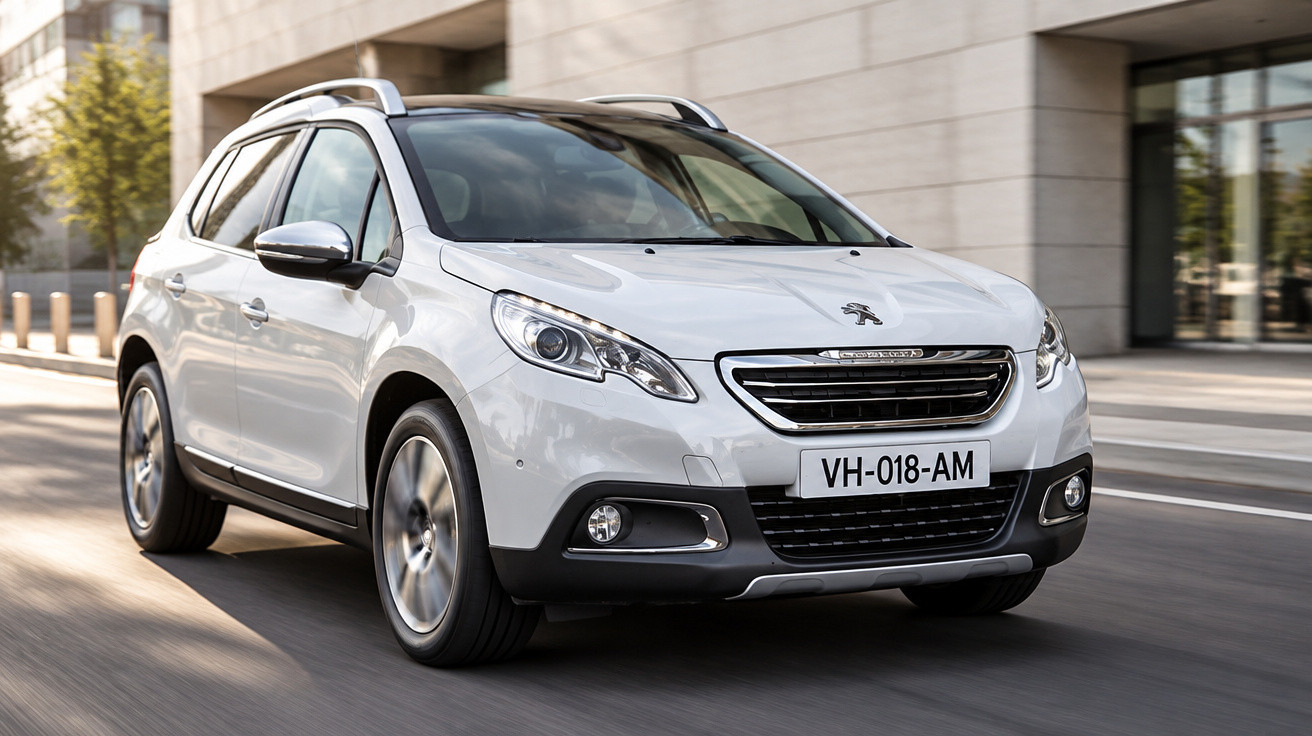
Yet another small crossover?
Yes. The Peugeot 2008 is effectively a beefed-up Peugeot 208, designed to compete for buyers with the Vauxhall Mokka and Ford B-Max, and perhaps even the Nissan Juke, although the Nissan is slightly larger and costs a little more. Years ago, this role might have been filled by a compact estate such as the old 207 SW. Crossovers now dominate, however, so this is the direction in which the 208 has been expanded.
Peugeot 2008 size and practicality
So, how large is it?
The cabin feels much like that of a 208, though rear-seat occupants benefit from additional headroom. From the outside, it is less substantial than the photographs imply: even at the roof rails, it is under 1.52 metres tall. Its boot is usefully sized, while the load bay runs level with the opening to make loading easier. Fold the rear seats and they lie entirely flat, leaving ample space for several bags of footballs.
The interior looks much like a 208's...
The fundamental arrangement is unchanged, apart from a fresh handbrake styled like an aircraft control, but the choice of materials has been revised. In place of the normal piano-black surfaces and silver-coloured trim, there are satin-painted finishes and more tactile textures. The example we drove featured copper-toned surrounds for the air vents, fabric across the dashboard that resembled hessian matting, and upholstery that looked rather like gold fishnet.
Should the taste police be called?
It may sound like an odd collection of elements, yet it comes together rather successfully. The impression is of designers spending hours in furniture shops, touching lampshades and sofas while considering how the same effects might translate into a car. More than once, we caught ourselves stroking the dashboard or tracing a finger around the vents. It is a shame the exterior styling is not as attractive.
Peugeot 2008 styling and driving experience
But it appears fine in the pictures.
In person, it is simply a little... anonymous. Its body surfaces seem somewhat plain, with fussy details and add-ons used to disguise less flattering proportions. Notice the bend in the roof: chrome pieces above the rear doors split up its visual mass. At first glance, the roofline seems to follow the sweeping shape of the roof rails. In fact, it rises above the B-pillar, as on a Skoda Roomster, and that is unattractive. We would confidently bet this will not become a design classic.
Right. But is it good to drive?
Its road manners are the greatest surprise. This VTI weighs only 1080kg and is not especially tall, so there is little looseness or body roll. The 1.6-litre petrol engine, a detuned version of the unit used in the 208 GTI, is lively and refined. Ride quality is controlled on both 16-inch and 17-inch wheels, while the steering carries more weight and feedback than that of a standard 208. The 1.6-litre diesel, by contrast, adds a full 100kg, with much of that mass over the front axle, and consequently feels less nimble.
Peugeot 2008 off-road ability
Can it go off road?
If you really insist. The 2008 is available only with front-wheel drive, although more expensive models receive Peugeot's ‘Grip Control’ system, which electronically apportions power across the front axle. As in a Range Rover, you select the type of surface beneath you. Unlike a Range Rover, though, it will not conquer the terrain completely. In essence, it is a sophisticated, if reasonably capable, traction-control system... and a mildly unnecessary gesture towards SUV credentials.
Stats:
1598cc, 4cyl, FWD, 120bhp, 122mph max, 0-62mph 9.5secs, 1085kg



Comments
No comments yet. Be the first to comment!
Leave a Comment