An automatic gearbox is a major convenience in stop-start traffic, but it is also a complex and potentially expensive part of a modern car. The confusion starts when owners see phrases such as ‘filled for life’ or find no obvious gearbox service interval in the handbook.
The sensible approach is not to assume that every automatic needs routine fluid changes, nor that no maintenance will ever be needed. Check the maintenance information for your exact car and gearbox, then seek advice from a suitably equipped garage if its history is unclear or the transmission is behaving differently. The correct fluid, level-setting procedure and timing matter far more than a blanket rule.
Why automatic gearbox servicing can matter
An automatic transmission is not simply a manual gearbox that changes gear on its own. Depending on the design, it may contain a torque converter, wet clutches, hydraulic passages, a valve body, electronic controls and, in some cases, twin clutches.
Its fluid may lubricate components, help manage heat and operate hydraulic controls. In transmissions with wet clutches, it can also play a part in smooth clutch engagement. Heat, repeated use and normal wear can gradually affect fluid condition.
‘Lifetime fill’ is not a universal promise that a gearbox will never need attention. Its meaning depends on the manufacturer, transmission design and intended service conditions.
That does not mean every automatic gearbox should be flushed at the same mileage. Some have specified service intervals; others do not. The key point is that the gearbox should be considered as part of the vehicle’s maintenance plan, rather than ignored because it has no dipstick under the bonnet.
Start with the exact vehicle information
The owner’s handbook, digital service record and official maintenance schedule for the specific vehicle should be your first reference. Requirements can differ between engines, model years and gearbox versions, even within the same model range.
Some manufacturers specify a fluid replacement by time or mileage. Others give different advice for demanding use. Conditions that can place extra load on a transmission may include:
- Frequent short journeys and congested urban driving
- Regular towing or carrying heavy loads
- Repeated hill driving
- Taxi, delivery or driving-school work
- Long periods of high-load driving
- Very hot operating conditions
UK driving often involves low average speeds, queues, wet roads and short trips. These conditions do not automatically mean your car needs an earlier gearbox service, but they are worth discussing with a garage when the handbook includes an alternative schedule for demanding use.
If the documentation is unclear, a franchised dealer can usually identify the factory-fitted gearbox from the vehicle identification number. A reputable independent transmission specialist may also be able to check the correct technical information. Avoid relying on a generic interval found online.
Fluid and parts must match the gearbox
‘Gearbox oil’ is convenient shorthand, but different transmissions need very different fluids. A conventional torque-converter automatic generally uses automatic transmission fluid. A dual-clutch gearbox may use one or more specialist fluids, while a continuously variable transmission (CVT) requires its own specified fluid.
Using an unsuitable product can affect shift quality and may cause damage. Filters, seals, sump gaskets and bolts must also be suitable for the exact transmission.
What a proper gearbox service may include
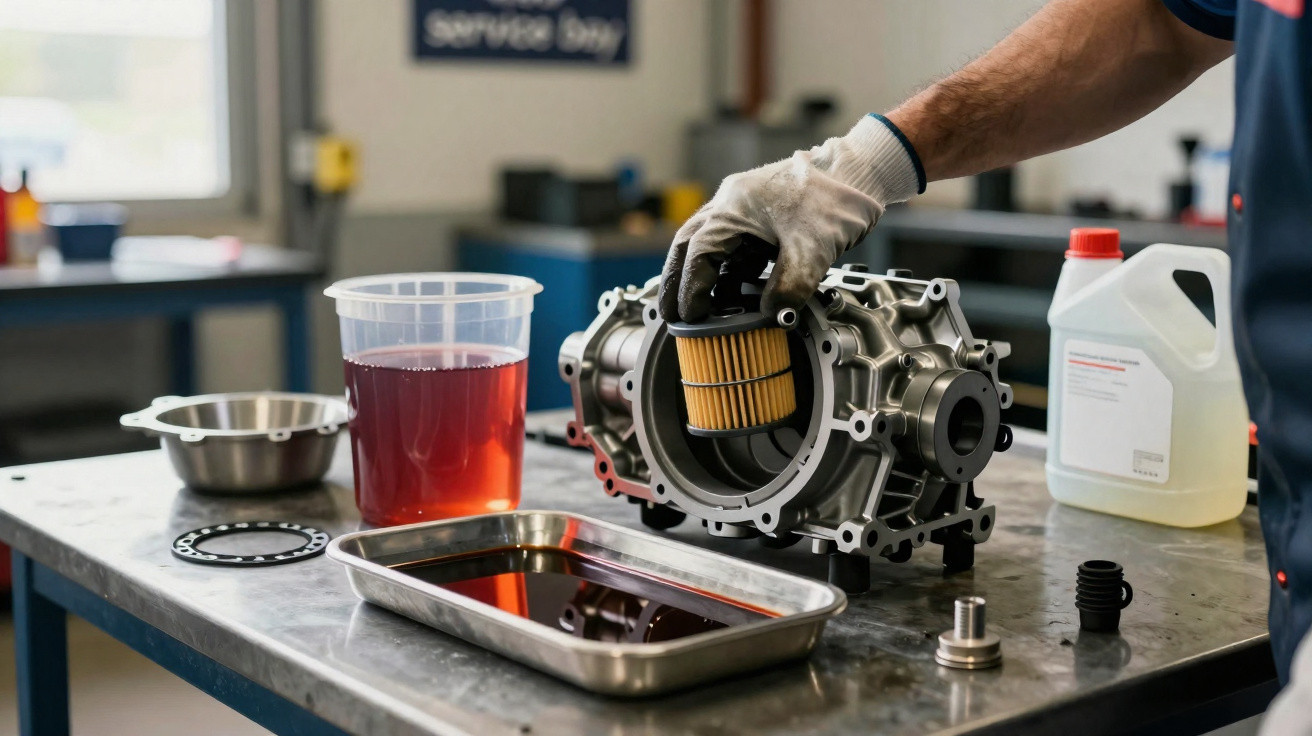
The work varies by design, but a competent garage may:
- Confirm the gearbox code and required fluid specification.
- Check for leaks, stored fault codes and reported driving symptoms before starting work.
- Drain the old fluid where the design permits.
- Replace a serviceable filter, if fitted.
- Renew seals, bolts or the sump pan when the manufacturer’s procedure requires it.
- Refill using the specified fluid and quantity.
- Set the level at the required fluid temperature, often with diagnostic equipment.
- Carry out any required adaptation procedure and road test the vehicle.
Not every transmission has a replaceable filter, and not every routine drain removes all of the old fluid. A garage should explain what its quoted service includes and what it does not.
Drain-and-fill versus fluid exchange
You may be offered a conventional drain-and-fill or a fluid exchange, sometimes called a flush. Neither option is automatically best for every car.
A drain-and-fill is commonly used where it forms part of the manufacturer’s service procedure. A fluid exchange can replace a larger proportion of the old fluid, but it requires suitable equipment, the right method and a transmission that is appropriate for the process. It should not be sold as a universal cure or as essential maintenance without reference to the vehicle’s requirements.
Be cautious with a high-mileage vehicle that has no gearbox service history and is already shifting poorly. New fluid cannot repair worn clutches, faulty solenoids or internal mechanical damage. A service may be recommended after diagnosis, but it is not a substitute for diagnosing the fault.
Gearbox maintenance is intended to help preserve a healthy transmission. It is not a guaranteed fix for slipping, shuddering or warning messages.
Before authorising work, ask for the recommendation in writing. It should state the fluid specification, whether a filter will be changed, how the level will be set and whether diagnostic checks are included.
Symptoms that need an inspection
A gearbox does not need to fail dramatically before it deserves attention. Book an assessment promptly if you notice:
- Delayed engagement when selecting Drive or Reverse
- Harsh jolts, hesitation or a sudden rise in engine revs between gears
- Shuddering when moving away or at low speed
- Whining, humming or grinding noises
- A burning smell or visible fluid leak
- A gearbox warning light or dashboard message
- Reduced-power operation, sometimes described as limp mode
These symptoms are not always caused by the transmission itself. Engine problems, worn mounts, driveshaft faults, software issues and a weak battery can all affect how a car drives or shifts. Proper diagnosis before expensive work is essential.
If a warning appears or the gearbox is slipping severely, avoid towing, heavy loads and unnecessary long journeys until you have obtained advice. Continuing to drive while a transmission overheats or repeatedly slips can make a fault worse.
Manual gearboxes are not always maintenance-free
Manual gearboxes are often simpler, but their oil can still age or escape through a leak. Some have stated replacement intervals, while others require attention only after certain repairs or if a problem is found.
As with automatics, the exact fluid matters. The wrong viscosity or specification can affect shift quality and synchroniser operation on some vehicles.
Clutch hydraulic fluid is separate from gearbox oil on many cars. It may share a reservoir with the brake fluid, but it does not lubricate the gears. This is one reason to use a workshop that understands the vehicle’s specific transmission arrangement.
Common mistakes to avoid
The most avoidable gearbox problems often stem from poor maintenance choices or ignoring early warnings.
- Ignoring a leak: a small seep can eventually leave the transmission low on fluid.
- Choosing fluid by colour: fluid colour is not a reliable specification; use the required product.
- Filling to a guessed level: many automatics need a temperature-controlled level-setting procedure.
- Changing fluid instead of diagnosing a fault: maintenance and fault-finding are not the same job.
- Using unapproved additives: do not add treatments unless they are explicitly permitted for the transmission.
- Coasting in Neutral: this removes engine braking and may be unsafe; follow the handbook’s driving guidance.
- Towing incorrectly: many automatics have strict restrictions on flat towing, particularly with driven wheels on the road.
Never work beneath a car supported only by a jack. Transmission fluid can be hot, and incorrect lifting, draining or filling can cause injury and vehicle damage. For most owners, fluid changes and level checks are jobs for a properly equipped workshop.
Planning the next step
Check your service book, online service record or manufacturer app and note the car’s age, mileage and gearbox type. If you cannot establish whether the transmission has previously been serviced, do not guess or authorise a generic package immediately.
Obtain quotes from a franchised dealer and a well-regarded independent transmission specialist. Compare the detail, not just the price: ask which fluid will be used, what parts are included, whether diagnostic checks are carried out and how the final level is set.
Keep invoices showing the fluid specification and work completed. Good records are useful for your own maintenance planning and help a future buyer understand the car’s history. The best protection for an automatic gearbox is informed, model-specific maintenance rather than blind faith in a label or an unnecessary service sold without evidence.















Comments
No comments yet. Be the first to comment!
Leave a Comment