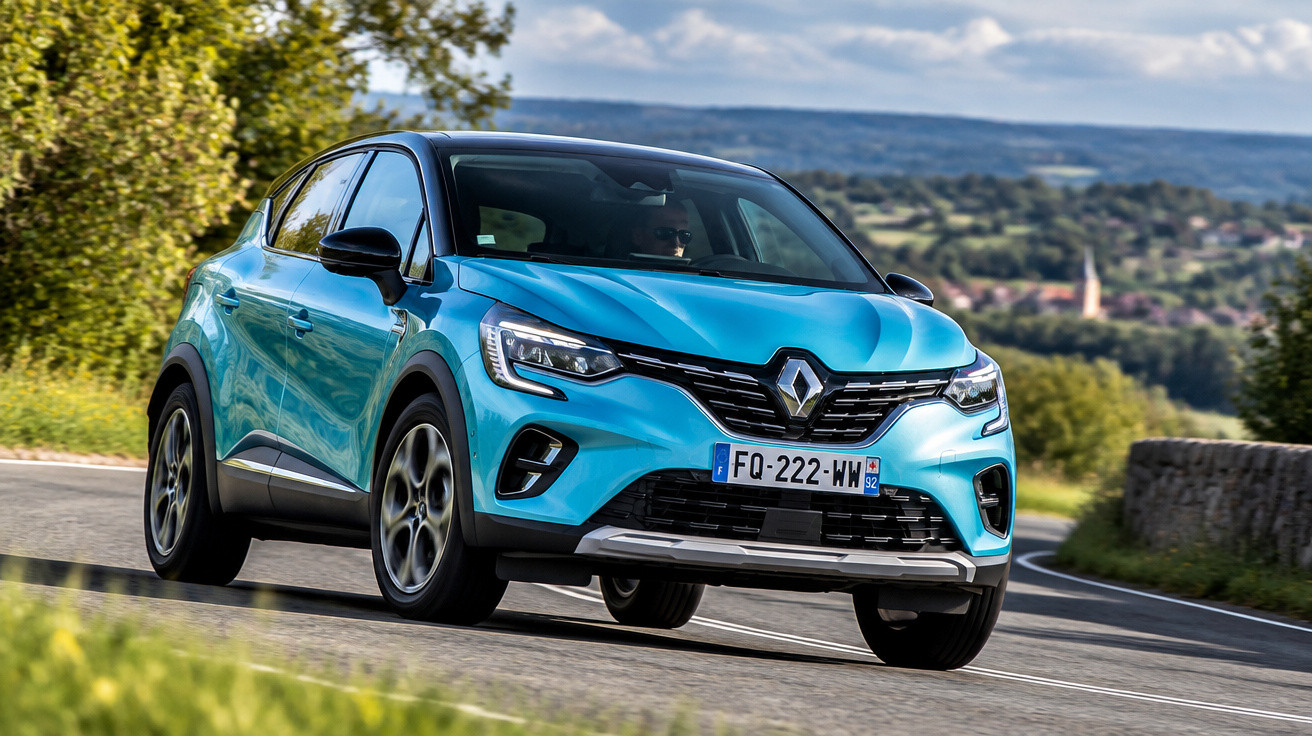
What exactly is the Renault Captur E-Tech?
Before you nod off through familiarity, it is worth pointing out that this is not merely an ordinary second-generation Renault Captur. Thankfully.
Visually, there is almost nothing to distinguish it, aside from a fuel flap on each rear quarter, but this is in fact the plug-in hybrid Renault Captur E-Tech.
You may already know the E-Tech name. It refers to Renault’s Formula 1-inspired hybrid set-up, combining two electric motors with a 1.6-litre four-cylinder petrol engine and a six-speed automatic transmission.
That gearbox is particularly intriguing. It is a clutchless, multi-mode dog-type transmission, much like those used in F1. The smaller electric motor synchronises engine speed with road speed to make gear changes smooth. It also fires up the combustion engine when required, although only while the car is moving: when you switch it on, the Captur will always pull away in EV mode. It is an impressively clever arrangement.
Renault Captur E-Tech powertrain and charging
The larger electric motor powers the front wheels. It can operate alone for 30 miles at speeds of up to 83mph, or work alongside the petrol engine according to the selected driving mode.
Renault says the powertrain’s intelligent control unit can choose from as many as 15 combinations of energy source and gear ratio. There is no reverse gear in the sophisticated transmission, either, because reversing is handled solely by electric power. Its 9.8kWh battery needs between three and four hours for a complete recharge, with charging capped at 3.6kW.
Despite the system’s complexity, Renault maintains that it represents good value. Yet at £30,495, the S Edition E-Tech PHEV costs roughly £5,000 more than a like-for-like 128bhp 1.3-litre petrol Captur. Ouch.
How does the Renault Captur E-Tech drive?
Most importantly, the E-Tech is now the most powerful Captur offered to UK customers. Its hybrid system delivers 158bhp and 257lb ft of torque in total, giving it a 107mph top speed and a 0-62mph sprint time of 10.1 seconds.
Those figures may not be the key consideration, although selecting Sport mode brings up an image of the Captur on a racetrack on the centre display. Optimistic.
Sport unlocks the full performance potential of the powertrain. More commonly, however, you will use the automatic MySense mode, which provides fairly linear acceleration and avoids much of the elasticated noise associated with CVT-equipped hybrids. Pure is Renault’s term for fully electric running, while E-Save lets the car use its somewhat coarse engine on its own, retaining at least 40 per cent of the EV charge for town driving later.
The entire package feels carefully considered, and the Captur’s ride and handling mirror that approach. It is a crossover, so excitement is not really on the agenda, but this second-generation model is sufficiently refined and entirely suitable for everyday use.
What fuel economy does it claim?
An admirably practical question. Renault quotes 188.3mpg and 34g/km under the WLTP test, although, as this is a PHEV, that is not an especially practical answer. Real-world consumption will come down to how often your journeys extend beyond 30 miles. You do, however, receive a free BP Chargemaster wallbox.
What is the interior like?
As with the exterior, it differs little from combustion-engined Capturs. Every E-Tech receives the frustratingly sluggish 9.3-inch portrait central touchscreen, along with a 10-inch digital instrument display and a wireless phone charger integrated into the dashboard.
The 379-litre boot is marginally smaller than that of the internal-combustion Capturs, however.
Final verdict
This is not a poor plug-in hybrid effort from Renault, but it is difficult to escape the sense that the E-Tech powertrain is better suited to the smaller, non-PHEV Clio. Its lack of rapid-charging capability is also disappointing, before even considering the price. The regular second-generation Captur earns a TG rating of 6/10, making this one distinctly middle-of-the-road…
5/10

Comments
No comments yet. Be the first to comment!
Leave a Comment