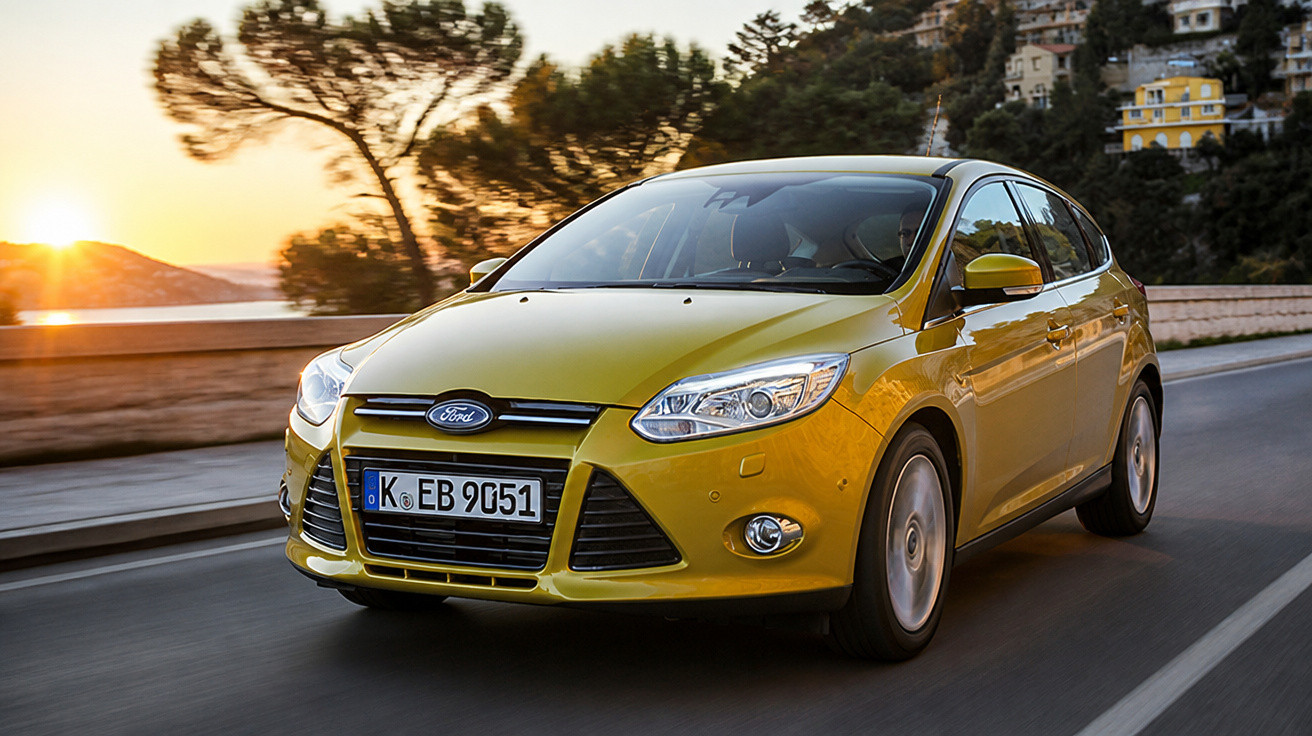
Ford Focus 1.0T: small engine, big expectations
Ford may be unwise to badge this car as the Focus 1.0T. Owning up to its tiny capacity could put off thrusting estate agents looking for a company car, yet it performs far beyond anything you might expect from 999cc.
This is a turbocharged three-cylinder unit, available with 100 or 125bhp. The more powerful 125bhp version I tested comes with a six-speed gearbox. It takes the place of the naturally aspirated 105 and 125bhp Focus models, and is considerably better to drive: quieter, more full of character and with greater torque. It is lighter too, allowing the car to turn more accurately and keenly. It also consumes substantially less petrol. What is there not to like?
Quiet, flexible performance
Its refinement is genuinely the standout feature. We have become accustomed to diesel engines in economical hatchbacks, so climbing into a small petrol car such as this is a real pleasure. Normally, it operates between 1,500 and 3,000rpm, where economy is strongest; its ample torque and lack of vibration, apart from a slight sensation through the pedals, make it a pleasant and relaxing car to use.
When you need to make faster progress, though, it is equally willing to rev. Even then it remains subdued: there is a recognisable three-cylinder beat, but it is an appealing one, with a vaguely half-a-911 character. There is no harshness whatsoever, while turbo lag and any other interference with throttle response are virtually absent.
Ingenious Ford Focus 1.0T engineering
It will also delight the engineer within you. This was designed entirely from scratch rather than being a larger engine with one cylinder removed, meaning every element has been tailored to its compact size. The engine block is as long as a sheet of A4 paper, while the powertrain is 40kg lighter than the old 1.6, or an extraordinary 150kg lighter than a 2.0 diesel. It features direct injection, twin variable camshafts and a tiny, jewel-like turbine capable of spinning at 248,000rpm.
The exhaust manifold is integrated into the cylinder head, so the exhaust gases are water-cooled. Meanwhile, the engine's narrow-bore layout gives it little inclination to knock. Consequently, it rarely requires much ignition retardation, which in turn keeps exhaust-gas temperatures lower. Finally, the turbo can tolerate gas at 1,030°C. What does that mean in practical terms? At high outputs, most turbo engines inject additional fuel purely to let it evaporate and cool the turbo. What a waste. This compact engine has been engineered to avoid needing that excess fuelling in most circumstances, so even occasional wide-throttle use should not take you far away from the official fuel-consumption figures. Unlike a Fiat TwinAir. During one particularly brisk drive across hilly Spanish countryside, I recorded 40mpg.
Price and economy
That means savings at the petrol station, and the pricing makes sense too. In 125bhp guise, it costs £500 more than the previous 125 1.6, while also adding an extra ratio to the gearbox. That is less than the cost of metallic paint, for Pete's sake.

Comments
No comments yet. Be the first to comment!
Leave a Comment