Hyundai is going through one of the most ambitious periods in its history. The South Korean manufacturer has gone from outsider to the world’s third-largest automotive group, yet its ambitions stretch further: to topple Europe’s leading brands. Are Volkswagen and Toyota listening?
Part of that plan involves a line-up that will continue to evolve, with several launches scheduled through to 2027, including new generations of the Bayon, i20, Tucson and Kona. The brand is particularly determined to gain ground in the electric-car market, and a new key player is on its way.
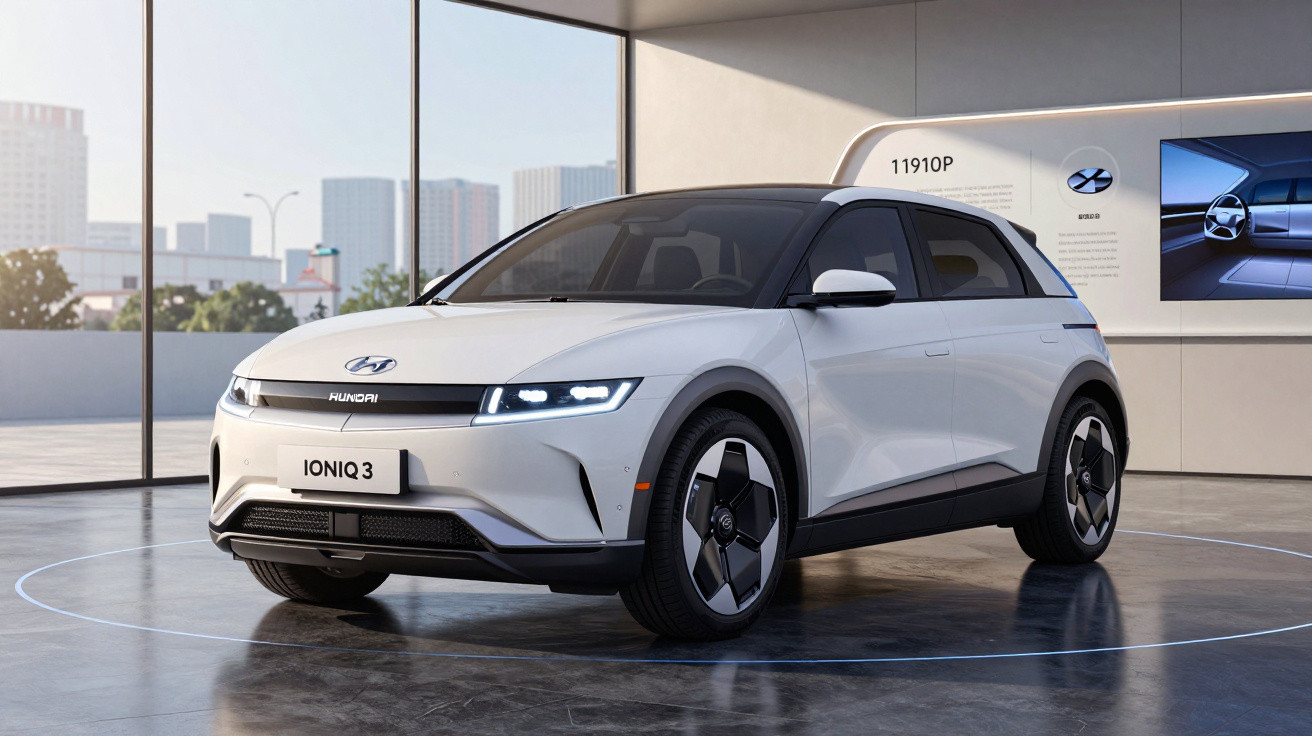
Called the IONIQ 3, it is Hyundai’s response to the Volkswagen Group’s new push into affordable electric cars. It is a B-segment electric vehicle, a class that remains among the most important in the European market and where competition is continuing to intensify.
“Car of steel”
The new IONIQ 3 adopts Hyundai’s fresh “Art of Steel” design language, inspired by the tension and purity of raw steel. It combines uncluttered surfaces with sharply defined volumes and creases, giving the impression that the bodywork has been formed from a single sheet of metal.
At both ends, like the rest of the IONIQ family, it uses a light signature made up of pixel-style elements. The real highlight, however, is the four dots at the centre which, according to Hyundai, reference the letter “H” in Morse code.
As this is a fully electric model, aerodynamics have not been overlooked either. Hyundai says the IONIQ 3 has a drag coefficient (Cx) of just 0.26, an exceptionally good figure for a compact car.
This has been achieved with a Kammback-style rear end - a descending roofline cut off sharply, as seen on the second- and third-generation Toyota Prius - together with a prominent rear spoiler. This is unusual for a model in this segment with no performance focus.
Hyundai IONIQ 3 interior and technology
Inside, Hyundai says it has adopted an approach called “Furnished Space”. Rather than a conventional cabin, the IONIQ 3’s interior has been designed as though it were a living room, featuring several storage areas and an intuitive layout.
There are changes on the technology front, too. The IONIQ 3 moves away from the twin matching-screen arrangement used in other IONIQ models: the instrument display is much smaller and simpler, while still providing all the information essential for driving.
Attention centres on the infotainment display, which may measure either 12.9 inches or 14.6 inches depending on the version. Whichever size is fitted, it introduces the new Pleos Connect operating system, based on Android Automotive, for more intuitive use.
Despite its compact dimensions, the new Hyundai IONIQ 3 does not disappoint for space. On paper, its boot offers 322 litres, a figure that excludes the additional underfloor compartment called the Megabox. This adds 119 litres, bringing the total to 441 litres, which is highly competitive for the segment. There is no frunk, or front boot, because the motor and all associated components are housed beneath the bonnet.
More than 490 km of range
Beneath its bodywork, the new IONIQ 3 uses the Hyundai Group’s familiar E-GMP platform. With a 400 V electrical architecture, it will be offered with two battery packs: 42.2 kWh and 61 kWh for the Standard Range and Long Range versions respectively, delivering ranges of more than 335 km and 490 km (WLTP).
Hyundai has not disclosed the charging power supported by the IONIQ 3. It has, however, stated that charging from 10% to 80% takes just 29 minutes using direct current (DC), regardless of battery size. With alternating current (AC), meanwhile, the model can charge at up to 22 kW.
The Hyundai IONIQ 3 has one curious feature: the more powerful version is paired with the smaller-capacity battery, while the less powerful model receives the larger battery. The Standard Range therefore delivers 107.8 kW (147 hp), whereas the Long Range produces 99.5 kW (135 hp). In both cases, torque remains at 250 Nm.
When will it arrive?
Hyundai has yet to announce a launch date for the new IONIQ 3 or confirm when it will reach the various European markets. Prices have also not been revealed, so they remain unknown for now.
Given the model’s positioning, it is expected to be priced alongside the new wave of affordable electric models arriving in the European market, with the entry-level version costing under €30,000.



Comments
No comments yet. Be the first to comment!
Leave a Comment