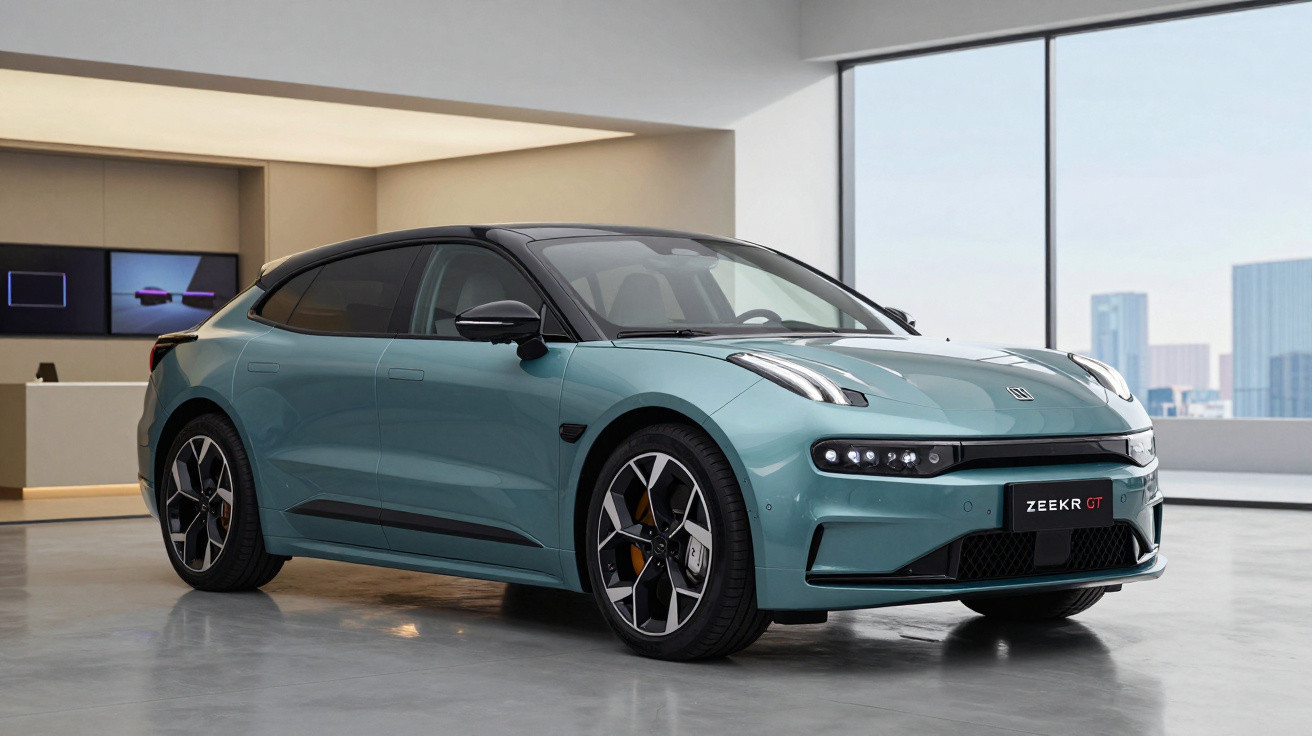
Zeekr, Geely’s premium electric-car brand, is planning an assertive move into Europe with an eye-catching new estate combining crisp design, substantial range and pricing intended to challenge BMW, Mercedes and Audi.
Zeekr’s major European expansion begins in 2026
Established in 2021, Zeekr has so far concentrated chiefly on its domestic Chinese market. It already operates in selected northern and eastern European countries, such as Scandinavia, the Netherlands and Switzerland, recording roughly 5,000 registrations in 2025. Its next step is more ambitious: a broad western European launch, beginning with Germany, Belgium and France.
Four battery-electric cars will lead the expansion:
- Zeekr X – a compact C-segment SUV
- Zeekr 7X – a larger, family-focused D-segment SUV
- Zeekr 001 – a large coupé-style SUV, on sale since 2021
- Zeekr 7 GT – a sporting D-segment shooting brake serving as the European flagship
As the newest-looking model in the line-up, the 7 GT will effectively act as Zeekr’s technology showcase for France in 2026.
The Zeekr 7 GT is pitched as a premium electric estate with long range, serious performance and a base price under €50,000.
A sleek shooting brake aimed at BMW buyers
While numerous electric estates adopt restrained, conventional styling, the 7 GT makes a strong commitment to the “shooting brake” format. It has a long, low roofline, a short bonnet and a sharply tapered rear end. Broad shoulders and sculpted bodywork create the presence of a rapid grand tourer, rather than an ordinary family estate.
Its dimensions reinforce that impression. The long 2.92-metre wheelbase places the wheels close to each corner, limiting overhangs while increasing interior room. Zeekr’s proposal is straightforward: offer Tesla and Mercedes owners an equally striking alternative with added everyday practicality.
Generous boot capacity and rear-room practicality
The 7 GT is designed to appeal to both lifestyle-focused buyers and families. That lengthy wheelbase gives rear occupants ample legroom. A flat floor also makes the centre rear seat more practical than in many estates derived from combustion-engine platforms.
Luggage capacity is one of the car’s key attractions. Zeekr states:
- 647 litres of boot space with the rear seats upright
- Up to 1,737 litres when the rear seats are folded
These numbers place it decisively in large-estate territory, meaning the 7 GT could genuinely take the place of a traditional diesel estate for holidays, sporting equipment or bulky work gear.
With up to 1,737 litres of load space, the 7 GT blends EV performance with old-school estate usability.
Extensive equipment, including the entry-level “Core RWD”
Zeekr appears to be relying on a generous standard specification to overcome remaining reservations around a relatively new Chinese marque. Even the entry-level “Core RWD” model comes with an extensive collection of technology and comfort features.
In-car technology and comfort equipment
Standard specification covers:
- 15-inch central OLED touchscreen with Apple CarPlay and Android Auto
- Adaptive cruise control and a comprehensive package of driver-assistance systems
- Panoramic glass roof
- Dual-zone climate control
- Powered tailgate
- Heated front and rear seats, along with a heated steering wheel
- 10-speaker sound system
Zeekr presents material quality and build finish as priorities, recognising that buyers also considering BMW, Audi and Mercedes models can be highly critical of perceived quality. The cabin is expected to combine soft-touch materials, contrasting trim elements and a minimalist fascia centred around the main display.
Performance: as much as 646 hp with touring range
The technical details underline how seriously Zeekr intends to take on established European brands. Two outputs are scheduled, paired with two battery capacities.
| Version | Power output | Battery capacity | Claimed range |
|---|---|---|---|
| Zeekr 7 GT (base) | 422 hp (rear-wheel drive) | 75 kWh | Lower than long-range, figure TBC |
| Zeekr 7 GT (performance) | 646 hp | Up to 100 kWh | Up to 655 km (test cycle figure) |
The standout figure is the claimed 655 km from the larger 100 kWh battery. On paper, this slightly exceeds the BMW i5 Touring’s approximate 602 km rating and comfortably surpasses many alternatives offering around 500 km.
With a claimed 655 km on a 100 kWh pack, the 7 GT targets long-range touring rather than just urban commuting.
Charging: 22 kW AC plus ultra-rapid DC capability
The charging specification is another notable strength. A 22 kW onboard AC charger is fitted as standard, useful for quicker recharging at three-phase public charge points or domestic wallboxes in some parts of Europe.
At DC rapid-charging stations, the 7 GT is claimed to accept up to 480 kW in ideal conditions. Where a suitably capable charger is available, Zeekr says it can recharge from 10–80% in about 13 minutes. This would make it one of the fastest-charging EVs announced to date.
The estate also includes V2L (vehicle-to-load) capability, enabling the battery to supply external electrical devices. Owners could use it for anything from camping equipment to tools at a remote workplace, turning the car into a mobile power bank.
Price: Zeekr’s intended challenge to BMW
The first pricing reference comes from Belgium, where the Zeekr 7 GT is priced from €49,990. UK and French prices for 2026 have not been finalised, but the Belgian figure clearly indicates the strategy: price below comparable premium German models while providing better equipment and range.
A sub-€50,000 entry price for a 422 hp, well-equipped electric estate leaves German rivals little room for comfort.
By comparison, a BMW i5 Touring or Mercedes EQE SUV with similar power can readily cost considerably more once specified to a comparable standard. Zeekr is wagering that fleet users and private customers will assess the figures and accept a newer marque in return for stronger value.
How the Zeekr 7 GT compares with its principal rivals
The BMW i5 Touring is Zeekr’s leading European estate competitor, while China’s Denza Z9 GT adopts a similar electric-GT approach. Based on the data currently available:
| Model | Power | Battery | Range (km) | Boot volume (L) | Fast charge 10–80% | Base price |
|---|---|---|---|---|---|---|
| Zeekr 7 GT | 422 / 646 hp | 75 or 100 kWh | Up to 655 | 647 – 1,737 | 13 min (up to 480 kW) | €49,990 (Belgium) |
| BMW i5 Touring | n/a | n/a | 602 | n/a | n/a | n/a |
| Denza Z9 GT | n/a | n/a | ~500 | n/a | n/a | n/a |
Although complete rival data is unavailable, the overall message is evident: Zeekr’s advantage rests on its blend of range, usability and list price.
What the 7 GT could offer French and UK customers
For buyers in France in 2026, the 7 GT will arrive as many families consider replacing ageing diesel estates but remain concerned about the compromises of electric motoring. Its long range is intended to reduce concerns on extended autoroute journeys, while its large boot and adaptable interior preserve the practicality expected of an estate.
Company-car users could benefit from reduced operating costs and possibly advantageous tax arrangements, subject to local zero-emission vehicle rules. Zeekr’s broad standard equipment list also limits the need to navigate expensive, extensive options catalogues.
Key terms: V2L, rapid charging and battery capacity
Three technical factors are particularly relevant for prospective 7 GT buyers:
- Battery capacity (kWh): A larger number, such as 100 kWh, generally provides more range, but it also brings additional weight and cost. The 7 GT is available with both 75 kWh and 100 kWh batteries, allowing customers to balance price against range.
- Fast charging rate (kW): The 480 kW maximum is a best-case headline figure. Actual charging performance depends on the charger’s capability, battery temperature and charge level, so real-life charging sessions may take longer.
- Vehicle-to-load (V2L): This function allows the vehicle to act as an electricity supply. Examples include powering laptops at a remote workplace, charging an e-bike while away, or keeping a small fridge operating during a power cut.
Real-world use cases: who the 7 GT suits
Consider a family in Lyon or Manchester that commutes weekly and makes regular long-distance journeys. With the larger battery, the 7 GT could manage an extended motorway journey with only one rapid-charging stop, assuming suitable high-power chargers are available. Its 22 kW AC charger is useful for overnight stays at hotels or with relatives who have a three-phase supply, reducing the time needed to replenish the battery.
For freelancers and small firms, the sizeable boot combined with V2L capability means equipment can be carried and powered at the destination. Photographers, tradespeople and outdoor-event organisers could connect directly to the car rather than transporting a separate generator.
Questions nevertheless remain over long-term dependability, residual values, dealer networks and software support in France and the wider region, all of which will shape customer confidence. Even so, the essential elements for a credible challenge are present: compelling specifications, keen pricing and a direct rival for models such as the BMW i5 Touring, which have long held a prominent position in the premium estate market.


Comments
No comments yet. Be the first to comment!
Leave a Comment