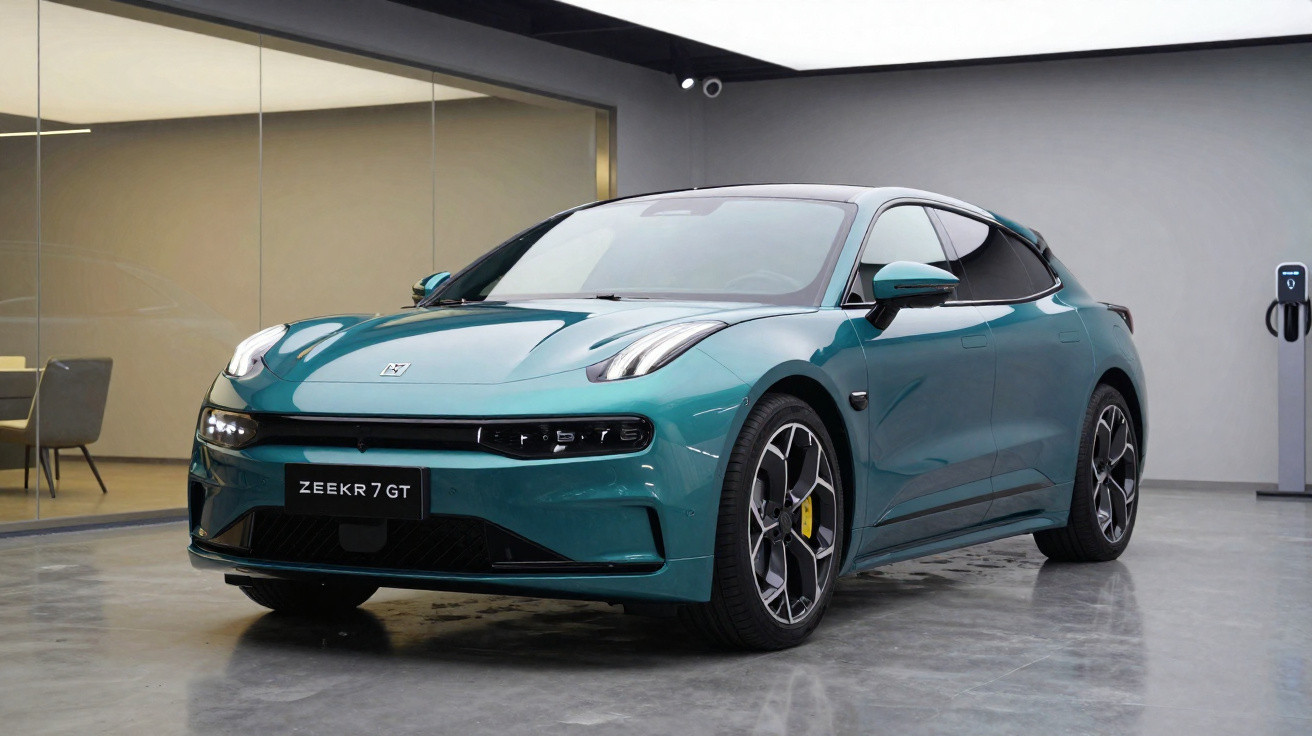
The Zeekr 7 GT, a stylish electric shooting brake from Geely’s premium marque, is set to arrive in Western Europe with specifications targeted directly at BMW, Audi and Mercedes, alongside a price designed to undercut those rivals.
Zeekr enters Western Europe with ambitious plans
Zeekr is a relatively new brand, having been founded in 2021 by Chinese automotive giant Geely, the company also behind Volvo, Polestar and Lotus. To date, its electric vehicles have largely remained close to its home market, although it has made early moves into Scandinavia, the Netherlands, Switzerland and several Eastern European countries.
That “trial phase” has now ended. From the second quarter of 2026, Zeekr will turn its attention to Western Europe, beginning in Germany, Belgium and France. Its French debut will include four fully electric models from launch:
- Zeekr X – a compact C-segment SUV
- Zeekr 7X – a larger family D-segment SUV
- Zeekr 001 – a coupé-styled E-segment SUV introduced in 2021
- Zeekr 7 GT – a D-segment electric shooting brake serving as the technology flagship
The 7 GT is Zeekr’s showcase for Europe: the newest platform, the longest range, and the sharpest design in the line-up.
Although the 001 has represented the brand’s luxury offering since 2021, the 7 GT brings Zeekr’s newest hardware and software. It is clearly intended to persuade European premium-car buyers who may remain doubtful about a newer Chinese nameplate.
A low, muscular estate aimed at BMW and Mercedes
Rather than following the high-riding SUV formula, the 7 GT is a shooting brake: low-slung, long and broad, with a purposeful stance reminiscent of performance estates from BMW and Audi. Strong shoulder lines, an extended roof and a short rear overhang create a coupé-like shape, while the full-size estate tailgate retains everyday usability.
Zeekr is counting on European motorists’ enduring appetite for quick estates, even as crossovers continue to dominate the market. From a design perspective, the 7 GT occupies territory currently held by vehicles such as the BMW i5 Touring and Mercedes-Benz EQE estate variants, but it uses more assertive surfaces and a more futuristic, EV-focused profile.
Space, practicality and a huge boot
Beneath its bodywork, the 7 GT has a lengthy 2.92-metre wheelbase. This creates ample rear legroom, an area in which many streamlined electric cars make compromises. Zeekr stresses that rear-seat passengers should enjoy comfort comparable with those in the front, aided by the flat floor associated with an electric skateboard platform.
Boot capacity ranges from 647 litres to a massive 1,737 litres with the rear seats folded - firmly in big family estate territory.
That capacity makes the 7 GT suitable as both a family car and a business workhorse. Bicycles for the weekend, pushchairs and large camera equipment should all be accommodated with little difficulty. The rear seat bench folds in sections, enabling a combination of passengers and luggage.
A technology-rich cabin without an options headache
Inside, Zeekr combines soft-touch finishes, contrasting materials and uncluttered horizontal styling. The intention is to deliver a premium atmosphere rather than a stripped-back, overly technological minimalist interior.
Even the entry-level “Core RWD” model comes with substantial standard equipment:
- 15-inch OLED central touchscreen with Apple CarPlay and Android Auto
- Adaptive cruise control and advanced driver assistance systems
- Panoramic glass roof
- Dual-zone climate control
- Electric tailgate
- Heated front and rear seats plus heated steering wheel
- 10-speaker audio system
Zeekr is pushing a “fully loaded” approach: high-end kit as standard, fewer complex option packs, and a clear value message.
The approach echoes Tesla’s early strategy, as well as the direction now being taken by some European manufacturers: simplify the ordering process, include high-tech equipment as part of the package and control margins through scale.
Power, range and charging: where Zeekr wants to surpass BMW
The engineering figures underline how forcefully Zeekr intends to challenge established rivals.
Two power outputs and two battery capacities
The 7 GT is expected to be available with two principal power outputs:
- 422 hp version, likely rear-wheel drive
- 646 hp version, likely dual-motor all-wheel drive
Buyers will have a choice of 75 kWh or 100 kWh battery packs. With the larger battery, Zeekr quotes a maximum single-charge range of 655 km on the European test cycle.
On paper, the 7 GT out-ranges the BMW i5 Touring, which sits at 602 km, and is ahead of Chinese rival Denza Z9 GT at around 500 km.
Actual range will be strongly affected by wheel size, weather conditions and driving style. Even so, the quoted figure demonstrates Zeekr’s determination to take “range anxiety” out of the purchase decision, particularly for company-car users covering substantial motorway distances.
Strong ultra-rapid charging capability
Zeekr is also making ambitious promises about charging. The 7 GT is engineered to take up to 480 kW from an ultra-rapid DC charger, allowing a 10% to 80% charge in around 13 minutes where compatible charging infrastructure is available.
A 22 kW AC on-board charger is also included as standard. This is particularly relevant in France, Belgium and Germany, where workplace and apartment charging commonly provides three-phase AC power.
The 7 GT further includes V2L (vehicle-to-load) capability, allowing it to supply electricity to external devices, ranging from camping equipment and tools to another EV in an emergency.
Price: the key weapon against Europe’s premium brands
In Belgium, the Zeekr 7 GT will start at €49,990. French prices have yet to be confirmed, but the Belgian starting figure makes the brand’s intentions clear.
At roughly €50,000, the 7 GT undercuts many German premium estates with similar space and significantly less performance.
Combined with its specification, this pricing presents the car as a high-value alternative rather than an unknown budget proposition. Zeekr is not pursuing cost-conscious buyers alone; it is seeking to attract customers who may find a suitably equipped BMW, Audi or Mercedes beyond their budget.
Key figures at a glance
| Model | Power | Battery | Range (km) | Boot (L) | Rapid charge 10–80% | Base price |
|---|---|---|---|---|---|---|
| Zeekr 7 GT | 422 / 646 hp | 75 or 100 kWh | Up to 655 | 647 – 1,737 | 13 min (480 kW) | €49,990 (Belgium) |
| BMW i5 Touring | n/a | n/a | 602 | n/a | n/a | n/a |
| Denza Z9 GT | n/a | n/a | ~500 | n/a | n/a | n/a |
What the Zeekr 7 GT could offer everyday drivers
On paper, the 7 GT meets several requirements for European buyers looking for one vehicle capable of doing everything. It should handle weekday commuting, long August holiday journeys and trips along country roads at weekends, while still offering space for children, pets and luggage.
For a typical family covering 15,000 km annually, a rated 655 km range may equate to around 450–500 km of real-world motorway travel at 120–130 km/h with the air conditioning operating. On lengthy cross-country trips, that could mean one rapid-charging stop instead of continually planning journeys around charging locations.
The V2L feature brings further versatility. It could supply power at a campsite, charge a fleet of e-bikes for a holiday-rental business or run tools at a work site before mains electricity has been installed.
Concerns over brand confidence and resale values
There are, inevitably, unanswered questions. European customers are familiar with BMW’s resale values, dealer coverage and service standards. Zeekr still needs to establish its credentials in each of those areas.
Residual values for new Chinese EV brands remain uncertain, which will affect leasing costs. Corporate fleet operators and salary-sacrifice schemes will examine total cost of ownership closely, rather than focusing only on the list price and quoted range.
There is also the question of whether charging infrastructure can genuinely provide 480 kW. In everyday use, many motorists will rely on chargers rated between 150–350 kW, meaning charging times may be longer than the headline claim.
Terms and technology features worth understanding
For anyone less familiar with EV terminology, several elements of the 7 GT specification deserve clarification.
- kWh (kilowatt-hour): This is comparable to the size of a fuel tank. A 100 kWh battery holds more energy than a 75 kWh unit and will normally provide a longer range.
- AC vs DC charging: AC is the slower day-to-day charging available at home and at many public charge points. DC rapid charging is used for quicker top-ups on motorway journeys.
- V2L (vehicle-to-load): This enables the vehicle to work as a large battery pack, powering equipment through external sockets.
- Adaptive cruise control: The vehicle maintains a chosen distance from the car ahead, automatically slowing down and accelerating with surrounding traffic.
If Zeekr supports the 7 GT with clear warranties, dependable software updates and a robust service network in France, Germany and Belgium, it could place pressure on premium EV pricing in ways established manufacturers would prefer to avoid. Its specification suggests that the contest for Europe’s fast electric estates is only beginning.

Comments
No comments yet. Be the first to comment!
Leave a Comment