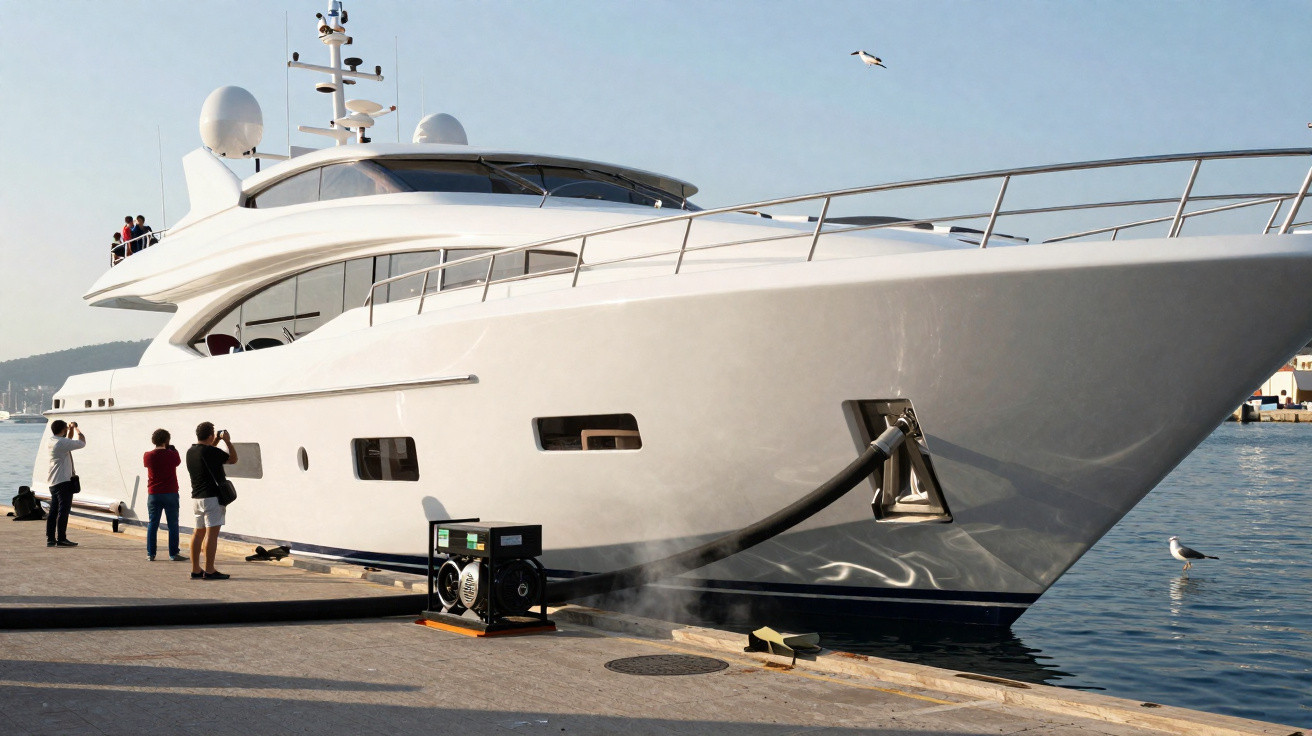
The superyacht lay utterly motionless in the harbour, a glass-and-chrome illusion. There were no deck parties or jet skis slicing through the water-only a floating palace with nowhere to go. From the quay, however, its sound was unmistakable: a subdued mechanical drone, generators continuously battling the Mediterranean heat. Crew members went discreetly about their work, inspecting gauges and polishing unseen metalwork, maintaining an emptiness. The owner had not stepped aboard for months.
The fuel lorry, though, kept arriving.
The $500 million freezer that stayed at the dock
For three years, a 90-metre superyacht stayed berthed in one European marina and seldom cast off its lines. Residents started joking that it resembled a five-star office block floating on water rather than a boat. Although the gangway was usually raised, the air conditioning was never allowed to rest. Diesel generators operated almost continuously to hold the interior at a brisk 21°C, prepared “in case the owner flew in on short notice,” as a former crew member described it.
The water around the yacht remained placid. Its exhaust was not.
Officially, the yacht was “inactive”. In practice, it consumed thousands of litres of fuel every week. Marina workers regularly saw bunker lorries arrive, with hoses stretching across the quay to replenish immense tanks-not for ocean passages, but for cooling jacuzzis and marble-clad suites. Estimates for comparable vessels indicate that a large yacht at berth may use 500 to 1,000 litres of diesel daily purely for hotel loads. Across three years, that adds up quietly to hundreds of tonnes.
Most remarkably, the owner came aboard fewer than ten times.
The generators continued not because they were needed, but because the yacht was expected to be ready. For a multibillionaire, a yacht must be kept in permanent readiness, much like a private jet waiting with its engines metaphorically warm. Crew cannot simply power down the vessel and leave it unattended. Its systems are interlinked: air conditioning, humidity management, electronics, galley refrigerators and security. Without climate control, costly finishes may distort, mildew can spread through soft furnishings and electronics may be damaged.
Luxury does not enjoy being switched off; it prefers to idle without end.
How a moored superyacht tests the planet’s patience
Engineers who have worked aboard these floating mansions will tell you that the greatest fuel use does not necessarily happen while a yacht races from Monaco to Mykonos. It can occur while she is entirely still. An unseen city of systems continues operating behind the scenes: chilled-water units force cool air across the decks, desalination plants stand ready, batteries receive continual top-ups and stabilisers gently keep the vessel steady even alongside the dock.
In a spreadsheet, this is simply “hotel load”. Along the quay, it smells of diesel.
A captain speaking off the record recalled an extended standby period in the Middle East. The owner did not visit for eight months, but the yacht retained its full crew, its lights stayed on nightly and the air conditioning murmured across every level. “We were burning about 700 liters a day, with no guests,” he said. “That’s just to keep everything pristine and at owner temperature.” He laughed at “owner temperature”, yet the figure lingered. At that pace, eight months amounted to well over 160 tonnes of diesel.
There was no sunset cruise and no adventure-only the anxiety of being unprepared.
Purchasing a yacht is a spectacle; sustaining it is an unglamorous routine. The systems are so intricate that shutting them down completely can seem hazardous, or at minimum profoundly inconvenient. Engineers are concerned about condensation, corrosion and power surges when restarting. Management companies sell seamless service: arrive on board and find everything flawless, at any time. That promise carries an inherent energy cost. Here, the fantasy of “ultimate freedom” meets a tangible reality that demands vast amounts of fuel.
That is not the side we usually see on Instagram.
Between outrage and fascination: what this superyacht reveals about us
There is an easy way to grasp the scale of this waste: reduce it to human proportions. Imagine running your home air conditioning at maximum all summer in a house you scarcely visit, merely in case you decide to spend a weekend there. Then enlarge that house to the scale of a small cruise ship. Include industrial freezers, satellite equipment, a complete gym, cinema, spa, lifts, dozens of cabins and a tender garage. Every “just in case” amenity relies on a cable, pump or motor.
Extend that over three years, and the absurdity becomes almost unreal.
Yet it also prompts an awkward kind of curiosity. In truth, many of us recognise a smaller version of the temptation. We know the moment: leaving a car’s air conditioning running while waiting, lingering too long in a hot shower for comfort, or taking a long-weekend flight because the fare was cheap. Increase that behaviour to a scale where price does not matter and nobody says “no”, and the result is a 90-metre yacht cooling vacant suites for an absent owner.
Let’s be honest: nobody really does this every single day with their own money on the line.
Some owners attempt to reduce the environmental impact. Certain newer superyachts include battery packs, shore-power links or hybrid propulsion. Port authorities in some popular destinations now provide “cold ironing”, enabling yachts to connect to cleaner grid electricity and reduce generator use. But where the prevailing expectation is permanent readiness and immaculate comfort, efficiency is always trying to catch up.
“The real luxury isn’t the yacht,” one environmental researcher told me. “It’s believing you can burn energy without ever noticing the burn.”
- Hotel load never sleeps - Even without guests, large yachts commonly operate energy-intensive systems around the clock.
- “Owner-ready” mindset - Crews face pressure to maintain perfect conditions, quietly committing the vessel to heavy energy consumption.
- Invisible emissions - Because the yacht scarcely moves, local people may assume it is harmless while its generators work day and night.
- Technology can help - Shore power, improved insulation and batteries can lessen the harm, but cannot remove the culture behind it.
- Mirror effect - These accounts hurt because they reflect our own behaviour back to us, albeit on a smaller scale.
What remains after the diesel smoke has gone
Imagine the yacht once more: still in its berth, its white hull reflecting the heat of an afternoon sun. For tourists, it provides a selfie backdrop. For the crew, it is a workplace that cannot be turned off. For its owner, it may be no more than a portfolio entry-an asset required to stay permanently “on”, should the urge arise. The real engine is not in the engine room; it lies in the story we tell ourselves about what we deserve to have available at a moment’s notice.
You need not own a superyacht to recognise the echo of that story. It may be an unused gym membership, a second home empty for most of the year or devices left on standby in every room. On a planetary scale, the superyacht is simply the most conspicuous and photogenic emblem of a habit that crosses income brackets: comfort first, with the cost unseen.
When you next pass a marina and spot a silent giant humming at the dock, you may hear it in another way. It is not merely a wealthy person’s plaything, but a question suspended in the hot air: how much are we prepared to burn simply to ensure something is ready for a moment that might never arrive?
| Key point | Detail | Value for the reader |
|---|---|---|
| Hidden fuel burn | Superyachts at berth can use hundreds of litres of diesel each day solely for “hotel load”. | Helps you understand the true impact of luxury assets that seem inactive. |
| Culture of readiness | Owners demand instant, flawless comfort, requiring crews to keep systems operating continuously. | Encourages reflection on your own “always-on” comfort habits. |
| Symbol, not exception | An idle superyacht represents an extreme form of everyday energy waste. | Changes outrage into an opportunity to reconsider smaller personal choices. |
FAQ:
Question 1 How much fuel can a large superyacht burn while moored and not sailing?
For a 70–100-metre yacht, engineers often cite 500–1,000 litres of diesel per day for generators and essential systems alone, even if it never leaves the dock.Question 2 Why can’t crews simply switch off the air conditioning when the owner isn’t on board?
They are concerned about humidity, mould, damage to timber and fabrics, and sensitive electronics. In addition, many management contracts require the yacht to remain “owner-ready” at all times.Question 3 Do some ports let superyachts plug into cleaner electricity instead of running generators?
Yes. Major marinas in Europe and the United States are introducing shore power, allowing yachts to connect to the grid. Depending on how that electricity is generated, this reduces local air pollution and noise.Question 4 Are there superyachts designed to be more eco-friendly?
A new generation of yachts uses hybrid propulsion, batteries, better insulation and even solar panels, although their sheer size and onboard luxuries still require considerable resources.Question 5 Why do stories about idle superyachts provoke such strong reactions?
They combine fascination with frustration: extreme wealth made visible, obvious waste and the unsettling sense that the same mentality appears, on a smaller scale, in our everyday lives.









Comments
No comments yet. Be the first to comment!
Leave a Comment