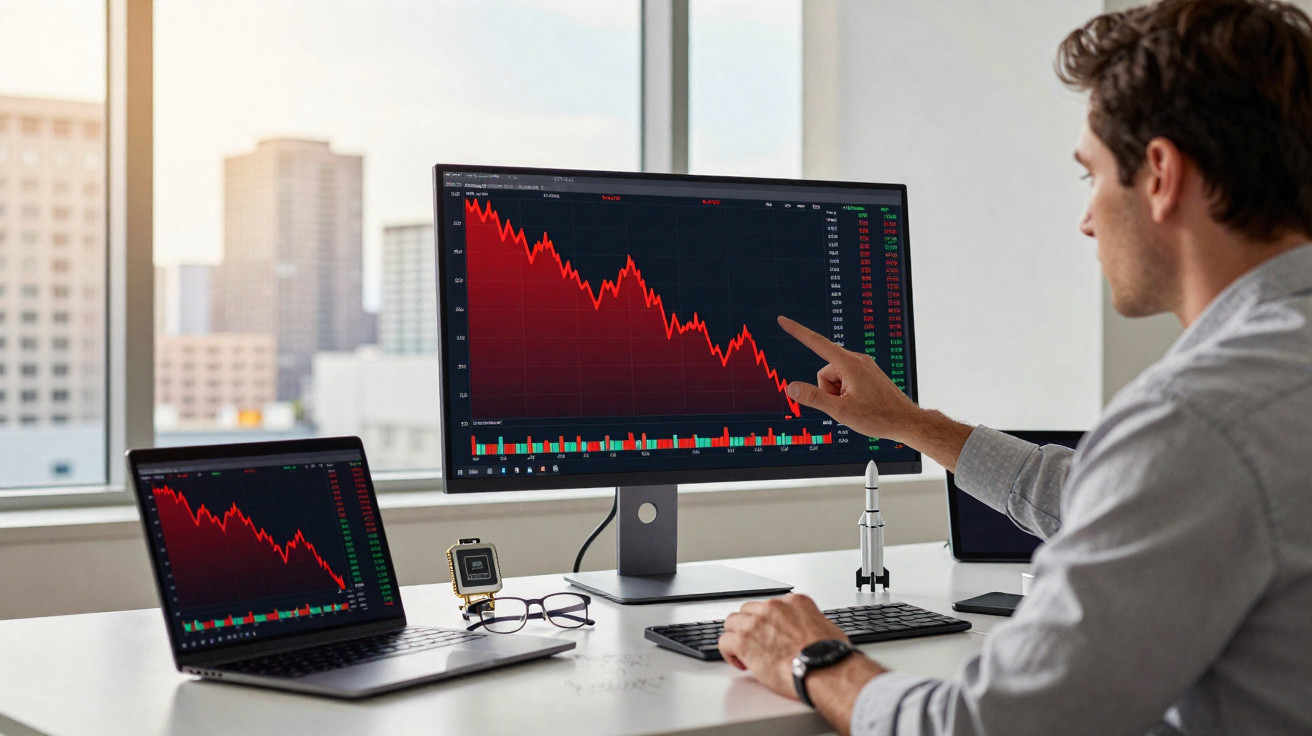
The Nasdaq has shed 5% in ten days, largely because of the technology giants. The drop has taken many by surprise, although it should have been anticipated.
On Tuesday 9 June, the Nasdaq index closed 1% lower after coming close to a 3% intraday fall. During trading, the VIX - the S&P 500 volatility gauge - climbed above 23 points, its highest level for several weeks. Goldman Sachs analysts have publicly voiced concerns about the path of US equities. Wells Fargo has warned of the risks arising from performance being concentrated in a small number of stocks. Wall Street is in disarray. Everyone is acting surprised, even though this outcome was foreseeable.
Between January and June 2026, the US technology sector achieved something striking: in six months, the SOX semiconductor index almost doubled. Supported by demand for data centres and memory chips that Goldman Sachs calls “insatiable”, the market decided that artificial intelligence was not merely the future, but was already profitable. That was a major mistake.
This week, chip giant Broadcom released its quarterly results, sending a chill through the stock market. Analysts considered the figures inadequate against expectations that had become stratospheric. That is understandable: when valuations rise at such speed, even the smallest gap between what was promised and what is delivered is punished.
Apple and Starlink add to the pressure
Apple did nothing to improve matters. On Monday 8 June, the evening of its WWDC keynote, its shares lost nearly 2%, followed by a further 4% the next day. The company had unveiled Siri AI, a complete overhaul of its voice assistant, trained by Google’s Gemini and awaited for two years. The issue was that Apple gave no definitive launch date. Instead, investors were left with beta releases “later this year”, a broad autumn rollout “alongside the next iPhone”, and no availability in Europe or China until further notice. Tim Cook even admitted to developers that Apple has not yet delivered on all of its AI promises. In markets that have overvalued every announcement for the past eighteen months, that kind of admission comes at a high price.
SpaceX flotation and tighter monetary policy
An unprecedented liquidity factor is also coming into play. On Friday, SpaceX is preparing to list on the stock market in what will, by a very wide margin, be the largest flotation in the history of US markets, with at least $75 billion of shares on offer. Investors keen to take part need to find cash somewhere. What better source than technology stocks already held in their portfolios?
The macroeconomic backdrop makes the equation still more difficult. The US economy remains resilient, but inflation is accelerating again. The Federal Reserve is being forced to tighten monetary policy, lifting the cost of capital and mechanically reducing the value of long-term assets. That means precisely the technology stocks with which the Nasdaq is packed.
Is the Nasdaq decline an AI crisis?
Should this be seen as an AI crisis? Not yet. Data centres will continue to be built, chips will continue to be sold, and models will continue to improve. But for eighteen months, the market has grown accustomed to pricing AI as though every promise turns into gold. This week, Wall Street is rediscovering what every investor has always known: trees do not grow to the sky. Even when they are called Nvidia.














Comments
No comments yet. Be the first to comment!
Leave a Comment