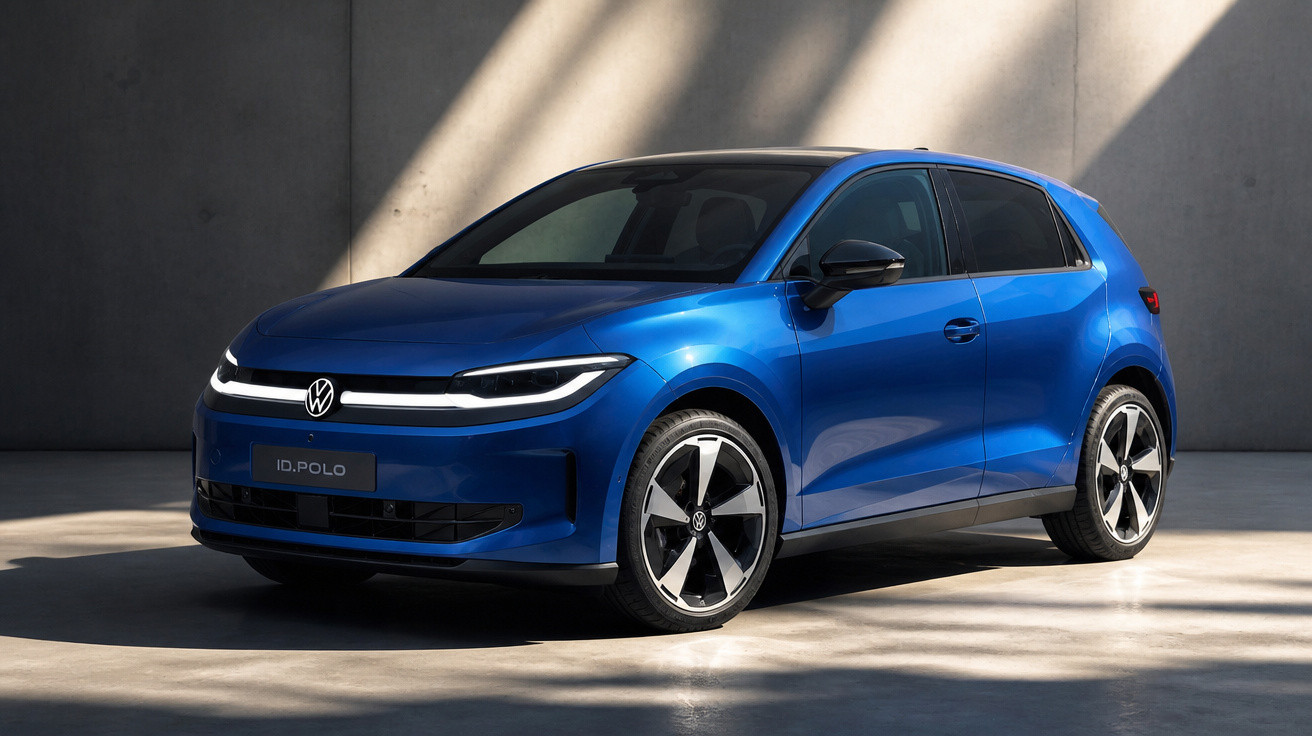
The point of the Volkswagen ID. Polo is that it’s still a Polo. Even with every badge removed, you’d clock it as a VW Polo straight away. This is a completely new electric supermini, yet Volkswagen hasn’t shaped it into a slippery, sci‑fi ‘future box’ in the way it attempted with the ID.3.
Volkswagen ID. Polo styling: traditional, not an ‘aero’ pod
Unlike some EVs, the ID. Polo wears a proper bonnet and a recognisable face, with the usual Polo-like outline. Sure, there are plastic curtains around the rear screen to help it slip through the air more cleanly, but it isn’t an ‘aero’ car.
Volkswagen’s engineers say improved battery and motor efficiency now means there’s less need to create eco-blobs like the ID.3 in the first place.
Which sounds promising for the forthcoming ID. Golf…
Proportions and details
Back to the ID. Polo. It’s a front-wheel drive, five-door hatch that stands a touch taller than the Polo you’re used to, simply because it has to package a battery beneath the floor. Even so, the stance works well.
Up front it comes across as friendly, while the rear has a faint Hyundai Ioniq 5-vibe. Higher-spec cars get an LED light bar; the entry version sits on big balloon tyres and wears a white plastic smile. It’s sweet and likeable, though not quite as shamelessly cool as the Renault 5.
Cabin, controls and space
Inside, the ID. Polo continues Volkswagen’s ‘we’re sorry, please have some buttons’ apology tour that began with the ID.3 Neo. The squircle steering wheel has been spared the haptic nonsense. Alongside the main touchscreen you’ll find physical toggles for the heater, hazards and the rest.
Even better, you’re given the correct number of window switches. Order is returning.
With no exhaust running beneath the back corner of the car, rear legroom for the middle seat is notably good, and the boot drops so deep you almost expect to discover Australians down there.
Batteries, power, charging and speed
On to the figures. Every ID. Polo is limited to 100mph.
More usefully, the 37kWh battery is offered with either 114bhp or 133bhp. Step up to the larger 52kWh pack and you get 208bhp. In time there’ll also be an ID. Polo GTI with extra power – watch out Alpine A290 and Mini Cooper S EV…
The bigger battery supports charging up to 105kW and, impressively, is claimed to add only 8kg over the smaller pack, which charges at up to 90kW. Don’t mistake it for featherweight, though: every electric Polo variant weighs more than 1.5 tonnes.
Range expectations and competition
Final range numbers still aren’t signed off, but Volkswagen is talking about roughly 204 miles with the ickle battery and 282 miles for the larger one. As a second car – and especially as an urban runabout – that should be adequate?
The key message is that Volkswagen has taken a ‘classic’ name for a genuinely new car, then given it a conventional look and a familiar feel both inside and out. That signals a very different mindset from the early days of the ID. project, and it feels like a brand steering back towards the right direction.
But with strong rivals such as the Renault 5, Hyundai Inster, Fiat Grande Panda and the upcoming Hyundai Ioniq 3, the Polo can’t merely be safe and traditional. It has to be properly, convincingly good.

Comments
No comments yet. Be the first to comment!
Leave a Comment